
ETF tax distribution mechanics describe how an ETF can pass dividends, capital gains, interest, or other taxable items to investors, and why the answer depends on fund structure, distribution source, holding period, account context, and tax jurisdiction.
The fastest way to understand the topic is to separate the question being asked. Cash paid by an ETF, year-end capital gains, qualified dividend treatment, structural tax efficiency, and ETF versus mutual fund comparisons are related, but they do not answer the same investor problem.
The key distinction is the starting question: cash income, fund-level realized gains, structural tax efficiency, or a comparison with mutual funds. A route-first approach avoids estimating an investor’s tax bill, ranking funds, or treating yield, distribution history, or structure as a complete tax conclusion.
Key Points
- ETF distributions are not one category; dividends, capital gains, interest, and other items can follow different rules.
- Dividends and capital gains answer different questions, so they should be separated before comparing ETFs.
- ETF tax efficiency is structural, not automatic, and depends on the fund, asset class, and transaction mechanics.
- Account type, holding period, investor jurisdiction, and distribution source can change the final tax result.
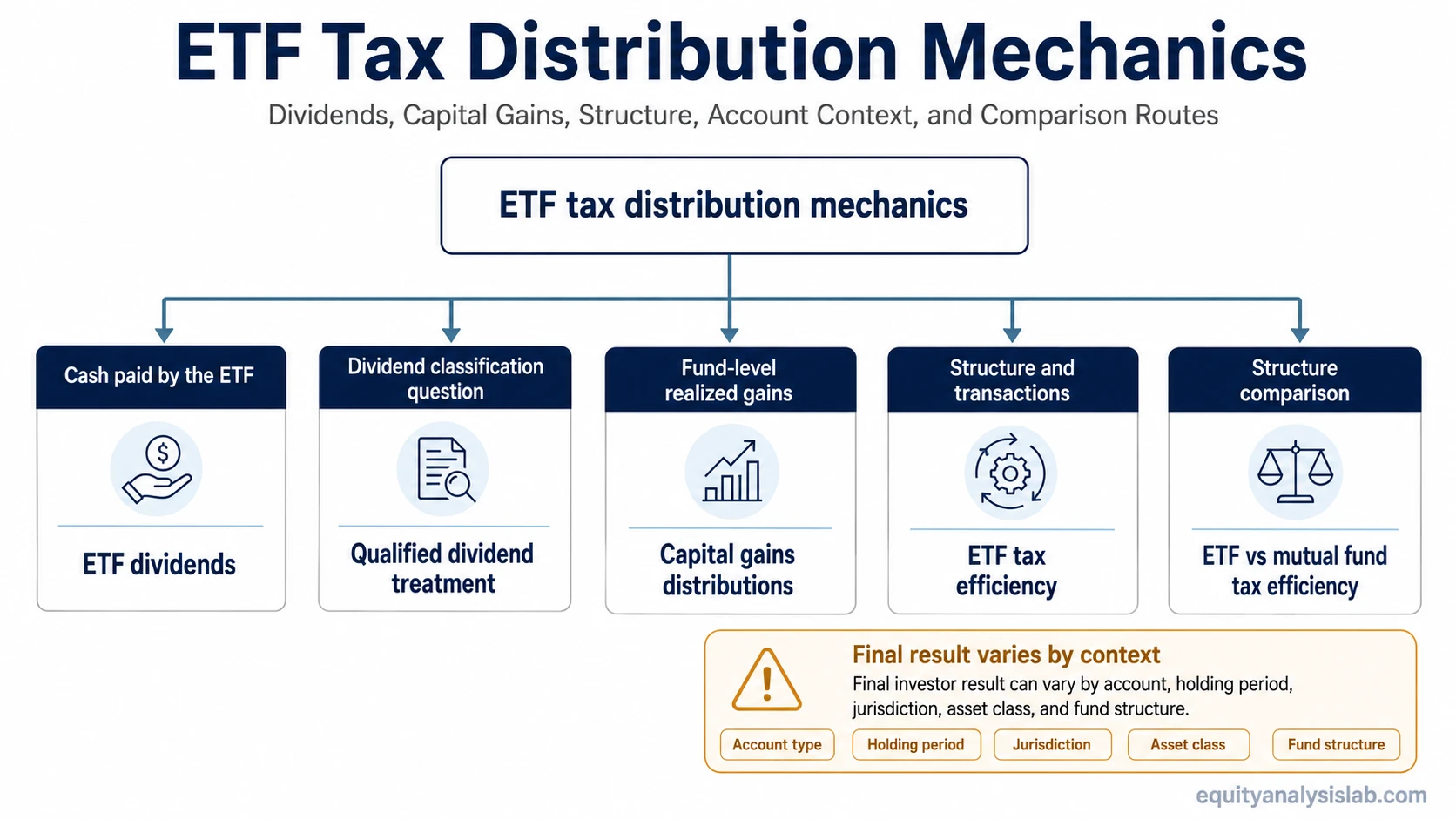
ETF Tax Distribution Mechanics: What To Resolve First
Start by identifying whether the question is about income, realized gains passed through by the fund, structural tax efficiency, or a comparison against mutual funds. Treating all of these as one tax issue can lead to the wrong starting point.
A cash distribution may be connected to dividends from underlying holdings, interest income, return of capital, or another source. A capital gains distribution is a different event because it relates to gains realized inside the fund and passed through to shareholders. Tax efficiency is broader still, because it concerns the structure and mechanics that may reduce some taxable distributions without eliminating tax exposure.
ETF Tax and Distribution Routes
The main ETF tax and distribution questions separate into distinct starting points. Each route points to the concept that should usually be resolved before adding tax-rate, account, or jurisdiction details.
| Investor question | Start with | Why this comes first |
|---|---|---|
| What cash did the ETF pay out? | ETF dividends | Dividend distributions are the first distinction when the concern is cash income paid by the ETF rather than gains realized inside the fund. |
| Could a dividend receive different tax treatment? | qualified dividend treatment in ETFs | Qualified dividend status depends on details that should not be blended into a general dividend discussion without context. |
| Why did the ETF distribute taxable gains? | ETF capital gains distribution mechanics | Capital gains distributions come from fund-level realization activity, not from the investor selling ETF shares directly. |
| Why might an ETF distribute fewer gains than another fund structure? | ETF tax efficiency | Tax efficiency is mainly a structure and transaction-mechanics question, including how creation and redemption activity may affect realized gains. |
| Is the ETF structure more tax efficient than a mutual fund? | ETF and mutual fund tax-efficiency comparison | The comparison needs both structures side by side, rather than a one-sided assumption that every ETF produces a lower tax burden. |
Where ETF Tax Efficiency Fits
ETF tax efficiency belongs after the distribution source is identified. A fund can be tax efficient in one respect and still make distributions that matter to a taxable investor.
The structural discussion usually centers on how ETF shares trade in the secondary market, how creation and redemption activity works, and whether in-kind mechanisms reduce the need for the fund to sell holdings and realize gains. That mechanism does not make every ETF tax efficient in every account, asset class, or jurisdiction.
Route note: Use tax efficiency when the main question is structural. Use dividends or capital gains distributions when the main question is the source of a specific distribution.
Priority Paths for Common ETF Tax Questions
- Cash distribution question: dividends come first, with qualified dividend treatment added only when classification matters.
- Year-end taxable distribution question: capital gains distributions are the starting point before fund structure and turnover context are compared.
- Structure question: tax efficiency is the relevant route when the issue is creation/redemption mechanics or ETF structure.
- ETF versus mutual fund question: the comparison route is safer because both structures handle flows, redemptions, and realized gains differently.
These paths keep the analysis in the right order. A distribution should be classified before its investor impact is interpreted. A structural advantage should be treated as a possible mechanism, not as a guaranteed outcome.
What ETF Tax Mechanics Do Not Decide
Limitation: ETF tax mechanics do not determine a specific investor’s tax bill, tax rate, filing treatment, or best fund choice. Outcomes can vary by jurisdiction, account type, holding period, asset class, fund structure, distribution source, and the investor’s own situation.
Current tax-rate tables are intentionally excluded because they can become stale and jurisdiction-specific. Product rankings are also excluded because tax treatment is only one part of ETF evaluation and cannot determine fund quality on its own.
For investor analysis, the safer sequence is concept first, structure second, account and jurisdiction context third. That order reduces the risk of treating a general ETF feature as a personal tax conclusion.
FAQ
Are ETF dividends and ETF capital gains distributions the same thing?
No. ETF dividends usually relate to income received from underlying holdings or similar distribution sources, while capital gains distributions relate to gains realized inside the fund and passed through to shareholders.
Does ETF tax efficiency mean an ETF will not create taxable distributions?
No. ETF tax efficiency describes structural features that may reduce certain taxable distributions, but it does not eliminate all tax exposure or override account, asset class, jurisdiction, or fund-specific details.