
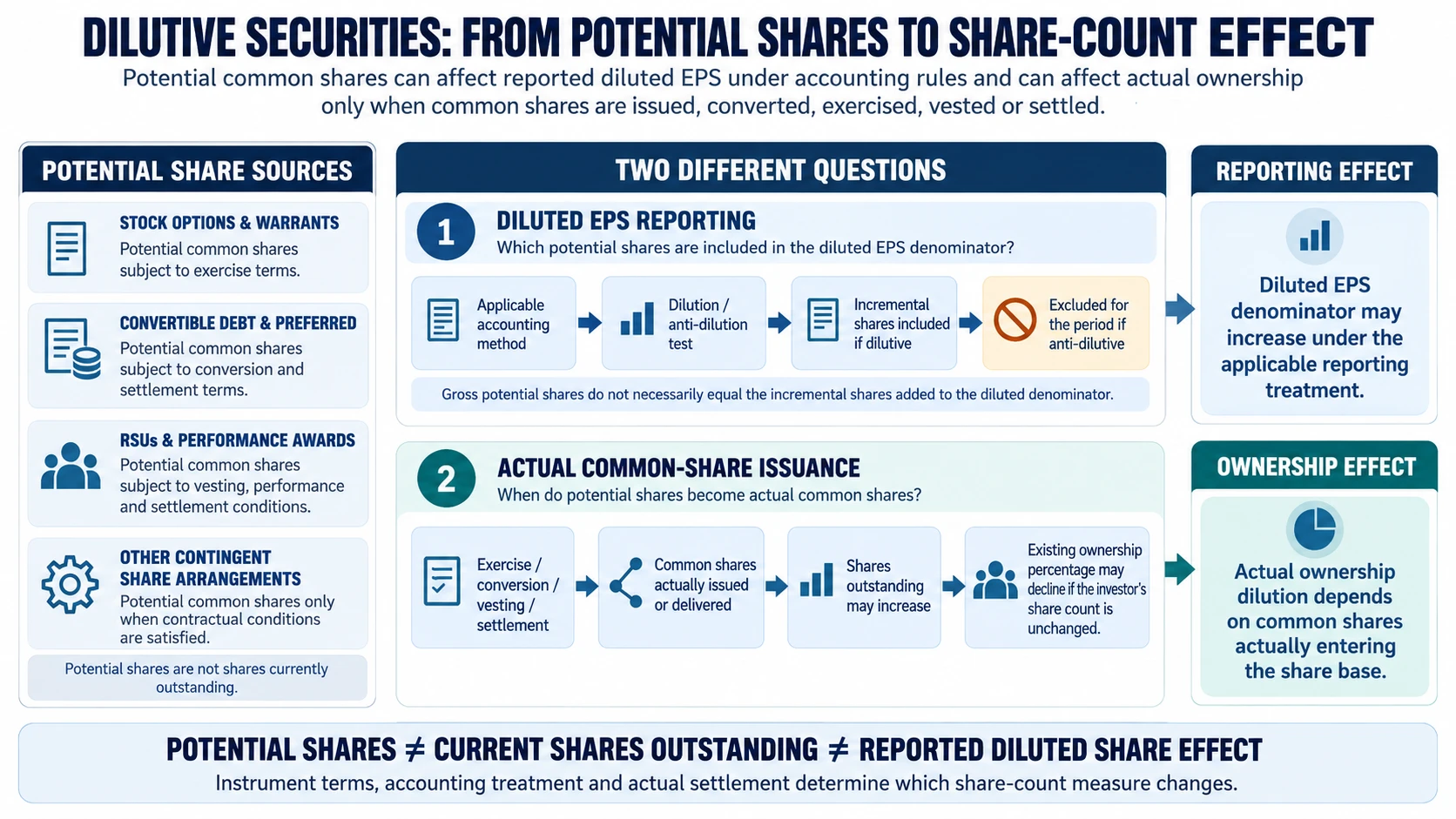
Dilutive securities are instruments or arrangements that can create potential common shares through exercise, conversion, vesting, settlement, or other issuance terms. They can affect diluted EPS when the applicable reporting treatment includes incremental shares, while actual ownership changes only when common shares enter the share base.
Key Points
- Dilutive securities are potential sources of common shares, not shares that are already outstanding.
- Common examples include stock options, warrants, convertible debt, convertible preferred stock, RSUs, and performance share awards.
- The reported diluted-share effect depends on the instrument terms and the applicable accounting treatment. Gross potential shares do not always enter the diluted denominator one-for-one.
- Some potential shares are excluded from diluted EPS when they are anti-dilutive for the reporting period.
- Actual ownership dilution depends on common shares entering the share base through issuance, exercise, conversion, vesting, or settlement.
What Are Dilutive Securities?
Dilutive securities include financial instruments and compensation arrangements that may lead to additional common shares. The route differs by instrument. Options and warrants can be exercised, convertible securities can convert according to their terms, and equity awards can settle in shares after vesting or performance conditions are satisfied.
A company may use these instruments for employee compensation, financing, acquisitions, or other capital-structure purposes. Their presence alone says little about the eventual share-count effect. Scale, exercise or conversion terms, vesting conditions, settlement method, and reporting treatment determine how relevant they become.
The current ownership base begins with shares outstanding. Dilutive securities represent possible additions around that base. A potential share can therefore matter to per-share analysis without already being an issued and outstanding common share.
How Dilutive Securities Work
Each instrument has conditions that determine whether common shares can be created or counted. An option usually requires exercise. A warrant follows its exercise terms. A convertible security can produce common shares under its conversion and settlement provisions. RSUs and performance awards depend on vesting, performance, and settlement conditions.
The potential share count and the reported diluted-share effect can differ. For options and warrants, the relevant accounting method can produce an incremental share amount rather than simply adding the full gross instrument count. Convertible securities can follow a different diluted-EPS treatment depending on their terms. The security type therefore identifies the potential source, while the reporting method determines its effect on the diluted calculation.
The resulting denominator is reflected through diluted shares outstanding. That number can exceed the basic share denominator even when some of the underlying potential shares have not actually been issued.
Common Types of Dilutive Securities
Dilutive securities appear most often in compensation plans, financing arrangements, and convertible capital structures. The instrument type identifies the possible source of shares; the terms determine how and when that source becomes relevant.
| Instrument type | How common shares may be created | What to check |
|---|---|---|
| Stock options | Exercise can result in common shares. Diluted EPS may reflect an incremental share effect before actual exercise. | Strike price, expiration, vesting, market price relationship, and outstanding option count. |
| Warrants | Holders may acquire common shares under the warrant terms. | Exercise price, expiry, warrant count, and the financing or transaction in which the warrants were issued. |
| Convertible debt | Debt may convert into common shares according to its conversion and settlement terms. | Conversion price or ratio, maturity, settlement method, and conversion conditions. |
| Convertible preferred stock | Preferred shares may convert into common shares under the stated terms. | Conversion ratio, dividend terms, conversion triggers, and settlement provisions. |
| RSUs and performance awards | Equity awards may settle in common shares after vesting, service, or performance conditions are met. | Vesting schedule, performance conditions, forfeitures, award count, and settlement method. |
Dilutive Securities and Diluted EPS
Diluted EPS considers applicable potential common shares when calculating earnings per share. When the diluted denominator increases while the earnings base does not increase proportionally, diluted EPS can be lower than basic EPS.
Diluted EPS can include an incremental potential-share effect under the applicable reporting assumptions even when those common shares have not been issued. Ownership dilution occurs when the actual common-share base expands and an existing holder does not increase the holding proportionally.
Potential shares are tested under the applicable reporting method and included only to the extent required for the diluted calculation.
Shares outstanding change when common shares are actually issued, exercised, converted, vested, or settled into the share base.
The diluted denominator should not be estimated by adding every option, warrant, convertible, or award directly to the basic share count. The applicable treatment determines the incremental effect. Some instruments can also be excluded for a reporting period when they are anti-dilutive.
An anti-dilutive instrument still exists. Its exclusion only means that including it in diluted EPS would increase EPS or reduce loss per share under the applicable assumptions for that period.
Dilutive Securities vs Share Dilution
Dilutive securities and share dilution belong to the same share-structure analysis, but they describe different stages. Dilutive securities are the instruments or arrangements that can create potential shares. Share dilution describes the ownership or per-share effect produced when the share base expands.
| Concept | What it measures or describes | Analytical role |
|---|---|---|
| Dilutive securities | Instruments or arrangements that can create potential common shares. | Identifies possible sources of future or reporting-period share-count effects. |
| Diluted shares outstanding | The denominator after applicable potential-share effects are included. | Supports diluted per-share calculations. |
| Share dilution | The reduction in ownership percentage or per-share claim associated with an expanded share base. | Describes an economic ownership or per-share effect. |
| Shares outstanding | The common shares currently issued and outstanding. | Provides the current ownership and basic share-count base. |
| Free float | The portion of outstanding shares generally available for public trading. | Measures tradable supply rather than potential share creation. |
| Treasury stock | Shares repurchased by the company and held in treasury. | Represents a separate share category rather than a dilutive security. |
A Simple Dilutive Securities Example
Example: A company has 100 million weighted-average common shares in its basic EPS denominator. After applying the relevant diluted-EPS treatment to its potential common shares, 5 million incremental shares are included. The diluted denominator becomes 105 million shares.
The 105 million figure is a reporting denominator. It does not establish that 5 million new common shares have already been issued. The actual shares outstanding can remain different from the diluted denominator until exercise, conversion, vesting, settlement, or another issuance event changes the share base.
If the same potential instruments are excluded as anti-dilutive, expire, fail to vest, or are settled without creating common shares, the reported or actual share-count effect can change.
What Investors Should Check in Filings
A filing review is more useful when instrument terms are reconciled with the reported difference between basic and diluted shares rather than treating the headline potential-share count as the final answer.
Check outstanding options, RSUs, performance awards, exercise prices, vesting conditions, forfeitures, settlement terms, and disclosed anti-dilutive awards.
Review conversion price or ratio, maturity, conversion conditions, and whether settlement can occur in cash, shares, or a combination.
Compare exercise price, expiry, outstanding warrant count, and the transaction that created the warrants.
Compare basic and diluted weighted-average shares across reporting periods, then trace material changes back to the instruments and disclosures that produced them.
Limitations of Dilutive Securities Analysis
Options can expire, awards can fail to vest, convertibles can follow different settlement paths, and potential shares can be excluded from diluted EPS when they are anti-dilutive. Instrument terms and the applicable reporting treatment determine which share-count measure changes.
| Check | Why it matters |
|---|---|
| Exercise or conversion terms | They determine when and how the instrument can produce common shares. |
| Vesting and performance conditions | Some equity awards never become shares because the required conditions are not satisfied. |
| Settlement method | Cash, share, and mixed settlement can produce different actual share-count outcomes. |
| Accounting treatment | The reporting method determines whether and how potential shares affect diluted EPS for the period. |
| Basic-to-diluted share gap | The reported difference helps show the current incremental diluted-share effect under the applicable assumptions. |
| Actual share-count trend | Changes in shares outstanding show whether potential issuance has moved into the current common-share base. |
Potential securities, the diluted denominator, and actual shares outstanding answer separate questions. Reading all three together makes it easier to distinguish accounting dilution from changes that have already reached the common-share base.