
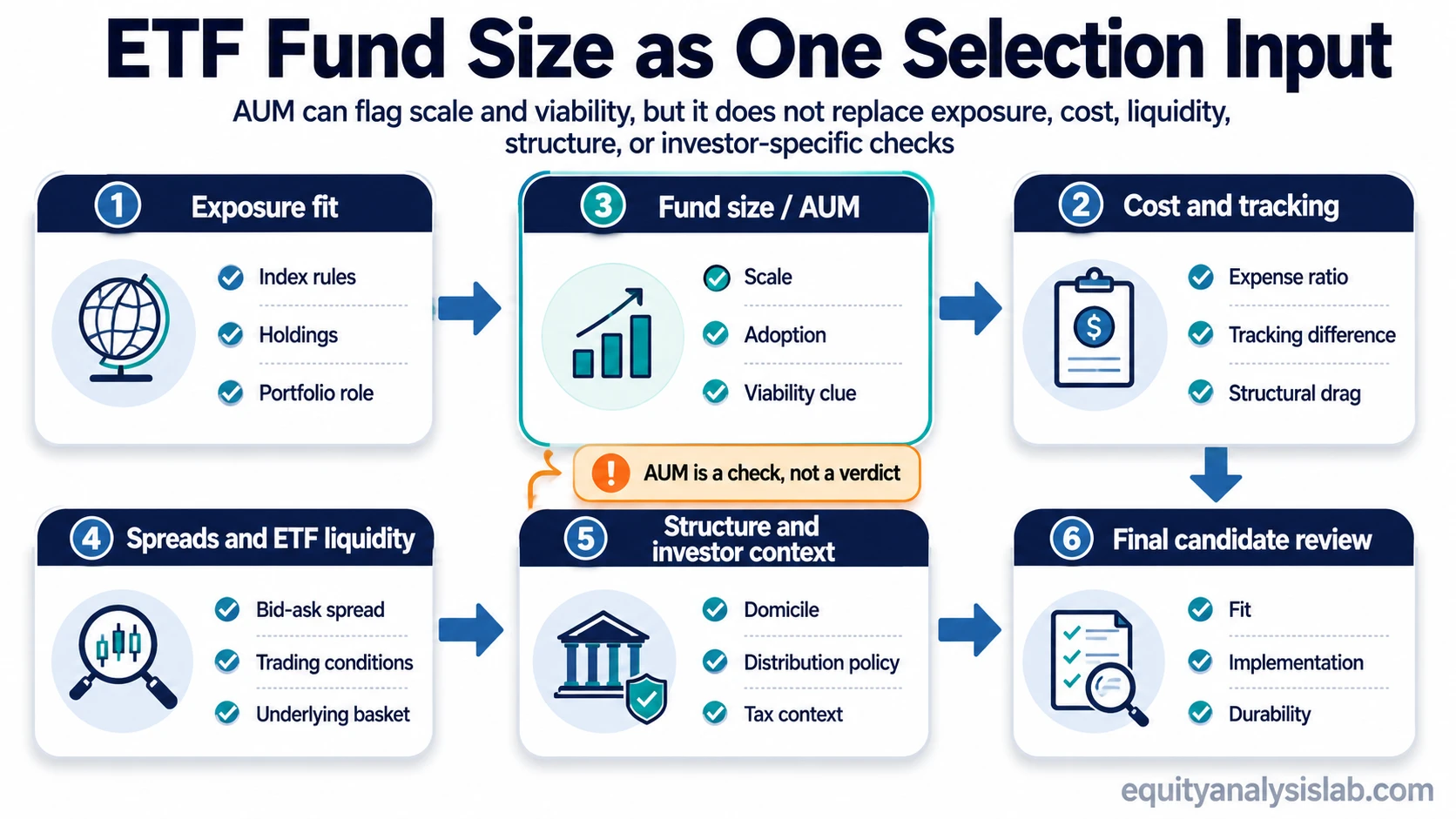
ETF fund size and AUM are useful ETF-selection checks, but they are not standalone quality scores. A larger fund can reduce some product-viability concerns and may reflect broader adoption, while a smaller fund may require closer review of age, issuer support, spreads, tracking, and the liquidity of the underlying holdings.
Definition: ETF fund size usually refers to the fund’s assets under management, or AUM. AUM is the market value of the assets held inside the ETF, not the same thing as daily trading volume, trading spread, or investor suitability.
Fund size is most useful as a diagnostic input. It can help flag whether the product has enough scale, whether closure risk deserves attention, and whether the fund has attracted meaningful assets. It does not prove that the ETF tracks better, trades cheaper, fits the portfolio role, or solves tax and distribution questions.
Key Points
- ETF fund size can help assess scale, adoption, and product viability.
- AUM is separate from ETF liquidity, trading volume, and the bid-ask spread.
- Current AUM and AUM trajectory are different signals. The same ending fund size can come from very different asset and flow paths.
- Larger funds may reduce some closure-risk concerns, but size alone is not a quality verdict.
- Smaller funds need closer checks on fund age, issuer support, spreads, tracking, and the underlying holdings.
What ETF Fund Size and AUM Mean
ETF AUM is the value of the assets inside the fund. If investors add capital or the holdings rise in value, AUM can increase. If investors redeem shares or holdings fall in value, AUM can decline.
That sounds simple, but the interpretation can be misleading if the investor looks only at the ending AUM figure. The number by itself does not reveal whether assets grew because the underlying market appreciated, because new capital came in, or because both happened at the same time.
The cleanest use of fund size is as a product-level question. AUM helps identify what to inspect next: durability, commercial scale, issuer commitment, and whether the ETF appears to be building or losing support.
AUM Level and AUM Trend Tell Different Stories
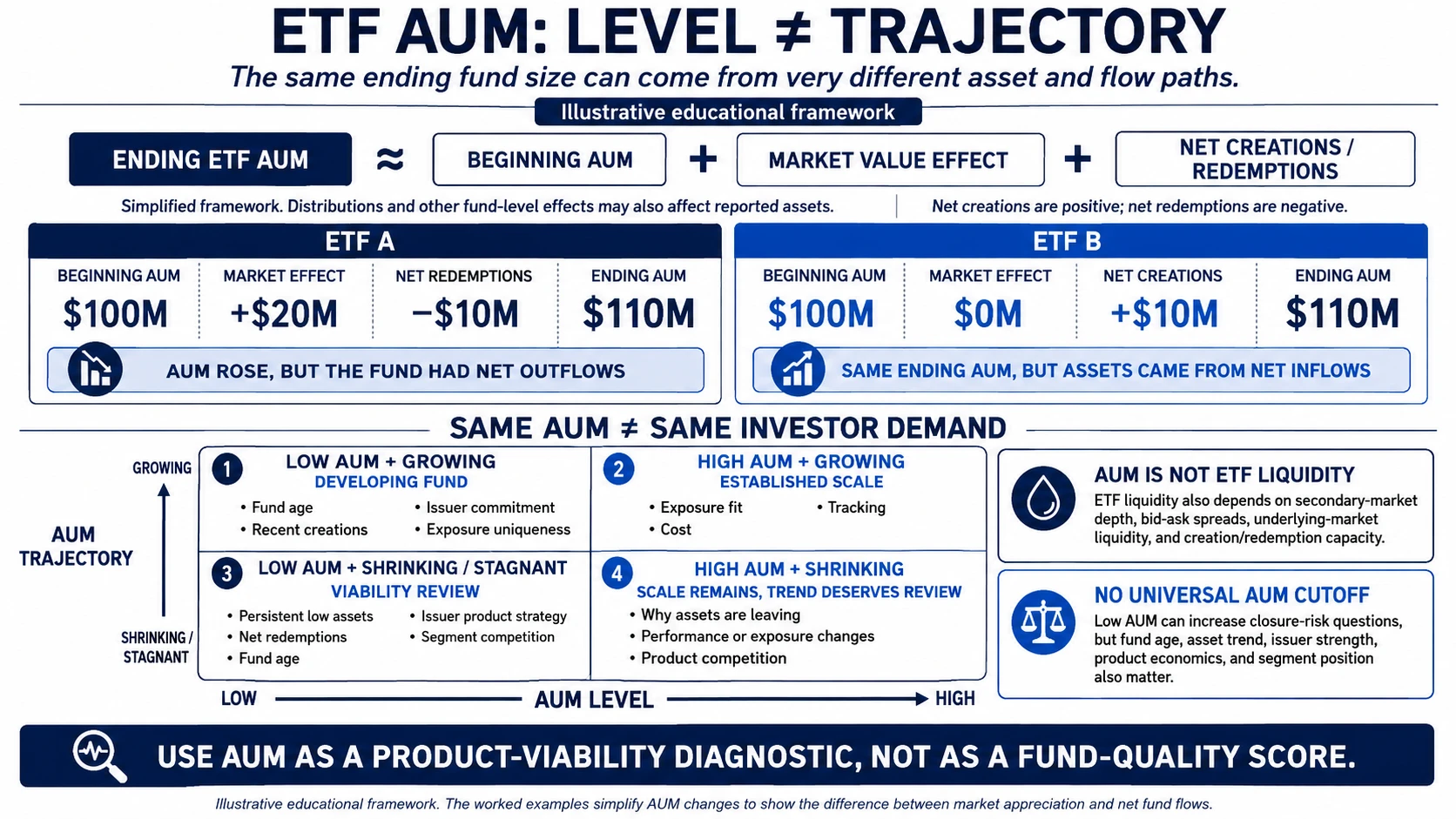
A more useful ETF review separates current AUM from AUM trajectory. Current AUM shows the scale of the fund today. AUM trajectory helps explain whether the fund appears to be building assets, holding its base, or losing support.
A simplified way to think about it is:
Ending AUM ≈ Beginning AUM + market-value effect + net creations or redemptions
That distinction matters because two ETFs can report the same ending AUM while reaching it through different paths. One fund may show higher AUM mainly because the underlying holdings rallied even while investors were redeeming shares. Another may reach the same ending AUM because investors were adding capital even without much market help.
Practical takeaway: the AUM number shows scale, but the path behind that number helps interpret product demand and product durability.
For selection work, that creates a more useful framework than a single size threshold. A low-AUM ETF that is young and steadily gathering assets can deserve a different interpretation from an older fund with low assets and a stagnant or shrinking base. A large ETF that is losing assets can still retain scale, but the asset trend may still deserve review.
What Fund Size Can Tell You, and What It Cannot
Fund size can signal that an ETF has attracted assets from investors who want that exposure. That can reduce concern that the product is too small to sustain, especially when the fund has been operating for a meaningful period and the issuer continues to support it.
Scale can also matter for operating efficiency. Larger funds may have more room to spread fixed operating costs across a wider asset base, but expense ratios, tracking difference, securities lending, index design, replication method, and issuer decisions still determine the actual investor experience.
At the same time, AUM can create false confidence when it is treated as a complete ETF score. A large fund can still have the wrong exposure, weak tracking, higher total cost, or structure and tax features that do not fit the investor. A small fund can also be dismissed too quickly if the exposure is coherent, the underlying basket is liquid, and the issuer appears committed to the product.
Main limitation: AUM is a product-viability clue. It does not settle exposure, holdings, index rules, total cost, tracking behavior, trading spread, domicile, distribution policy, or investor-specific tax context.
Closure Risk Is Product Risk, Not Market Risk
Closure risk: ETF closure risk means the issuer may decide to liquidate or merge a fund if it lacks enough commercial scale or strategic value. That is different from the market risk of the holdings moving up or down.
A closure can create inconvenience. Investors may need to reinvest, accept cash proceeds, reassess exposure, and consider investor-specific tax consequences. The details depend on the fund structure, account type, jurisdiction, and investor context, so closure should not be reduced to a single universal outcome.
Fund size can help flag closure risk, but no single AUM cutoff works across all ETFs. Some investors use informal thresholds as quick screening tools, but those thresholds should be treated as heuristics, not hard rules. A niche fund, newly launched fund, strategically important product, or issuer-supported exposure may deserve a different interpretation from a long-running fund that has stayed very small for years.
AUM, Liquidity, and Trading Costs Are Different Checks
AUM is separate from ETF liquidity. Liquidity depends on both the ETF shares traded on the exchange and the liquidity of the underlying holdings that support creation and redemption activity.
AUM is also separate from the bid-ask spread. A large ETF can still show wider spreads in stressed markets, outside active trading hours, or when the underlying assets are harder to price.
The ETF creation and redemption process is one reason on-screen exchange volume does not tell the full liquidity story. Authorized participants can help create or redeem ETF shares, but that mechanism still depends on market conditions, underlying holdings, and practical execution constraints.
Selection rule: AUM answers a scale question. Liquidity and spread analysis answer an execution-cost question. Those checks should not be merged into one shortcut.
How to Read Small and Large ETFs More Carefully
| Situation | What it may suggest | Why the reading is incomplete | Next review step |
|---|---|---|---|
| Large AUM, stable or growing | The fund appears established and commercially viable. | Size still does not prove exposure fit, tight spreads, or better tracking. | Check exposure, cost, tracking, and structure. |
| Large AUM, shrinking | The fund still has scale, but asset trend deserves review. | Outflows do not automatically make the ETF unsuitable, but they can signal growing competition or weaker demand. | Review asset trend, peer competition, and whether the product role has changed. |
| Low AUM, growing | The fund may be early in its development rather than structurally weak. | A small current size can still create product-risk questions. | Check fund age, issuer support, spread behavior, and asset-growth trend. |
| Low AUM, stagnant or shrinking | Product-viability questions become more important. | Low assets alone do not guarantee closure, but the risk deserves more attention. | Review age, issuer lineup, segment competition, and whether the exposure is still gaining support. |
What to Check After AUM
After fund size, the review should stay focused on the questions AUM cannot answer. Size answers a scale question. The next checks test whether the fund can deliver the intended exposure under acceptable implementation conditions.
- Exposure: index rules, holdings, sector and country weights, factor tilt, and portfolio role.
- Cost: expense ratio, tracking difference, spreads, taxes, and any structural drag.
- Trading conditions: spread behavior, order size, on-screen volume, and underlying basket liquidity.
- Structure: replication method, domicile, distribution or accumulation policy, currency exposure, and provider support.
- Durability: fund age, AUM trend, issuer lineup, and the likelihood that the fund remains viable.
FAQ
Is higher AUM always better for an ETF?
No. Higher AUM can reduce some product-viability concerns, but it does not guarantee better exposure, lower total cost, tighter spreads, better tracking, or better portfolio fit.
Does low AUM mean an ETF will close?
No. Low AUM can raise closure-risk questions, especially for older funds that have not gained assets, but closure decisions depend on issuer strategy, fund economics, exposure demand, and product lineup.
Is ETF AUM the same as ETF liquidity?
No. AUM measures the assets inside the fund. ETF liquidity also depends on exchange trading, spread behavior, underlying holdings, and creation and redemption support.
Why does AUM trend matter if I already know the fund’s size?
AUM trend helps show whether the current size is being supported, built, or eroded over time. Two ETFs can have the same current AUM but very different product-demand signals depending on flows, market effects, age, and issuer support.