
Risk and volatility describe related parts of an investment decision, but they are not interchangeable. Volatility describes how much returns or prices vary. Risk is broader and concerns uncertainty, potential financial loss, forced action, or failure to meet the investor’s objective.
A volatile price path can be manageable when the underlying investment remains sound and the investor can absorb the movement. A calm price path can still carry material risk when leverage, liquidity, valuation, business quality, or other constraints are weak.
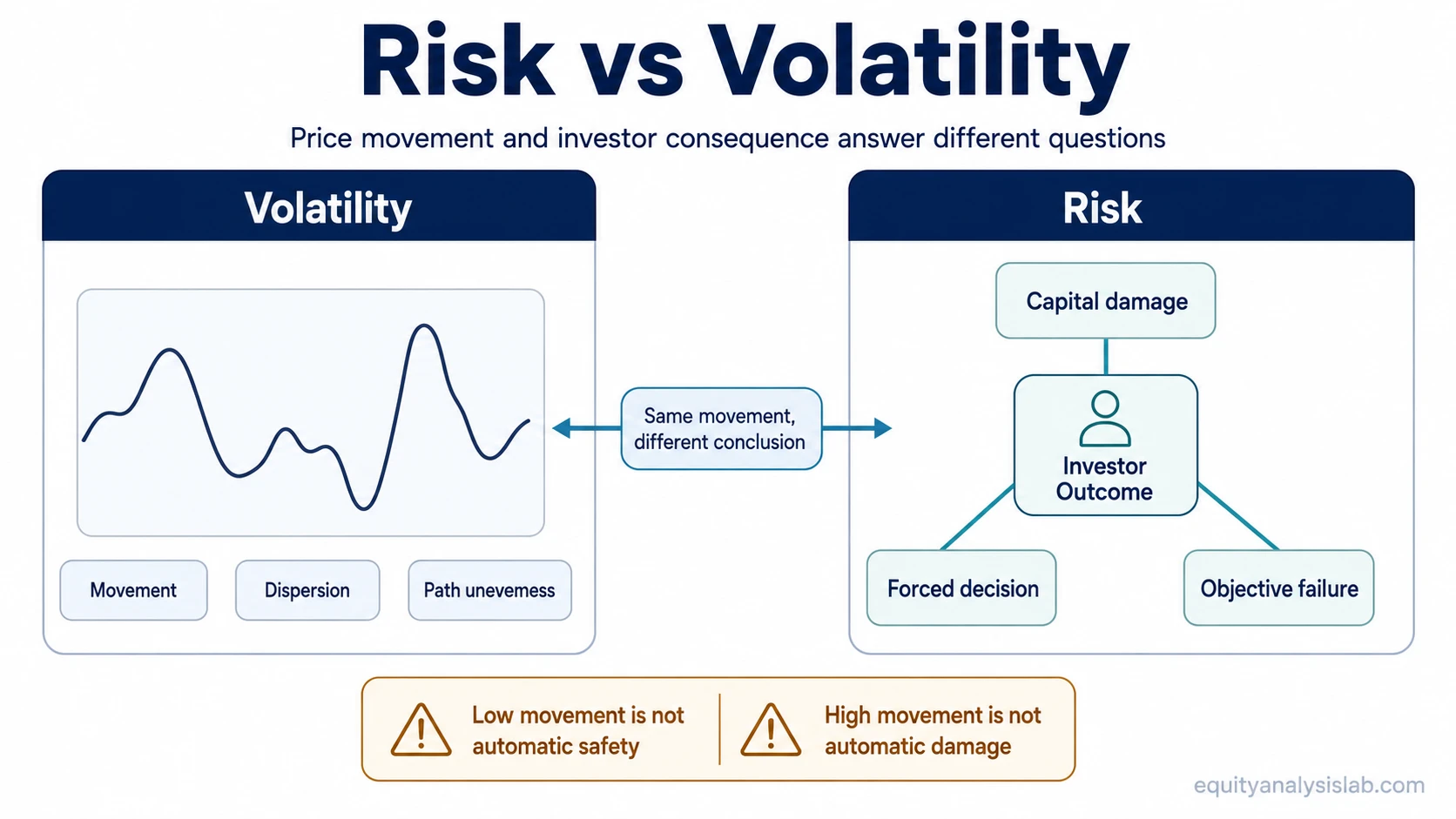
Risk and Volatility Are Related, but Not Equivalent
Volatility describes the variability of returns or prices over time. It can be summarized statistically and compared across securities, portfolios, or periods.
Risk includes uncertainty and potential financial harm. Depending on the investment, that can include business deterioration, leverage, liquidity pressure, concentration, valuation error, or an investor constraint that forces action at a bad time.
Risk vs Volatility Comparison
| Criterion | Volatility | Risk | Investor interpretation |
|---|---|---|---|
| Primary question | How variable is the return or price path? | What can cause financial loss or prevent the intended outcome? | Large movement is visible, but the consequence depends on the investment and the investor. |
| Typical evidence | Return dispersion, historical price changes, standard deviation, or other volatility measures | Business quality, balance sheet, cash flow, valuation, liquidity, leverage, concentration, and investor constraints | Volatility can be measured directly from market data, while broader risk often requires several forms of evidence. |
| Measurement | Often summarized with a statistical measure | Usually requires more than one metric or model | A single volatility number cannot describe every source of investment risk. |
| When it becomes consequential | When price movement becomes large relative to the investor’s ability to absorb it | When a loss, financing problem, liquidity need, or thesis failure can materially damage the outcome | The same price move can matter differently across investors and investments. |
| Common misread | Low volatility is treated as proof of safety | Risk is reduced to the most visible market movement | Quiet prices can coexist with hidden fragility, while volatile prices do not automatically imply permanent impairment. |
Why Volatility Is Still Used as a Risk Measure
Investor.gov defines investment risk broadly as uncertainty and potential financial loss and separately identifies volatility risk. CFA Institute lists volatility, measured as the standard deviation of portfolio returns, among several formal portfolio risk measures alongside drawdown, value at risk, and expected shortfall. Volatility is therefore useful as a measurable risk dimension, while broader investment risk still depends on the specific source of possible loss.
When Volatility Becomes a Practical Risk
Price variability becomes more consequential when the investor cannot absorb the path. A short liquidity need, leverage, concentration, margin pressure, or a narrow holding window can turn a temporary decline into a forced decision.
The investment experiences a large or rapid decline.
The investor needs cash, uses leverage, faces margin pressure, or cannot tolerate the required holding period.
The price path now creates a material possibility of forced selling, realized loss, or failure to meet the original objective.
Use maximum drawdown to describe how deep a peak-to-trough decline became. Drawdown still needs context because depth alone does not identify the cause of the loss or whether recovery is likely.
Low Volatility Can Still Hide Risk
Illustrative example: Position A moves sharply from month to month, but the business has durable cash generation, modest leverage, and no immediate financing pressure. Position B trades in a narrow range, but the business depends on refinancing, has weak cash generation, and carries a valuation that leaves little room for disappointment.
Position A has the more volatile price path. Position B can still carry greater business or financing risk despite looking calmer in the market. The comparison depends on the source of uncertainty, not only the amount of observed price movement.
What Volatility Does Not Capture
Business deterioration, liquidity stress, leverage, refinancing pressure, overvaluation, dilution, concentration, and permanent capital impairment can matter even when recent prices have been relatively stable. Volatility can reveal how uneven the market path has been without explaining every cause or consequence behind that path.
Permanent impairment matters because future returns build from the capital that remains. When capital is damaged rather than temporarily marked down, the compounding base is smaller.
A Practical Reading Sequence
Measure how variable the returns have been and how deep recent declines became. This establishes the visible path without deciding what caused it.
Review liquidity needs, leverage, concentration, holding period, and any condition that could force action before the investment thesis has time to play out.
Examine business quality, cash generation, balance-sheet strength, valuation, financing needs, and other evidence that could turn uncertainty into lasting capital damage.
How This Connects to Risk and Return
The risk-and-return relationship asks how uncertainty relates to the return investors may require for accepting it. Risk vs volatility answers a narrower question: how much of the observed price variability is relevant to the specific loss, constraint, or objective being evaluated.