
Index funds vs stocks compares two different ways to take equity exposure: owning a company directly or owning shares of a fund that follows an index or basket.
The choice changes concentration, control, research burden, costs, and the source of risk. An index fund can reduce dependence on one company, while an individual stock leaves more of the result tied to that business.
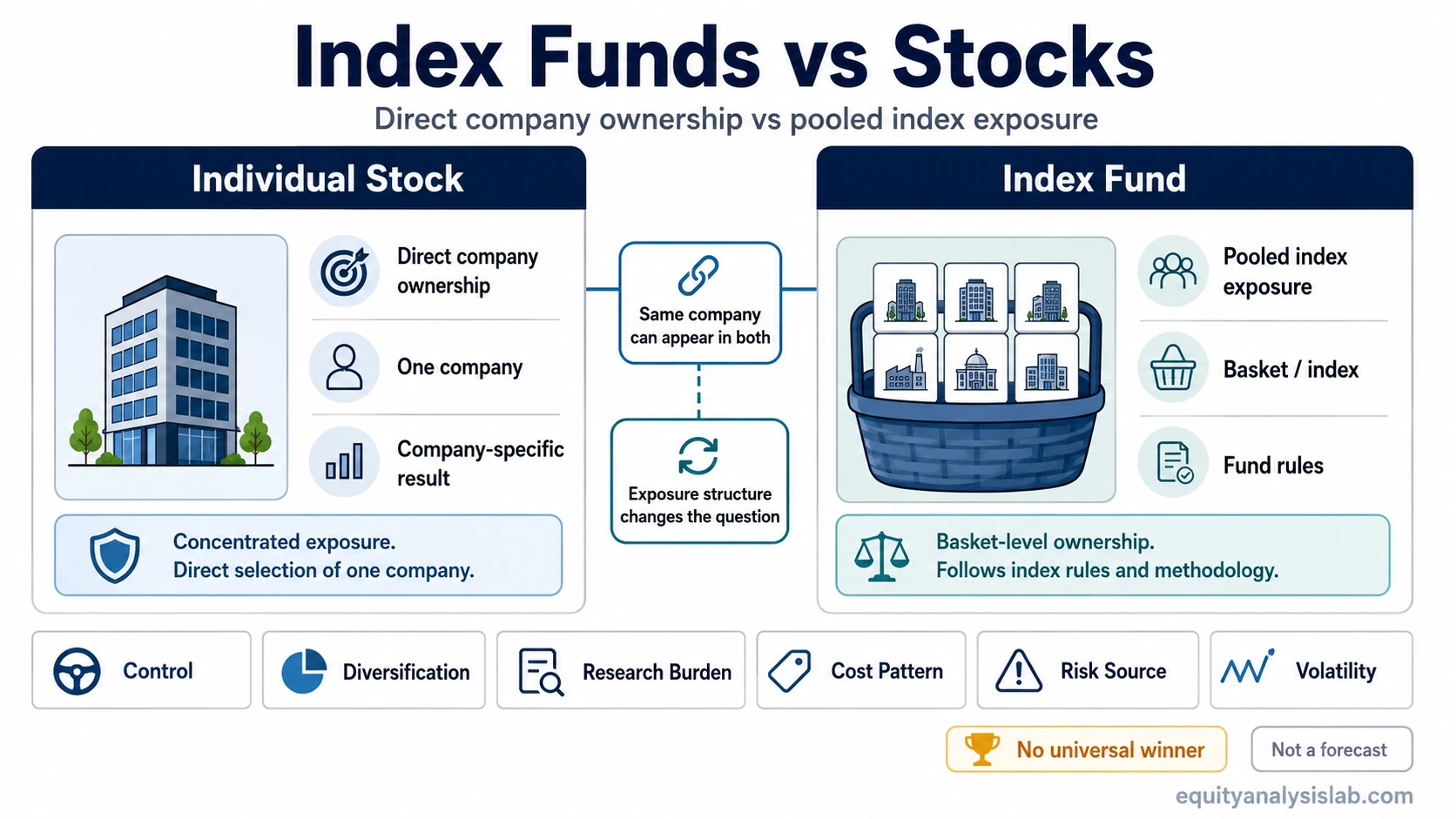
Stocks and Index Funds: The Structural Difference
Buying a stock creates direct exposure to one company. The result can be heavily influenced by that company’s business performance, balance sheet, management decisions, valuation, and company-specific risks. This is the direct ownership side of equity investing.
Buying an index fund creates exposure through a fund that follows a defined index or basket. Holdings and weights are determined by the index methodology and the fund’s implementation rather than by a separate company thesis for every holding.
Stocks vs Index Funds at a Glance
| Criterion | Individual stocks | Index funds |
|---|---|---|
| What the investor owns | Shares of a specific company | Shares or units of a pooled fund |
| Exposure | Company-specific | Index or basket exposure |
| Diversification | Depends on how many companies the investor owns and how positions are sized | Usually broader than one stock, but the degree of diversification depends on the index, holdings, and weights |
| Security selection | The investor chooses each company directly | The index methodology and fund rules determine the basket |
| Research burden | Requires company-specific analysis and monitoring | Shifts more of the work toward the index, holdings, weighting method, costs, and fund structure |
| Ongoing fund fee | The stock itself has no fund expense ratio, although trading, spread, and tax costs can still apply | Expense ratios and other fund-level costs can reduce the investor’s return |
| Tracking difference | Not applicable to direct ownership of one company | The fund can differ from its index because of fees, trading costs, sampling, or other implementation effects |
| Risk concentration | Company-specific risk can dominate the result | Single-company dependence can be reduced, while market, index, sector, and fund-specific risks remain |
Which Structure Fits the Investment Question?
Direct stock ownership fits a company-specific question. The investor chooses the business, accepts the concentration that comes with the position, and has to keep the thesis, valuation, and company risks under review.
Index-fund ownership fits a basket-level question. The investor accepts the index methodology and fund structure instead of selecting every company individually, while still needing to understand the actual holdings, concentration, and costs.
The two structures can also coexist in the same portfolio. Their roles still need to be evaluated separately because the source of exposure and concentration is different.
Index Fund Structure Matters
Investor.gov notes that an index fund can be structured as a mutual fund, exchange-traded fund, or unit investment trust. Some funds hold all securities in an index, while others use sampling or derivatives. An index ETF is one implementation of index-based exposure, not the only one.
That distinction matters for trading, fees, liquidity, distributions, and tracking. Comparing a stock with an index fund therefore requires looking at both the index methodology and the specific fund structure used to obtain the exposure.
What Control Means in Each Structure
Control has more than one layer in this comparison. One layer is portfolio selection. Another is how voting rights attached to underlying company shares are exercised.
The investor chooses the company directly. Voting rights may also attach to the shares, depending on the share class and security terms.
The investor chooses the fund and its index exposure. For portfolio securities held by a registered fund, proxy voting is generally exercised by the fund or its investment adviser rather than by each fund shareholder directly.
The SEC requires registered management investment companies to disclose how they vote proxies relating to portfolio securities. Fund shareholders can review those voting records, but they do not cast each underlying portfolio-company vote themselves.
Diversification Changes the Source of Risk
An index fund can spread exposure across many securities, which reduces dependence on the outcome of one company. The amount of diversification still depends on what the index actually owns and how those holdings are weighted.
A narrow sector index, a concentrated weighting method, or a market-wide decline can still create substantial losses. Investor.gov also identifies tracking error, fund costs, and the risks of the securities in the underlying index as relevant index-fund risks.
Same Company, Different Exposure
The same company can appear in both structures. An investor can own that company directly and can also own an index fund in which the company is one holding among many.
Illustrative example: Suppose a large public company represents one position in a broad market index. Owning the stock directly makes that company’s business results and valuation a major driver of the position. Owning the index fund still creates exposure to the same company, but its effect is combined with the other holdings and the index weighting method.
The difference is the weight that one company carries in the final result. Direct ownership can make the company thesis central. Fund ownership places that company inside a broader rule-based portfolio.
Costs, Research, and the Return Path
Individual stocks and index funds create different cost structures. A stock position can involve spreads, brokerage costs, taxes, and the time required for company research. An index fund adds fund-level costs such as an expense ratio and can also experience tracking difference, trading spreads, and wrapper-specific tax effects.
Research responsibility changes as well. Direct stock ownership requires deeper company-specific monitoring. Index-fund analysis shifts more attention toward the benchmark, methodology, holdings, concentration, fund implementation, and costs.
Over longer periods, reinvestment, fees, and market path affect how returns accumulate. That makes compounding over time relevant to both structures without making either structure universally superior.
Where the Comparison Can Break Down
The fund tracks an index and holds more than one security.
The index is narrow, sector-heavy, factor-driven, or concentrated in a small number of large positions.
Judge diversification from the holdings and weights rather than from the index-fund label alone.
The same caution applies to the active-versus-passive label. Individual stocks can be held with low turnover, while index funds can follow narrow or specialized rule sets. The actual exposure is more informative than the label by itself.
A Neutral Decision Frame
Stock question: Do I want direct exposure to this company’s business results, valuation, and company-specific risks?
Index-fund question: Do I want exposure to this index or basket under its current holdings, weighting rules, costs, and fund structure?
The comparison does not produce a universal winner. It clarifies where concentration, decision control, research responsibility, fund costs, and risk sit before the investor evaluates the role of either structure.