
A thematic ETF is an exchange-traded fund built around a specific investment theme, trend, or portfolio idea rather than a broad market benchmark alone. The theme label is only the starting point: actual exposure depends on the fund’s holdings, weighting method, costs, liquidity, tracking behavior, distributions, overlap, and tax or structure details.
Definition: A thematic ETF is an ETF that organizes its portfolio around a defined theme, such as a technology trend, demographic shift, energy transition, consumer behavior pattern, or other investment idea. The fund may hold companies from multiple sectors if the methodology treats them as connected to the same theme.
The useful distinction is between the theme name and the portfolio that implements it. A fund can carry a clear theme label while holding companies with different revenue sources, business models, geographic exposures, market capitalizations, or levels of direct connection to the stated idea.
Key Points
- A thematic ETF groups holdings around a theme or trend rather than only around a broad index or single sector label.
- The theme label does not prove exact exposure; holdings and weighting determine what the fund actually owns.
- ETF wrapper mechanics such as fees, liquidity, spreads, NAV behavior, tracking, distributions, tax context, and overlap affect interpretation.
- A thematic ETF can differ from a sector ETF, broad equity ETF, commodity ETF, bond ETF, or actively managed ETF because those labels describe different classification layers.
What Is a Thematic ETF?
A thematic ETF is a fund structure used to package a specific investment theme into a tradable basket of securities. Instead of starting with the whole equity market or a standard sector classification, the fund starts with a theme and then applies a methodology to decide which securities belong in the portfolio.
The theme may be narrow or broad. One thematic fund might focus on a specific industry trend, while another may combine companies from technology, healthcare, industrials, consumer, or infrastructure areas if the methodology connects them to the same stated methodology.
Because the ETF wrapper trades on an exchange, the fund also has the normal ETF features that affect interpretation: market price, net asset value, bid-ask spread, expense ratio, distributions, tracking behavior, and fund structure. The theme identifies the idea, but the wrapper affects how the exposure is delivered.
How a Thematic ETF Turns a Theme Into Holdings
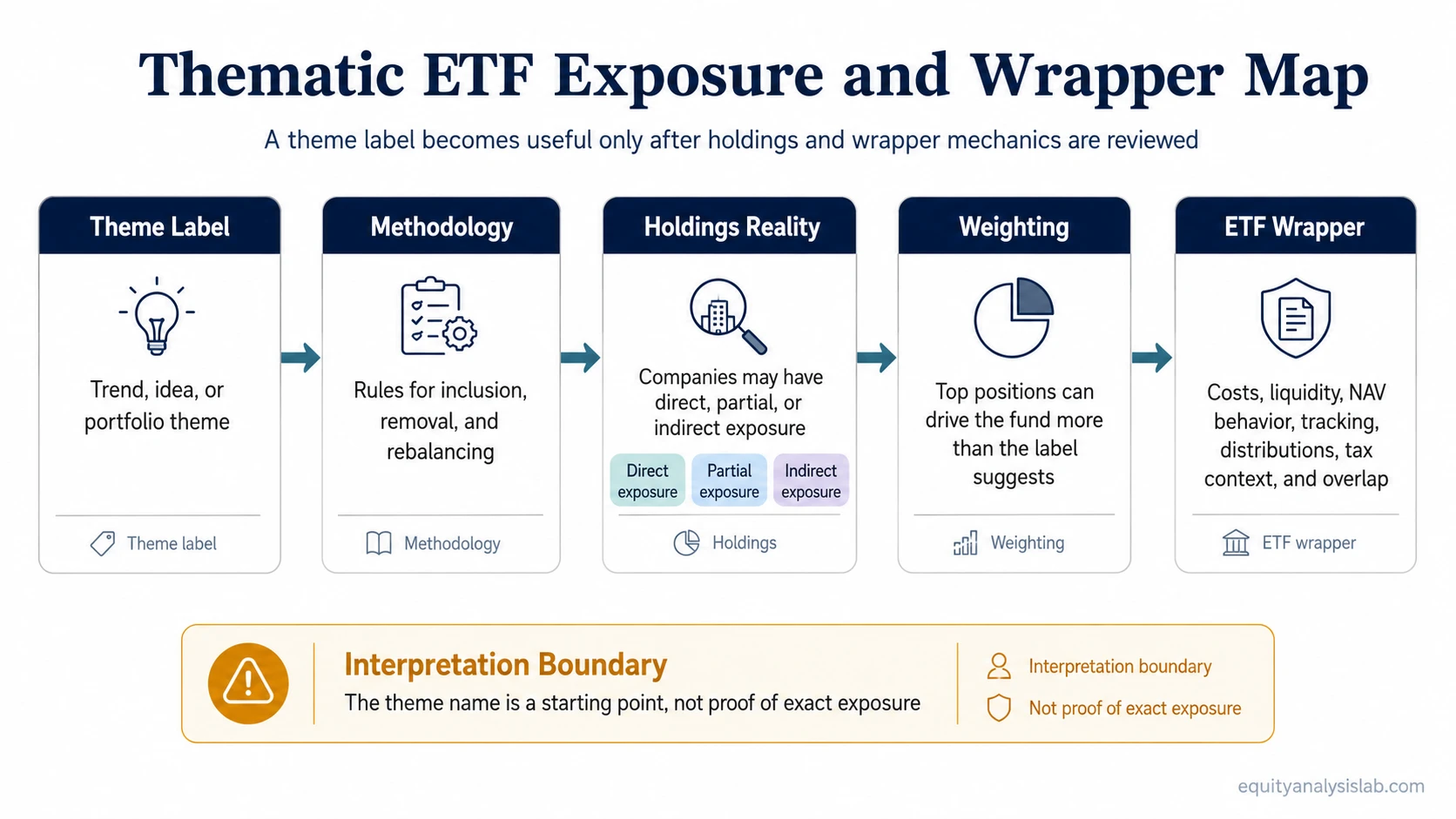
A thematic ETF usually begins with a stated theme, then converts that theme into inclusion rules. Those rules may come from an index methodology, a fund sponsor’s selection process, or an active management process. The important question is not only what the theme is called, but how the fund decides which companies qualify.
Some companies may have direct exposure to the theme because the theme is central to their revenue. Others may have partial or indirect exposure because the theme is only one segment, supplier relationship, product line, or future growth angle inside a broader business. That difference can change how concentrated or diluted the theme exposure really is.
Weighting also matters. A fund can hold many names but still be driven by a few large positions if it uses market-cap weighting or if the methodology allows heavy concentration. Another fund can apply equal weighting or caps that spread exposure more evenly, even when the theme name sounds similar.
Interpretation note: Two thematic ETFs with similar names can behave like different portfolios if their index rules, eligible universe, rebalancing process, country exposure, market-cap exposure, and top-holding weights differ.
What the ETF Wrapper Changes
The ETF wrapper changes how theme exposure is accessed and measured. A thematic idea can sound simple, but the fund still has operating mechanics that affect cost, trading, tracking, income treatment, and portfolio overlap.
| Wrapper factor | What it changes | Why it matters |
|---|---|---|
| Expense ratio | Ongoing fund cost | Higher costs reduce the return retained by shareholders before any theme-level outcome is considered. |
| Liquidity and bid-ask spread | Trading cost and ease of execution | A fund can hold liquid securities but still trade with wider spreads if the ETF itself has limited trading activity. |
| NAV vs market price | Relationship between portfolio value and exchange price | Premiums, discounts, and intraday trading conditions can affect the price paid or received. |
| Tracking difference and tracking error | How closely the fund follows its stated index or strategy over time and how variable that gap can be. | The delivered result can differ from the reference methodology because of costs, trading, sampling, cash drag, or portfolio changes. |
| Distributions | Income or capital gain payments | Distribution patterns can affect taxable accounts and total-return interpretation. |
| Tax, domicile, and structure | Investor-level treatment and fund mechanics | Structure can affect withholding, reporting, distribution treatment, and account-level interpretation depending on jurisdiction. |
| Overlap | Duplicate exposure with existing holdings | A thematic ETF may increase concentration if its largest positions already appear in a broad equity ETF or another theme fund. |
Thematic ETF vs Sector ETF vs Broad Equity ETF
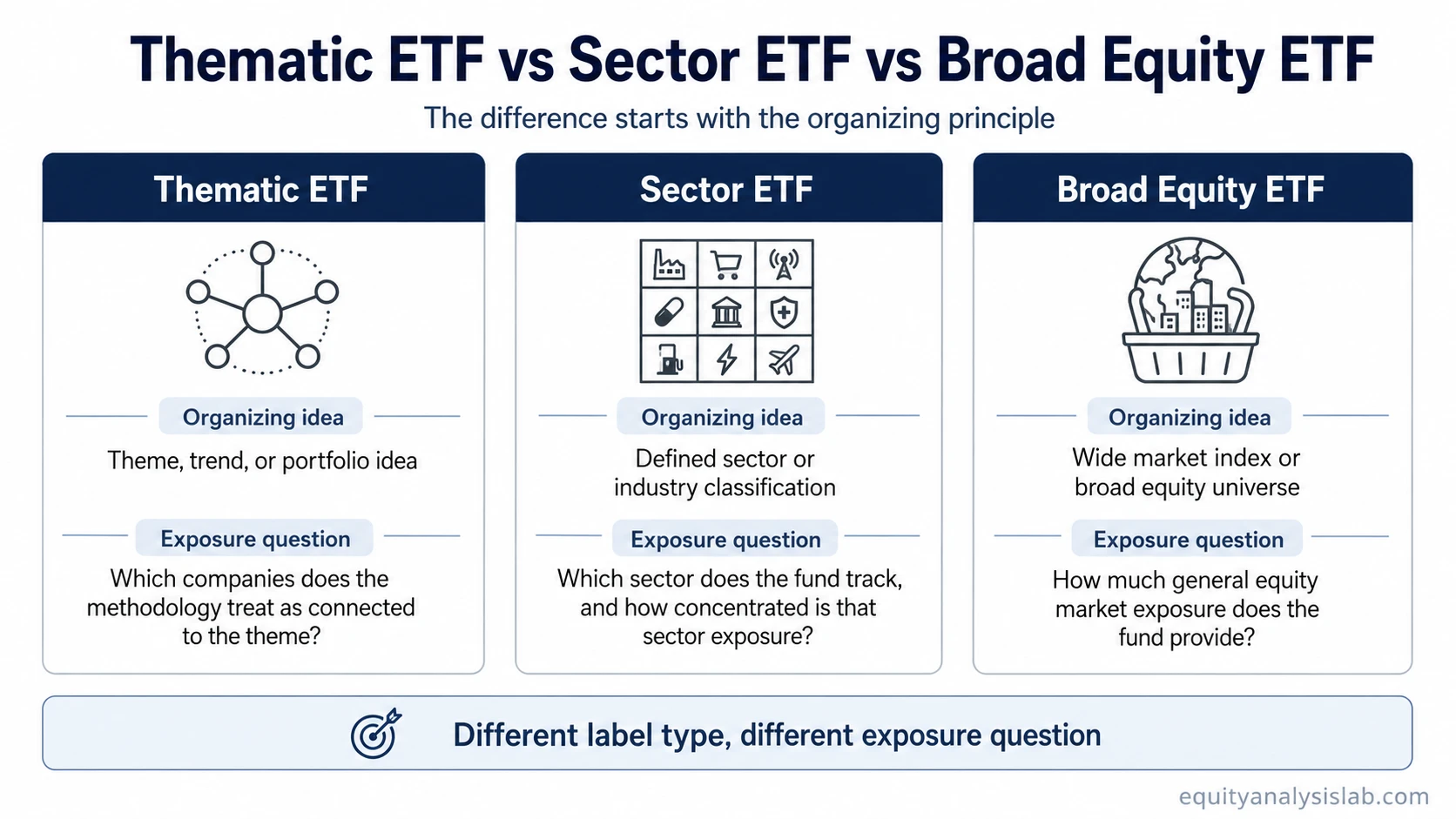
A thematic ETF is not the same as a sector ETF or a broad equity ETF. The difference is the organizing principle. A sector ETF usually starts from an industry classification. A broad equity ETF usually starts from a market index. A thematic ETF starts from a theme and then maps that theme into holdings.
| ETF type | Main organizing idea | Typical exposure question |
|---|---|---|
| Thematic ETF | A theme, trend, or portfolio idea | Which companies does the methodology treat as connected to the theme? |
| Sector ETF | A defined sector or industry classification | Which sector does the fund track, and how concentrated is that sector exposure? |
| Broad equity ETF | A wide market index or large equity universe | How much general equity market exposure does the fund provide? |
| Commodity ETF | Commodity or real-asset exposure | Is the fund linked to physical commodities, futures, commodity producers, or another real-asset structure? |
| Bond ETF | Fixed-income exposure | What duration, credit quality, issuer type, and yield profile does the bond portfolio carry? |
| Actively managed ETF | Manager discretion rather than only index replication | How much of the portfolio is shaped by active decisions rather than a rules-based index? |
A thematic ETF can be index-based or active. A thematic label describes the exposure concept; it does not automatically describe the management style. That is why an actively managed thematic fund and an index-based thematic fund can share a theme while using different portfolio construction rules.
What to Review Before Interpreting a Thematic ETF
The strongest review starts with the portfolio, not the name. A theme can be useful as a classification shortcut, but the holdings, weights, and methodology show what the fund actually represents.
| Review item | Question to ask | Interpretation risk if ignored |
|---|---|---|
| Holdings | Which companies are actually in the fund? | The fund may include companies with indirect or mixed exposure to the stated theme. |
| Top holdings | How much of the fund is concentrated in the largest positions? | A few names may drive most of the exposure even if the fund owns many securities. |
| Weighting method | Is the fund market-cap weighted, equal weighted, capped, tiered, or actively weighted? | The same theme can create very different risk exposure depending on weight distribution. |
| Methodology | How are companies selected, removed, and rebalanced? | A theme label can hide a ruleset that is broad, narrow, discretionary, or frequently changing. |
| Expense ratio | What ongoing cost does the fund charge? | A compelling theme can still be expensive to hold if the wrapper cost is high. |
| Liquidity and spread | How easily does the ETF trade, and how wide is the bid-ask spread? | Trading cost can matter even when the underlying idea is long term. |
| NAV and market price | Does the ETF trade close to the value of its underlying holdings? | Premiums and discounts can affect entry and exit prices. |
| Tracking | How closely does the ETF follow its index or stated strategy? | The fund’s delivered exposure may differ from the headline methodology. |
| Distributions | Does the fund distribute income or capital gains? | Distributions can change total-return and tax interpretation. |
| Overlap | Do the holdings already appear in other ETFs or portfolio positions? | Thematic exposure can become duplicate concentration rather than new diversification. |
| Tax and structure context | Does domicile, structure, or account type change treatment? | Investor-level outcomes can differ by jurisdiction and account structure. |
Common Misunderstanding: Theme Label Is Not Actual Exposure
Limitation: A thematic ETF name is a classification label, not a complete exposure analysis. The same theme can be implemented with different holdings, different concentration levels, different sector mixes, different country exposure, different costs, and different trading characteristics.
A fund can appear diversified because it holds many companies, but diversification depends on how those companies behave together and how heavily the largest positions are weighted. If several holdings are exposed to the same revenue driver, financing condition, policy risk, or valuation factor, the fund may be more concentrated than the number of holdings suggests.
Overlap can also change the interpretation. A broad market ETF may already hold large companies connected to the same theme. Adding a thematic ETF beside it may increase exposure to names already present rather than create a fully separate allocation.
Short Illustrative Scenario
Example: Two ETFs both use the same technology-related theme. One holds a small number of large companies with heavy top-position weights. The other holds a wider basket of smaller and mid-sized companies with capped weights. Both funds share the theme label, but the first may behave more like a concentrated large-cap exposure while the second may behave more like a diversified theme basket.
The same difference can appear in costs, spreads, rebalancing rules, country exposure, and overlap with an existing broad equity ETF. The useful review is not whether the theme sounds attractive, but how the ETF turns that theme into a real portfolio.
Related ETF Type Boundaries
The clean interpretation separates the exposure idea from the ETF mechanics. A thematic ETF starts with a stated theme, while other ETF types may start with a sector, asset class, fixed-income profile, or active strategy process. In each case, the label should be checked against holdings, methodology, costs, liquidity, tracking behavior, distributions, and overlap.
FAQ
Does a thematic ETF always hold only companies from one theme?
No. A thematic ETF can include companies with direct, partial, or indirect exposure to the stated theme. The holdings, weighting, and methodology show how closely the portfolio matches the label.
Is a thematic ETF the same as a sector ETF?
No. A sector ETF usually follows a sector or industry classification, while a thematic ETF starts with a theme that may include companies from multiple sectors or geographies.
Can a thematic ETF overlap with a broad market ETF?
Yes. A thematic ETF can hold companies that also appear in a broad market ETF. That overlap can increase concentration instead of adding a fully separate exposure.
Is a thematic ETF automatically diversified?
No. Diversification depends on holdings, top-position weights, sector mix, company similarity, and overlap with other portfolio exposures, not only on the number of holdings.