
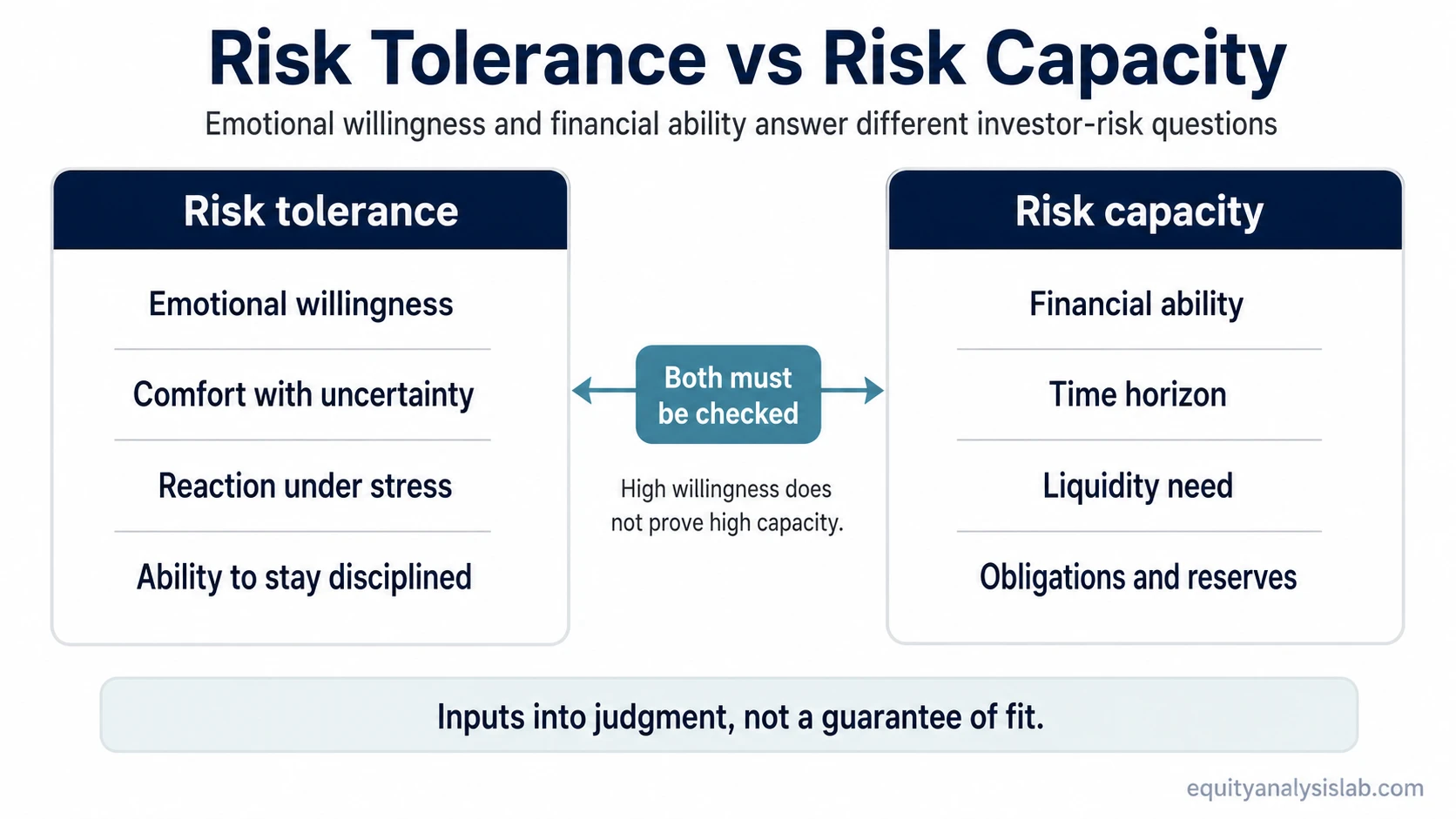
Risk tolerance and risk capacity answer different investor questions. In this comparison, Risk tolerance refers to the willingness to accept investment uncertainty and possible loss.
Risk capacity refers to the financial ability to absorb an adverse outcome without compromising the purpose of the capital. The two inputs can point in different directions, so willingness and financial ability need to be checked separately.
Why the Terminology Can Vary
CFA Institute’s Financial Risk Tolerance review uses risk tolerance for willingness to accept uncertainty and treats risk capacity as a separate financial concept. FINRA’s digital investment advice report uses risk tolerance more broadly and describes capacity and willingness as separate dimensions within it. This page uses the narrower willingness-versus-capacity convention so the comparison remains explicit.
Risk Tolerance vs Risk Capacity
| Comparison point | Risk tolerance | Risk capacity |
|---|---|---|
| Core question | How much investment uncertainty and potential loss is the investor willing to accept? | How much adverse financial outcome can the investor absorb without disrupting important needs or the purpose of the capital? |
| Primary type of constraint | Willingness and psychological comfort with risk. | Financial ability and the consequences of loss. |
| Evidence to review | Stated risk trade-offs, consistent preferences, and behavior under stress interpreted over time. | Income stability, liquidity needs, obligations, cash reserves, time horizon, and the intended use of the capital. |
| What may change the reading | Experience and longer-term changes in willingness can matter, while a short-term emotional reaction does not necessarily establish a permanent change in tolerance. | Changes in income, debt, reserves, time horizon, spending needs, or the purpose of the funds can materially change capacity. |
| Common misread | Treating comfort with volatility as proof that the investor can financially afford the downside. | Treating financial strength as proof that the investor will remain comfortable with the exposure during stress. |
When Willingness and Capacity Point in Different Directions
- The investor may feel comfortable with volatility or temporary loss.
- A shorter time horizon, liquidity need, unstable income, or financial obligation can still limit the room to absorb an adverse outcome.
- The financial constraint remains relevant even when the investor feels comfortable taking risk.
- The investor’s financial position may be able to withstand a meaningful decline.
- Uncertainty or drawdowns may still create enough discomfort to undermine the intended process.
- Financial capacity does not establish behavioral willingness.
Same Investor, Different Reading
An investor may say they are comfortable with large portfolio swings and still expect to use part of the capital for a major expense within the next year.
The stated willingness may indicate relatively high tolerance, while the near-term cash need reduces capacity. The mismatch comes from two different constraints: one concerns willingness to accept uncertainty, while the other concerns whether the financial consequences can be absorbed.
How the Two Inputs Fit Into a Broader Investor Decision
Investment objectives define what the capital is meant to accomplish. Risk tolerance and risk capacity then help test whether the uncertainty attached to an investment approach is compatible with the investor’s willingness and financial constraints.
A separate question is whether the investment can be understood and evaluated with enough evidence. That boundary belongs to the circle of competence rather than to either risk measure.
Limits of the Comparison
They are separate inputs into a broader investor profile and decision process. Investment objectives, time horizon, liquidity needs, existing financial commitments, portfolio structure, and the evidence behind the investment still affect the final interpretation.