
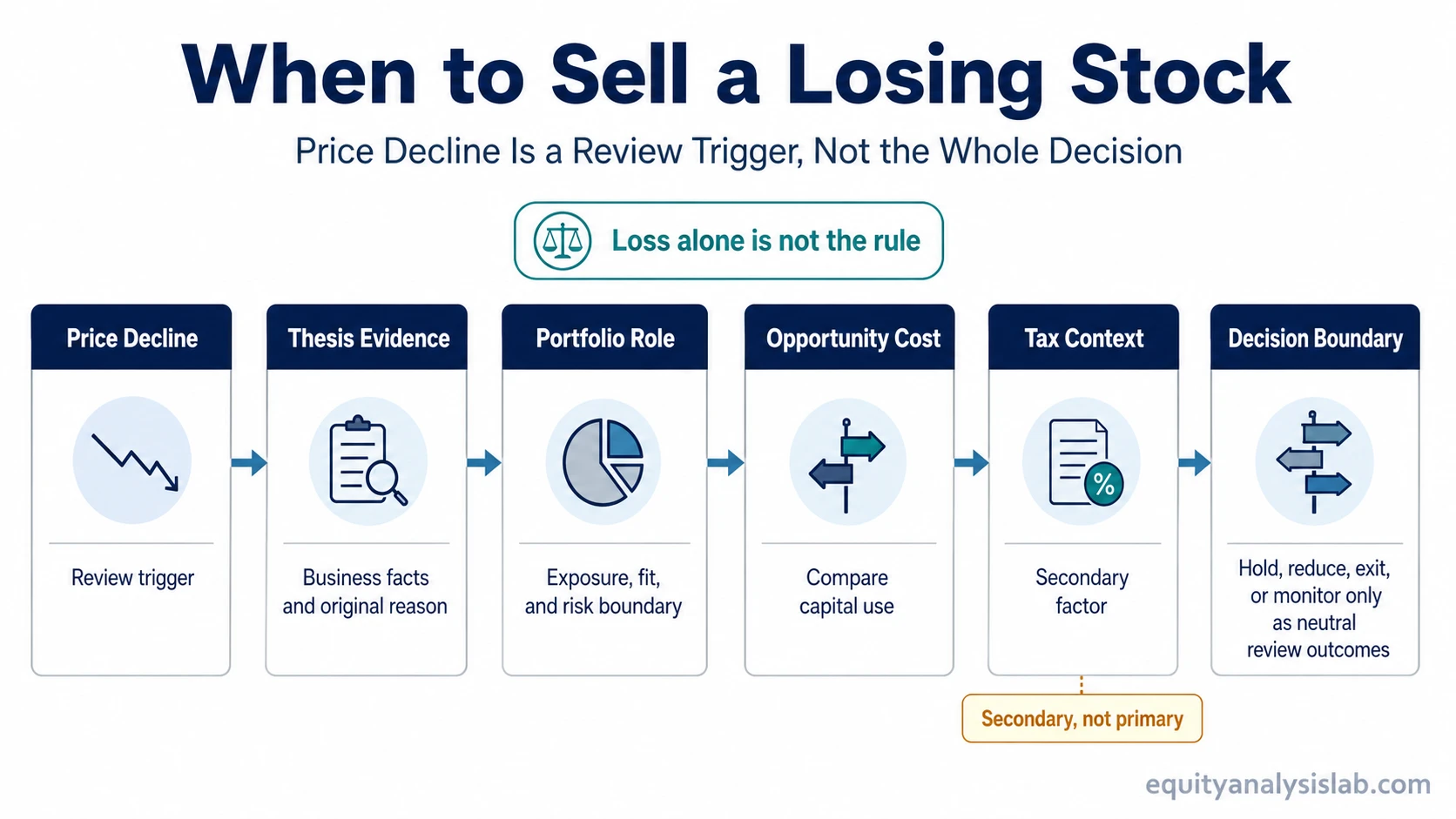
A losing stock deserves a sell review when the price decline is paired with weaker thesis evidence, business deterioration, a changed portfolio role, excessive exposure, or a better opportunity cost. The loss itself is not a complete sell rule.
The useful question is not only whether the position is below cost. The better question is whether the original reason for owning it still holds. A stock can be down while the business case remains intact, or it can be down because the facts behind the investment thesis have changed.
That distinction keeps the review focused on evidence rather than discomfort. Price can create urgency, but thesis quality, business durability, valuation context, portfolio fit, and decision discipline determine whether the loss has changed the investment case.
Key Points
- A losing stock is a review trigger, not an automatic sell rule.
- The decision changes when thesis evidence, business quality, portfolio role, or opportunity cost changes.
- Tax-loss harvesting can matter, but it should not replace the investment rationale.
- No universal percent-loss rule fits every stock, thesis, portfolio, and time horizon.
When a Losing Stock Deserves a Sell Review
A losing position deserves a structured review when the decline points to a possible change in the underlying case. The review becomes more serious if revenue quality weakens, margins deteriorate, debt risk rises, competitive position erodes, management guidance changes, or the valuation gap is no longer supported by fundamentals.
Portfolio context also matters. A small losing position can be a manageable thesis review, while a large losing position can create a different problem if it damages the portfolio beyond the original risk plan. Exposure size can change the decision context even when the company-specific facts are still mixed, which makes position sizing part of the review.
Opportunity cost adds another layer. Capital tied to a weak or uncertain thesis may prevent the investor from using the same capital in a better-supported idea. That does not automatically decide the outcome, but it makes the comparison more explicit.
Price Decline vs Thesis Break
A price decline is observable. A thesis break is analytical. The first tells the investor that the market value has moved against the position. The second means the reason for owning the stock has lost support.
Price decline: the stock trades below the investor’s cost or below a prior reference point.
Thesis break: the business, valuation, risk, or portfolio logic that justified ownership is no longer supported by the evidence.
This separation matters because a losing stock can remain analytically valid if the business case is intact and the valuation still leaves a reasonable buffer between price and value. That buffer is related to a margin of safety, but it still depends on the quality of the thesis, not on the loss alone.
The opposite can also be true. A smaller loss can deserve a more serious review if the business evidence has clearly worsened. The size of the loss is less important than what the loss now says about the original assumptions.
Signals That Can Change the Decision
The review becomes more serious when multiple signals point in the same direction. A falling price by itself can be noise. A falling price combined with weaker fundamentals, reduced confidence in the business model, and a heavier portfolio exposure is a different decision environment.
| Signal | What it may mean | What to review | Page-safe interpretation |
|---|---|---|---|
| Price is below cost | The position is losing money on paper | Original thesis, valuation assumptions, and time horizon | The loss starts the review, but does not complete the decision. |
| Business evidence has weakened | The original assumptions may no longer hold | Revenue quality, margins, cash flow, balance sheet risk, and competitive position | A thesis-based review becomes more important than the entry price. |
| Portfolio exposure is too large | The position may now create portfolio-level stress | Concentration, liquidity needs, and risk tolerance | The same company view can carry different risk at a larger exposure size. |
| Better-supported opportunities exist | Capital may have a stronger alternative use | Opportunity cost, thesis strength, and portfolio priorities | A losing stock can be compared with current alternatives rather than only with its cost basis. |
| Tax-loss harvesting is available | A realized loss may have tax relevance | Tax rules, wash-sale considerations, and personal tax context | Tax context is secondary and should not replace investment rationale. |
| The investor wants to wait for break-even | The cost basis may be anchoring the decision | Current evidence versus the original purchase price | Break-even is not evidence that the thesis has recovered. |
Common Mistakes With Losing Stocks
Waiting for break-even without rechecking the thesis: the purchase price can become a psychological anchor. A stock returning to cost does not prove that the business case has repaired itself.
Selling only because the number is red: discomfort is not the same as changed evidence. A loss may reflect short-term repricing, poor initial timing, or a real deterioration in the company.
Holding only to avoid admitting a mistake: loss aversion can make a realized loss feel worse than an unrealized one, even when the current evidence no longer supports the position.
Letting tax logic dominate the investment case: tax-loss harvesting can be relevant, but a tax benefit does not prove that the stock is a poor investment from today’s price.
Using fixed percent rules mechanically: a 10%, 20%, or 30% decline can mean different things depending on valuation, business quality, leverage, time horizon, and position size.
Tax-Loss Harvesting Is Secondary
Tax-loss harvesting can be part of the review, but it should not become the whole review. A tax benefit may make a sale more efficient, but it does not answer whether the company is still attractive, whether the thesis is broken, or whether the position still fits the portfolio.
Tax rules are personal and jurisdiction-specific. Wash-sale rules, holding periods, account type, realized gains, and individual tax circumstances can change the analysis. A losing-stock review should treat tax context as a secondary factor and separate it from the investment rationale.
The investment question and the tax question can point in the same direction, but they are not the same question. A tax-driven sale can still require a separate decision about whether the investor wants similar exposure later, a different replacement idea, or no replacement at all.
When Not to Sell Only Because the Stock Is Down
A decline alone may not justify selling if the original thesis remains supported, the business evidence is stable, the valuation case has improved rather than deteriorated, and the position still fits the intended portfolio role. In that case, the review may lead to continued monitoring rather than an immediate exit.
The important condition is discipline. Holding a losing stock because the thesis remains intact is different from holding because the investor does not want to realize a loss. That kind of process discipline is part of a repeatable investment process.
A losing position can still deserve continued monitoring when the original evidence remains intact, the valuation gap still exists, and the exposure does not create unacceptable portfolio stress. The conclusion can also remain unresolved if the evidence is mixed.
A Compact Review Scenario
An investor owns a stock that has fallen below the purchase price. The first review separates the market loss from the company evidence. If the business outlook, cash flow profile, and valuation case remain broadly consistent with the original thesis, the decline alone does not settle the decision.
The review changes if the same decline is paired with weaker business performance, a thinner valuation buffer, heavier portfolio exposure, or a better-supported use of capital. The useful output is not a mechanical sell rule. It is a clearer decision boundary between temporary loss, broken thesis, and unresolved evidence.
No Universal Percent-Loss Rule Works for Every Investor
A fixed percentage loss can be useful as a personal review trigger, but it is not a universal answer to when to sell a losing stock. The same percentage decline can mean different things depending on the company, valuation, balance sheet, portfolio role, time horizon, and evidence behind the original thesis.
No rule can guarantee that selling improves the future outcome. A stock can recover after being sold, and a held position can continue to deteriorate. The stronger process is to review the thesis, business evidence, portfolio exposure, opportunity cost, and tax context without turning any single factor into a mechanical answer.
This is educational analysis, not individualized investment, tax, or legal advice.
FAQ
Should I sell a stock just because it is down?
No. A stock being down is a reason to review the position, not a complete sell rule. The review should focus on whether the thesis, business evidence, portfolio role, opportunity cost, or tax context has changed.
Is tax-loss harvesting a reason to sell a losing stock?
Tax-loss harvesting can be a relevant secondary factor, but it should not replace the investment review. Tax rules, wash-sale issues, and individual circumstances require separate tax context.
What if I still believe in the company?
Continued belief needs current evidence. If the original thesis remains supported, the portfolio exposure is appropriate, and the valuation case still makes sense, the loss alone may not settle the decision. If the facts have changed, conviction should be rechecked.