
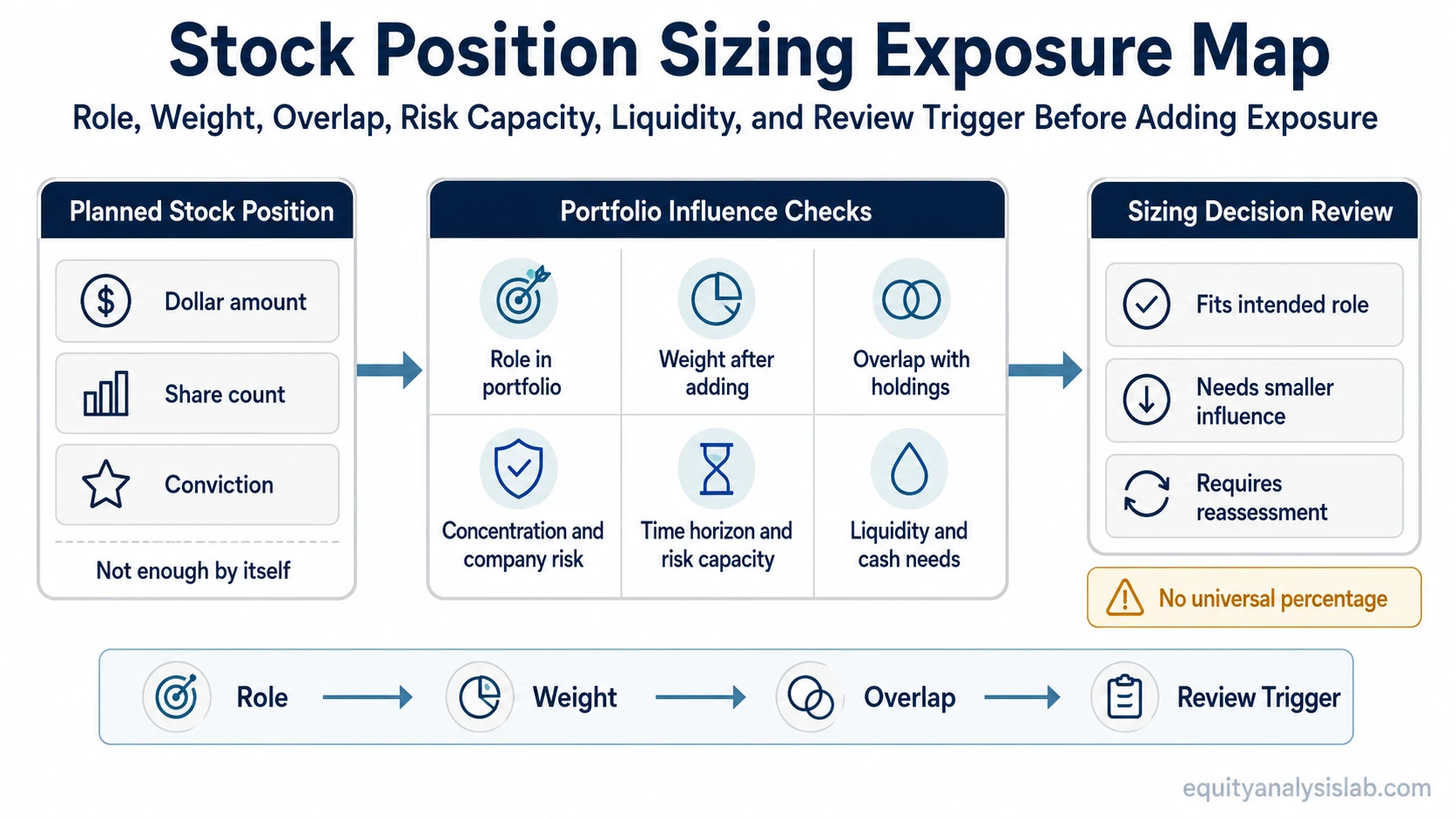
To size a stock position, decide how much influence one company should have inside the whole portfolio before adding or increasing exposure.
A stock position size is the portfolio weight or exposure assigned to one company. The useful question is not only how many shares to buy or how many dollars to commit. The better starting point is whether that company’s role, risk, overlap, liquidity, time horizon, and review discipline justify the influence it will have.
Key Points
- Stock position size is portfolio influence, not just share count or dollar amount.
- The same dollar position can be small in one portfolio and dominant in another.
- Overlap with existing holdings can make a position more influential than it first appears.
- Risk capacity, time horizon, liquidity, and review rules change what size is tolerable.
- No universal percentage can reliably fit every investor, company, and portfolio.
What Sizing a Stock Position Really Means
Sizing a stock position means assigning one company a defined level of influence within the portfolio. That influence should fit the broader asset allocation plan rather than being judged only by conviction, share price, or available cash.
For investors, stock position sizing is different from a short-term trade-risk formula. A formula based on account size and stop distance may help traders define trade risk, but a long-term stock position also changes business exposure, sector exposure, factor exposure, liquidity needs, and portfolio drawdown behavior.
Compact definition: A stock position size is the weight or exposure assigned to one company inside a portfolio, measured by how much that company can affect total portfolio behavior.
What Evidence Is Needed Before the Size Makes Sense
Several inputs matter before a position size can be judged. The main question is whether the planned exposure fits the portfolio role, risk, overlap, liquidity, time horizon, and review discipline.
| Input checked | Why it matters | What can go wrong if ignored |
|---|---|---|
| Current portfolio weight | Shows how much of the total portfolio one company will control after the position is added or increased. | A position can feel moderate in dollars while becoming too large as a share of the whole portfolio. |
| Intended role | Clarifies whether the holding is meant to be a core position, a smaller satellite idea, or a limited exposure. | A speculative or uncertain thesis can receive core-position influence by accident. |
| Company-specific risk | Connects the size to business quality, balance-sheet risk, earnings durability, valuation risk, and thesis uncertainty. | Conviction can hide fragile assumptions, weak cash flow, dilution risk, or dependence on one catalyst. |
| Overlap with existing holdings | Checks whether other holdings already depend on the same sector, factor, business model, customer base, or economic condition. | The new position can duplicate existing exposure instead of adding real diversification. |
| Sector and factor exposure | Shows whether the position increases dependence on one area of the market or one return driver. | The portfolio can become more top-heavy or cyclical than the holding count suggests. |
| Liquidity | Helps determine whether the position can be adjusted without creating unwanted friction or forced-sale risk. | An oversized position in a less liquid stock can become hard to reduce when conditions change. |
| Time horizon | Links the size to how long the investor can tolerate business uncertainty, valuation swings, and thesis development. | A long-horizon idea can be sized as if it only needs short-term confirmation. |
| Risk capacity | Tests whether the investor can absorb the downside impact if the thesis is wrong or delayed. | The position may be mathematically small but still too large relative to financial or emotional capacity. |
| Cash-flow needs | Checks whether near-term cash requirements could force a sale before the investment thesis has time to develop. | A position can become risky because the portfolio needs liquidity at the wrong time. |
| Review and rebalancing rule | Defines when the position should be reviewed because of drift, thesis change, valuation change, or exposure overlap. | A position can grow or shrink into a different role without a clear review trigger. |
Why Shares and Dollars Are Not Enough
Share count can be misleading because different stocks have different prices, volatility profiles, liquidity, and business risks. Dollar amount is better, but it still does not explain how much the position changes the whole portfolio.
A $5,000 position has a different meaning in a $25,000 portfolio than it has in a $500,000 portfolio. The same dollar amount also means different things if the rest of the portfolio already depends on similar companies, similar earnings drivers, or the same market cycle. Position size is therefore a portfolio-level question, not just a transaction-size question.
Common Mistake: Sizing Without Checking Overlap
A common mistake is treating a new stock as separate exposure because it has a different ticker. The portfolio may already own several companies that depend on the same economic driver, customer behavior, sector cycle, or valuation factor. Adding another similar stock can increase concentrated exposure even when the individual position looks modest.
Illustrative scenario: An investor adds a small new position because it represents only a limited dollar amount. The problem is that several existing holdings already depend on the same sector and growth expectations. The new stock does not add a separate source of portfolio behavior; it increases the influence of an exposure that is already present.
The stronger test is not whether the new holding looks small in isolation. The stronger test is whether the total portfolio becomes more dependent on the same driver after the position is added.
When a Position Size Becomes Too Influential
A stock position becomes too influential when its downside, thesis uncertainty, or overlap can dominate the portfolio more than intended. That does not mean every large position is automatically wrong. It means the size needs stronger evidence, clearer review rules, and a better reason for accepting the influence.
The broader position-size decision should connect the company thesis to the portfolio result. A stronger company case does not remove the need to check exposure. A weaker or less tested thesis usually needs a clearer reason before it is allowed to carry meaningful portfolio influence.
Why Universal Position-Size Percentages Can Mislead
A fixed percentage can be a rough starting point, but it cannot judge every stock position safely. The same percentage can have very different meaning depending on the holding’s role, thesis uncertainty, and overlap with the rest of the portfolio.
Position size depends on context: portfolio role, business risk, valuation risk, existing exposure, liquidity, time horizon, cash needs, and risk capacity. A percentage rule that ignores those inputs can look disciplined while still producing the wrong portfolio influence.
A Practical Sequence for Sizing a Stock Position
- Define the role: decide whether the holding is core, satellite, exploratory, or temporary.
- Measure the weight: check the position as a percentage of the whole portfolio after the position is added or increased.
- Map the overlap: identify whether existing holdings already depend on the same sector, factor, geography, currency, business model, or earnings driver.
- Test the downside: ask how much the portfolio would be affected if the thesis weakens, valuation compresses, or the business risk increases.
- Check the time horizon: match the size to the period over which the thesis is expected to develop.
- Set a review trigger: define what would require reassessment, such as thesis deterioration, unexpected drift, concentration increase, liquidity needs, or a change in risk capacity.
The sequence keeps the decision grounded in portfolio influence. It does not require a single universal percentage, and it does not turn stock sizing into a short-term trade formula.
FAQ
How big should a stock position be?
A stock position should be large enough to match its intended role, but not so large that one company or one repeated exposure controls more of the portfolio than the investor can tolerate. The answer depends on portfolio weight, overlap, company-specific risk, time horizon, liquidity, and risk capacity.
Is position size the same as conviction?
No. Conviction can be one input, but position size should also reflect downside risk, evidence quality, liquidity, portfolio overlap, and the investor’s ability to tolerate a wrong or delayed thesis.
Is a smaller stock position always safer?
Not always. A smaller position can reduce single-company impact, but it may still add hidden exposure if the portfolio already owns similar companies or depends on the same market driver.
Should investors use stop-loss distance to size long-term stock positions?
Stop-loss distance is common in trading frameworks, but long-term stock position sizing also needs portfolio context. Company thesis quality, valuation risk, overlap, liquidity, time horizon, and risk capacity usually matter more than a formula alone.