
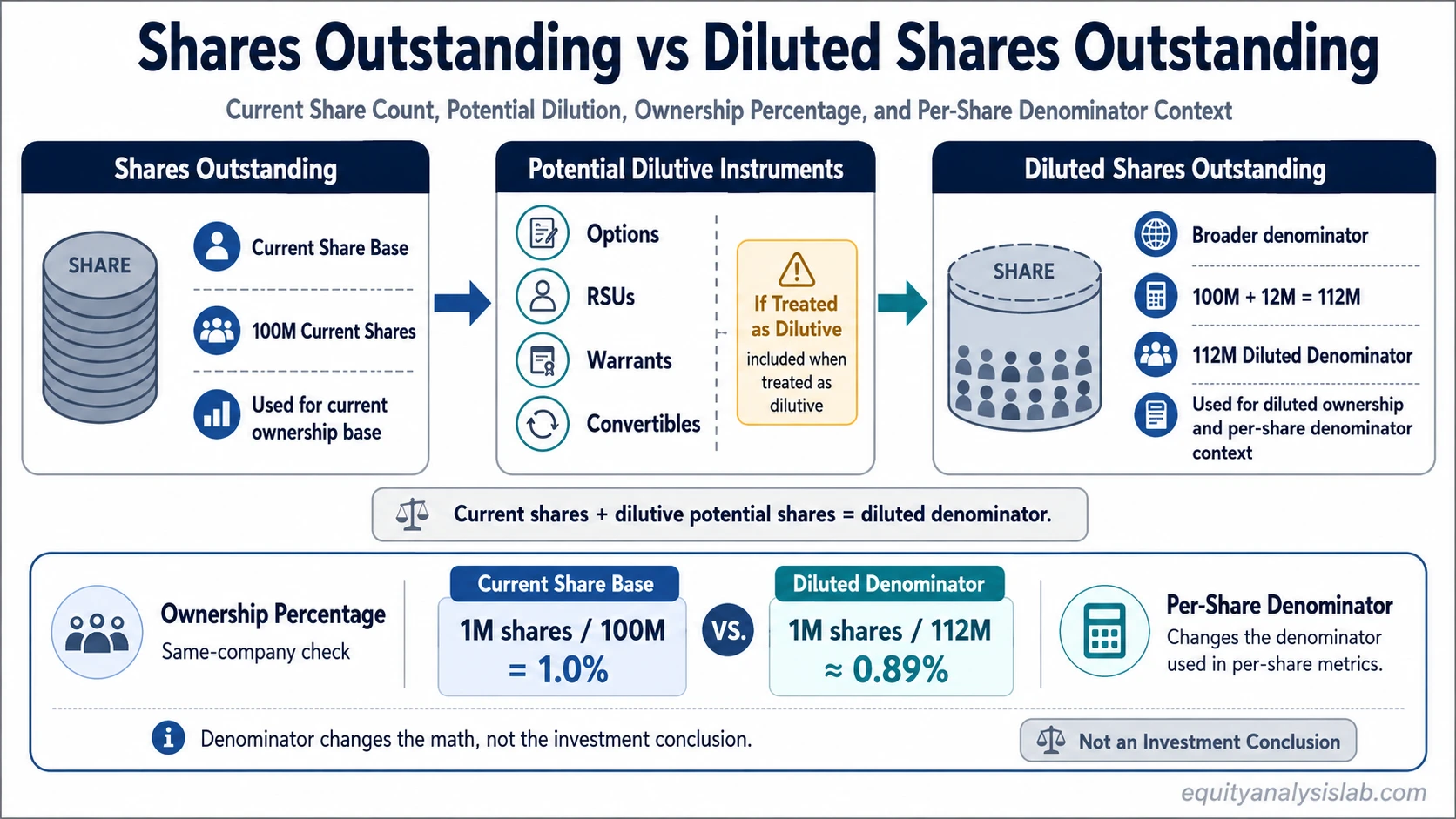
Shares outstanding is the current common share count held by shareholders at a point in time. Diluted shares outstanding is a broader denominator concept that can refer to a larger share base when potential dilution is included.
The distinction matters because ownership percentages, per-share metrics, and valuation denominators can change depending on whether the question is about the current share base, diluted EPS, or a broader dilution scenario.
Key Points
- Shares outstanding represents the current common shares outstanding at a specific point in time.
- Diluted shares outstanding is a broader denominator concept that can include potential shares from dilutive instruments when the context requires it.
- Current shares outstanding, weighted-average diluted shares, and fully diluted analytical share count can all be different for the same company.
- The correct denominator depends on the question being asked.
- Neither denominator proves that a stock is attractive, cheap, expensive, high quality, or likely to perform well.
Shares Outstanding vs Diluted Shares Outstanding: Core Difference
Shares outstanding is the current common share-count base used to describe how many shares are actually outstanding at a point in time.
Diluted shares outstanding is a broader denominator concept used when potential dilution from options, RSUs, warrants, convertibles, or similar instruments is included under a specific reporting or analytical context.
The core difference is that one denominator answers a current share-base question, while the other answers a potential-dilution question. The two figures are related, but they should not be treated as interchangeable.
| Question | Shares outstanding | Diluted shares outstanding | Interpretation boundary |
|---|---|---|---|
| What does it measure? | The current common shares outstanding. | A wider denominator after including potential dilutive shares where relevant. | One is current. The other is broader and context dependent. |
| What does it usually exclude? | Potential future shares that are not currently outstanding. | Anti-dilutive instruments or instruments not included under the relevant method. | The diluted figure is not automatically the maximum possible future share count. |
| Where is it commonly used? | Current ownership, current market cap, and point-in-time share-base analysis. | Diluted EPS, dilution review, and broader per-share analysis. | The right denominator depends on the specific question. |
| What is the main misuse? | Treating the current count as if future dilution cannot matter. | Treating the diluted figure as if those shares are already outstanding today. | Both errors can distort ownership and per-share interpretation. |
Three Share Counts That Are Often Confused
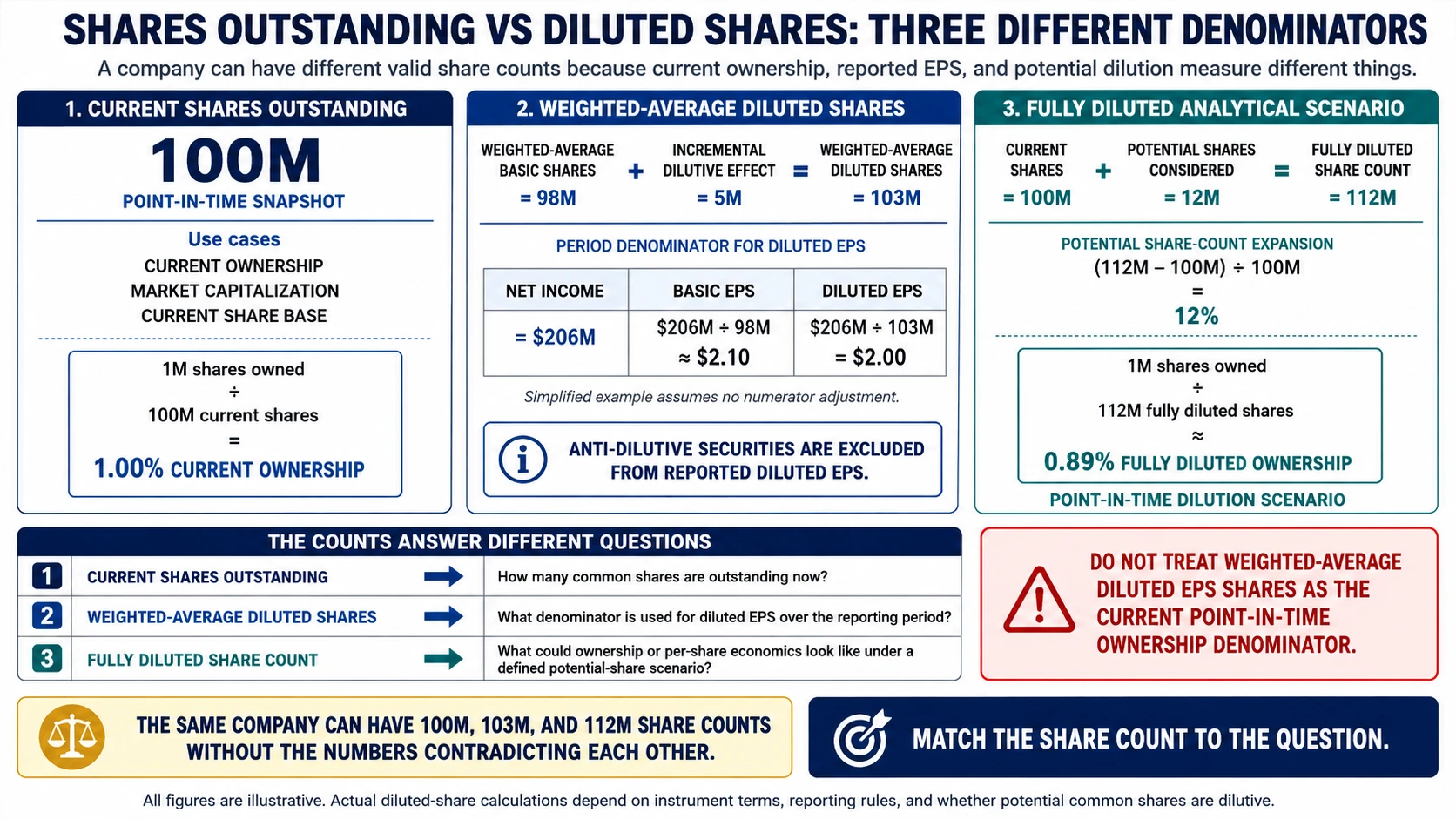
A company can have more than one valid share count without any contradiction. The confusion usually comes from mixing a point-in-time share count, a reporting-period EPS denominator, and a broader analytical dilution scenario.
| Share Count | Measurement Basis | Main Use |
|---|---|---|
| Current shares outstanding | Point-in-time snapshot | Current ownership and market-cap analysis |
| Weighted-average diluted shares | Reporting-period denominator | Reported diluted EPS |
| Fully diluted share count | Analytical dilution scenario | Potential ownership dilution and broader per-share review |
The three numbers answer different questions. The same company can therefore have different valid share counts at the same time without those numbers being inconsistent.
Same Company, Three Different Denominators
Consider an illustrative company with 100 million current shares outstanding. During the reporting period, the weighted-average basic share count is 98 million, and the incremental dilutive effect from eligible instruments is 5 million shares. Separately, an analytical fully diluted scenario considers 12 million potential shares.
| Measure | Illustrative Amount | What It Means |
|---|---|---|
| Current shares outstanding | 100 million | Current point-in-time common share base |
| Weighted-average basic shares | 98 million | Basic EPS denominator for the reporting period |
| Incremental dilutive effect | 5 million | Additional shares included in the diluted EPS denominator |
| Weighted-average diluted shares | 103 million | Diluted EPS denominator for the reporting period |
| Fully diluted analytical share count | 112 million | Current share base plus potential shares considered in a broader dilution scenario |
The same company can therefore have 100 million current shares outstanding, 103 million weighted-average diluted shares for diluted EPS, and 112 million shares in a broader fully diluted analytical scenario.
How the Different Share Counts Change EPS and Ownership
These different denominators affect different calculations. For example, assume net income is $206 million and use a simplified illustration with no numerator adjustment.
Basic EPS = $206 million ÷ 98 million = about $2.10
Diluted EPS = $206 million ÷ 103 million = $2.00
Now assume an investor owns 1 million shares.
Current ownership = 1 million ÷ 100 million = 1.00%
Fully diluted analytical ownership = 1 million ÷ 112 million = about 0.89%
The EPS example and the ownership example answer different questions. The weighted-average diluted EPS denominator should not be treated as if it were the company’s current point-in-time ownership denominator.
Important boundary: Diluted weighted-average shares are a reporting-period EPS denominator. A fully diluted analytical share count is a broader ownership or dilution scenario. They are not automatically the same number.
When Each Share Count Is Used
Shares outstanding is usually the cleaner denominator when the question is about the company’s current share base. It is commonly used for point-in-time ownership percentages and current market capitalization.
Weighted-average diluted shares matter when the question is about reported diluted EPS. In that context, the denominator is built for the reporting period rather than simply using the period-end current share count.
A fully diluted analytical share count matters when the question is broader and focuses on potential ownership dilution or a wider share-base scenario. This is where options, RSUs, warrants, convertibles, and similar instruments become especially relevant.
Why Diluted Shares May Equal Basic Shares
Potentially dilutive instruments do not automatically increase the diluted denominator in every reported period. If the instruments are anti-dilutive under the applicable method, they are excluded from reported diluted EPS.
That means a company can have options, RSUs, warrants, or convertibles outstanding while the diluted EPS denominator still equals the basic EPS denominator in a specific reporting period. The existence of potential dilution and the inclusion of dilutive shares are related but not identical questions.
Common Confusion About Diluted Shares
A common mistake is treating diluted shares outstanding as if every included share is already issued and trading. A diluted denominator is often a reporting or analytical construct rather than a direct statement that those shares are currently outstanding.
The reverse mistake is ignoring potential dilution completely. A company can look less diluted on the current share count while still having meaningful equity awards, warrants, or convertibles that affect ownership and per-share interpretation under a broader share-base review.
What Shares Outstanding and Diluted Shares Can and Cannot Tell Investors
Shares outstanding and diluted shares can help investors understand how current ownership, diluted ownership, and per-share measures may differ. That is useful when reviewing compensation structures, convertible financing, warrants, and broader dilution exposure.
These denominators cannot, by themselves, prove valuation quality, business quality, expected return, management quality, or investment merit. A wider diluted denominator may signal dilution to evaluate, but the full interpretation still depends on earnings, cash flow, capital allocation, growth, and valuation context.
Denominator rule: match the share count to the question being asked.
FAQ
Is diluted shares outstanding the same as shares outstanding?
No. Shares outstanding is the current common share count. Diluted shares outstanding is a broader denominator concept that can include potential shares when a diluted share-base question is being asked.
What is the formula for diluted shares outstanding?
There is no single universal formula that covers every context. For reported diluted EPS, the denominator is usually weighted-average basic shares plus incremental dilutive shares included under the relevant method. In a broader analytical fully diluted scenario, the share count may be built by starting with current shares outstanding and then adding selected potential shares for dilution review.
Is fully diluted share count the same as diluted weighted-average shares?
No. Weighted-average diluted shares are used for reported diluted EPS during a reporting period. A fully diluted share count is a broader analytical scenario used to review potential ownership dilution and related per-share effects.
Why can diluted shares equal basic shares?
Diluted shares can equal basic shares when potential common shares are anti-dilutive in the reporting period and are therefore excluded from reported diluted EPS.