
Quality of earnings evaluates how reliable and sustainable reported profit is after checking cash support, recurring and nonrecurring items, accruals, and accounting judgment. It focuses on whether the earnings number reflects repeatable operating performance rather than only the size of reported profit.
Quality of earnings is a financial-statement interpretation concept that asks whether reported earnings are supported by repeatable operations, cash generation, and accounting assumptions that appear reasonable for the business.
A company can report positive net income while the support behind that income is weaker than the headline number suggests. One-time gains, revenue timing, aggressive estimates, unusual expense classification, working-capital movements, or weak cash conversion can all change how reported profit should be interpreted.
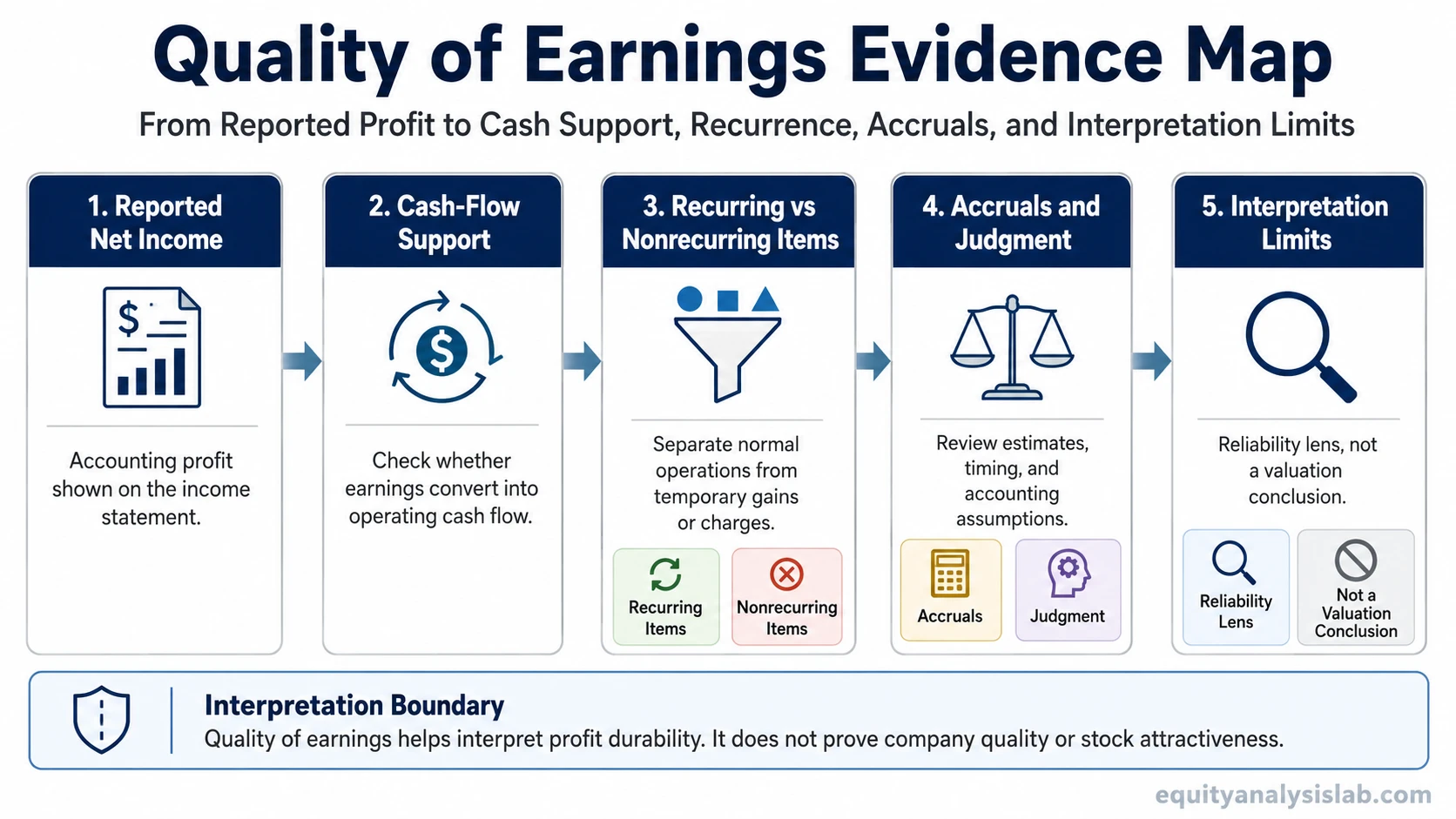
Key Points
- Quality of earnings evaluates the support and repeatability behind reported profit.
- Operating cash flow can be compared with net income as an initial cash-support check.
- A large gap between accounting profit and operating cash flow requires explanation, not an automatic negative conclusion.
- Nonrecurring gains, working-capital timing, and accounting estimates can change the interpretation of one reporting period.
- High earnings quality does not by itself prove that a stock is attractive or undervalued.
What Quality of Earnings Means
Quality of earnings focuses on the source and durability of reported profit. Earnings generally deserve more confidence when they come from recurring operations, are supported by cash generation over time, and do not depend heavily on unusual gains or judgment-sensitive accounting assumptions.
| What It Evaluates | What It Does Not Establish |
|---|---|
| Whether profit appears repeatable and supported by normal operations. | Whether the stock is undervalued or attractive at its current price. |
| Whether accounting earnings are supported by operating cash flow and collections. | Whether future cash flow or earnings are guaranteed. |
| Whether unusual items, accruals, or estimates materially influence reported profit. | Whether the entire business is high quality or low risk. |
Quality of Earnings vs Reported Net Income
Reported net income is the accounting profit shown on the income statement. Quality of earnings examines what created that profit and whether the same economic drivers are likely to support it beyond the current reporting period.
Net income can be positive while cash collection weakens, receivables rise faster than revenue, a one-time gain increases profit, or non-cash accounting estimates become more important. None of those conditions proves that reported earnings are improper, but each creates a reason to investigate the earnings base more closely.
The income statement records recognized revenue and expenses. The cash-flow statement provides a second view by showing how much operating cash the business generated during the period. Comparing the two is one of the starting points for earnings-quality analysis.
Quality of Earnings Ratio: Cash Flow Support
A simple cash-support check compares operating cash flow with reported net income:
Cash-support ratio = Operating Cash Flow ÷ Net Income
Assume a company reports $100 million of net income and $35 million of operating cash flow.
$35 million ÷ $100 million = 0.35x
In this illustrative period, the company generated $0.35 of operating cash flow for each $1.00 of reported net income.
The 0.35x result is a diagnostic signal rather than a mechanical earnings-quality score. A single period can be affected by receivable timing, inventory changes, supplier payments, taxes, seasonality, restructuring, and other working-capital movements. Net income that is close to zero or negative can also make the ratio difficult or impossible to interpret meaningfully.
Simple Cash-Earnings Gap
The same example can also be viewed as a difference between reported net income and operating cash flow:
Cash-earnings gap = Net Income – Operating Cash Flow
$100 million – $35 million = $65 million
The $65 million gap is not automatically evidence of weak accounting or poor earnings quality. It identifies an amount that needs explanation. The analyst can then trace whether the difference comes from working capital, non-cash expenses, unusual gains, taxes, or other accounting effects.
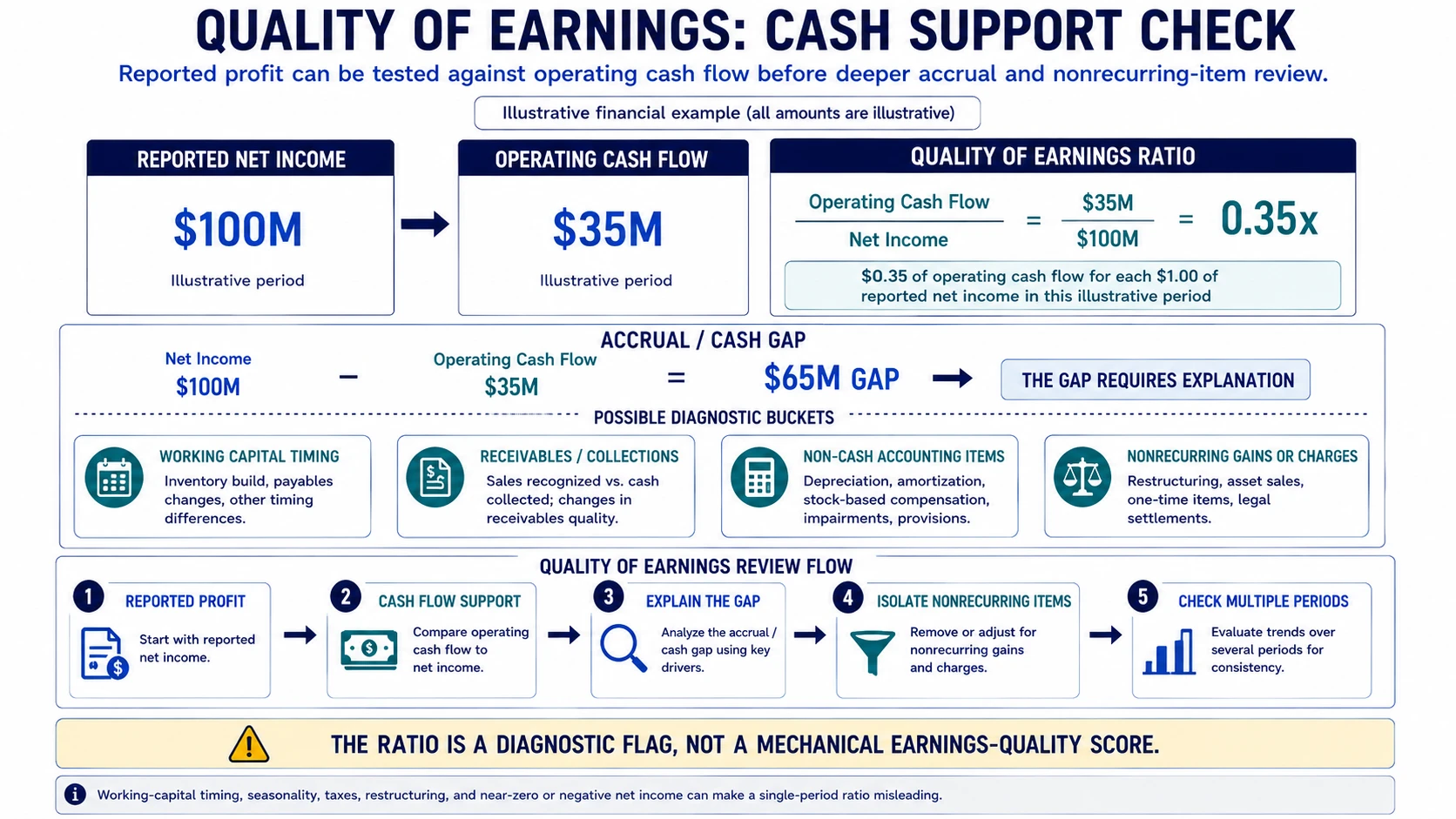
How to Investigate the Gap Between Earnings and Cash Flow
A difference between net income and operating cash flow becomes useful when the analyst traces what created it. The sequence is more informative than treating one ratio as a pass-or-fail test.
| Step | Question |
|---|---|
| 1. Start with reported profit | How much net income did the company report? |
| 2. Compare operating cash flow | How much operating cash flow supported that profit during the period? |
| 3. Explain working-capital movements | Did receivables, inventory, payables, or other operating balances create the difference? |
| 4. Isolate nonrecurring items | Did an asset sale, restructuring charge, tax item, settlement, or other unusual event affect profit? |
| 5. Review accounting estimates | Did reserves, capitalization, depreciation, allowances, or other judgment-heavy assumptions materially affect earnings? |
| 6. Compare multiple periods | Does the gap reverse, persist, or become larger over time? |
Same Net Income, Different Earnings Support
Two companies can report the same net income while the evidence supporting that profit looks very different.
| Comparison | Company A | Company B |
|---|---|---|
| Net income | $100 million | $100 million |
| Operating cash flow | $105 million | $45 million |
| Operating cash flow / net income | 1.05x | 0.45x |
| One-time gain included in profit | $5 million | $30 million |
| Receivables versus revenue | Roughly aligned | Receivables growing materially faster |
| Initial analytical response | Cash support appears stronger in this simplified example | Requires deeper review of collections and nonrecurring profit |
The companies report identical headline profit, but the supporting evidence is different. Company B is not automatically a weaker business or an accounting problem. The lower cash conversion, larger one-time gain, and receivables pattern simply create more questions that need to be resolved before the $100 million of net income is treated as a durable earnings base.
Cash Flow, Accruals, and Nonrecurring Items
Accrual accounting allows revenue and expenses to be recognized before or after the related cash movement. That is a normal part of financial reporting. Earnings-quality analysis becomes more important when accruals grow, persist, or require increasingly aggressive assumptions to reconcile profit with the economics of the business.
Working capital can create large temporary differences. Rapid growth may increase receivables or inventory before cash is collected, while changes in supplier payments can temporarily raise or lower operating cash flow. A multi-period review helps distinguish timing effects from a persistent deterioration in cash conversion.
Nonrecurring items require a different adjustment. Asset sales, restructuring charges, legal settlements, tax benefits, inventory write-downs, and other unusual events can materially change one reporting period without representing the normal earnings base.
Audit boundary: A clean audit opinion and high earnings quality are related but different concepts. Financial statements can comply with accounting standards while still requiring investor judgment about sustainability, cash conversion, unusual items, and accounting estimates.
Quality of Earnings Is Not the Same as EPS
EPS measures profit on a per-share basis. Quality of earnings asks whether the underlying profit deserves confidence before the per-share number is interpreted. A company can show rising per-share earnings while earnings quality weakens if the increase depends on nonrecurring gains, lower share count, or accounting estimates rather than stronger recurring operations.
Basic EPS uses the profit available to common shareholders and the weighted average common shares outstanding. The calculation can be correct while leaving a separate analytical question about whether the earnings numerator is recurring and supported by the underlying business.
A diluted EPS calculation includes the effect of potentially dilutive securities where applicable. Dilution can change the per-share result, but it does not determine the quality of the earnings being divided across those shares.
Quality of Earnings Reports and Investor Use
A quality of earnings report is a formal due-diligence analysis commonly used in transaction settings. It examines whether reported earnings are recurring, cash-supported, and affected by unusual, non-operating, or normalization items.
Investors working from public filings can apply a narrower version of the same logic. They can compare earnings with operating cash flow, investigate material working-capital changes, isolate unusual gains and charges, review important accounting estimates, and compare those relationships across several periods.
What Quality of Earnings Cannot Prove
Strong cash conversion and recurring earnings can increase confidence in the reported profit base, but they do not establish valuation, competitive advantage, balance-sheet strength, or future investment returns.
Weak cash conversion in one period also does not establish fraud or permanent deterioration. The difference may come from legitimate working-capital timing, seasonality, acquisition activity, restructuring, taxes, or other temporary effects.
Quality-of-earnings analysis is most useful when it identifies which parts of reported profit deserve more or less confidence and which differences require additional evidence.
FAQ
What is quality of earnings?
Quality of earnings describes how well reported profit is supported by recurring operations, cash generation, and reasonable accounting assumptions. It helps distinguish a durable earnings base from temporary or judgment-sensitive effects.
How is the quality of earnings ratio calculated?
A common cash-support calculation divides operating cash flow by net income. For example, $35 million of operating cash flow divided by $100 million of net income equals 0.35x. The ratio should be investigated in context rather than used as a mechanical score.
What is a quality of earnings report?
A quality of earnings report is a formal due-diligence analysis that examines whether reported earnings are recurring, cash-supported, and affected by unusual or non-operating items. Investors can apply similar principles when reviewing public financial statements.