
ROE measures profit relative to shareholders’ equity, while ROIC measures operating profit relative to the broader capital invested in the business. The useful distinction is that ROE can look strong when the equity base is small or compressed, while ROIC tests how efficiently the company uses a broader operating capital base.
Return on equity is mainly an equity-holder profitability measure. Return on invested capital is a broader capital-efficiency measure. They can point in the same direction, but they can also tell different stories when leverage, buybacks, accounting losses, write-downs, or capital intensity change the denominator.
Key Points
- ROE compares net income with average shareholders’ equity.
- ROIC usually compares NOPAT with a consistently defined invested-capital base.
- High ROE can be amplified by leverage, buybacks, or a small equity denominator.
- ROIC helps test broader operating capital efficiency, but its result depends on how NOPAT and invested capital are defined.
- Before comparing ROE and ROIC, check whether either denominator is economically meaningful and measured consistently.
What ROE and ROIC Measure Differently
ROE asks how much net income a company produces for each dollar of shareholders’ equity. ROIC asks how much operating profit a company produces for the capital used in the operating business, including equity and debt-like capital depending on the methodology.
The difference matters because shareholders’ equity can shrink for reasons that do not automatically mean the operating business improved. Buybacks, accumulated losses, write-downs, leverage, and other capital-structure decisions can change the equity base. ROIC reduces some of that equity-specific denominator effect by using a broader capital measure, but ROIC still requires judgment about what belongs in NOPAT and invested capital.
Core distinction: ROE is an equity-base return measure. ROIC is an operating capital-efficiency measure. ROE focuses on profit relative to common shareholders’ accounting equity, while ROIC focuses on operating profit relative to capital employed in the business.
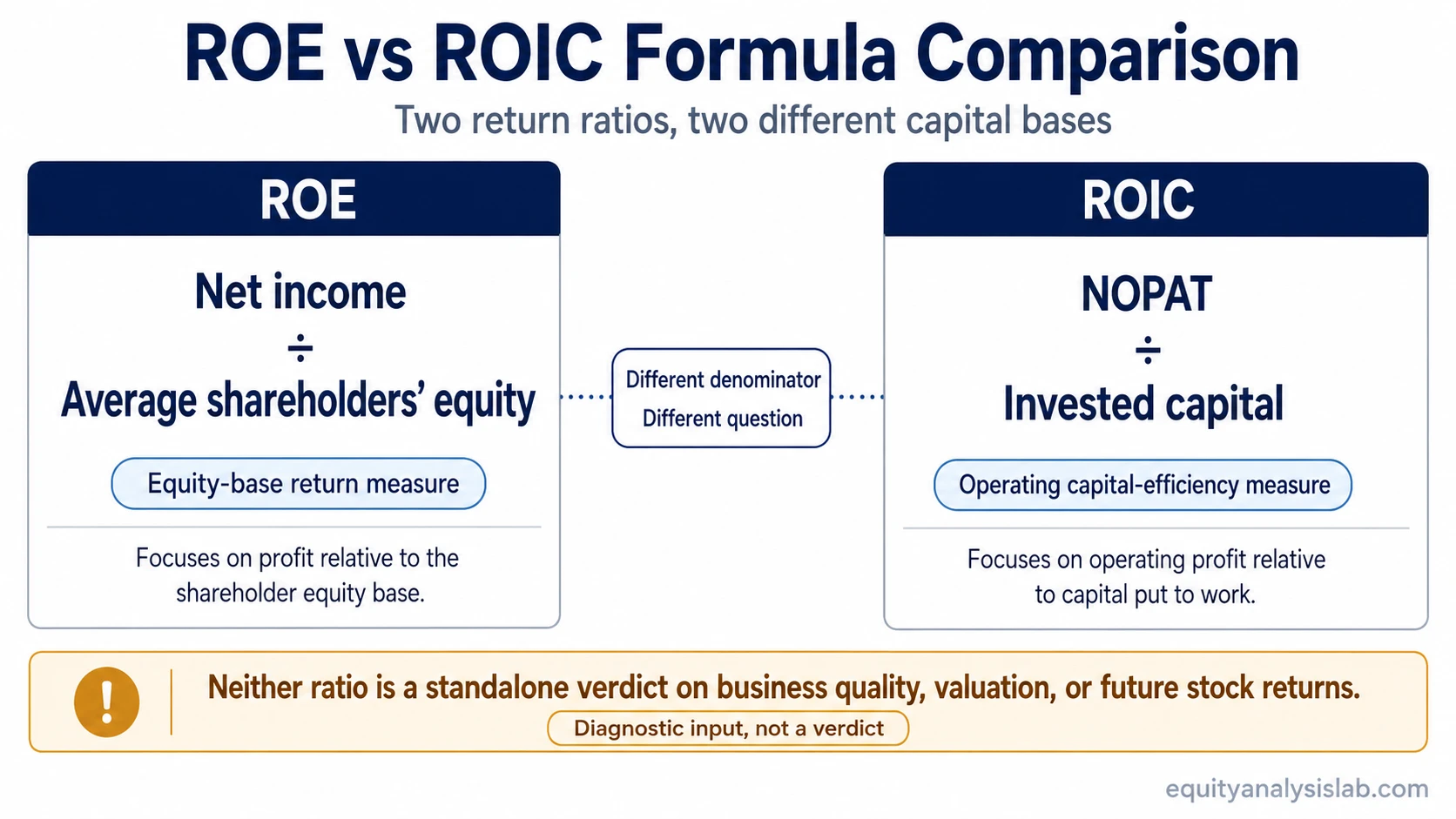
ROE vs ROIC Comparison Table
| Criterion | ROE | ROIC |
|---|---|---|
| Full name | Return on equity | Return on invested capital |
| Basic formula | Net income ÷ average shareholders’ equity | Commonly NOPAT ÷ average invested capital |
| Main numerator | Net income after interest, taxes, and non-operating items | Net operating profit after tax, before financing structure effects |
| Main denominator | Shareholders’ equity | Operating capital invested in the business |
| Main question answered | How much profit is generated relative to the equity base? | How efficiently does the operating business generate profit from capital employed? |
| Common denominator issue | Can become unusually high when equity is reduced by buybacks, losses, write-downs, or leverage | Can vary materially depending on treatment of cash, goodwill, leases, acquisitions, and other adjustments |
| Best use | Understanding profitability relative to a meaningful and reasonably stable equity base | Comparing operating capital efficiency across different capital structures and reinvestment profiles |
Why ROE and ROIC Can Disagree
ROE and ROIC can disagree because they use different numerators and denominators. ROE includes financing effects because net income is measured after interest expense. ROIC usually starts from operating profit after tax, so it is designed to evaluate the operating business before the final effect of capital structure.
The denominator can create an even larger difference. If shareholders’ equity falls while earnings remain stable, ROE rises mechanically. A company that repurchases shares, accumulates accounting losses, records large write-downs, or shifts more financing toward debt can therefore report a much stronger ROE without a comparable improvement in operating capital efficiency.
ROIC can provide a useful second perspective because it measures returns against a broader capital base. It is not immune to denominator problems, however. Different treatments of excess cash, acquired goodwill, leases, restructuring charges, or other operating adjustments can produce different ROIC estimates for the same company.
Check the Denominator Before Comparing ROE and ROIC
The quality of the denominator can matter as much as the reported percentage. Before interpreting a large ROE or ROIC gap, check whether the capital base is stable, economically meaningful, and measured consistently with the numerator.
| Diagnostic Check | ROE | ROIC |
|---|---|---|
| Period matching | Period net income is usually compared with average shareholders’ equity. | Period NOPAT is commonly compared with average invested capital when the required data are available. |
| Very small denominator | A small equity base can produce an unusually large ROE from ordinary earnings. | The broader invested-capital base may remain larger, so the same distortion may be less severe. |
| Negative equity | The percentage can become difficult to interpret because a negative denominator reverses the normal economic meaning of the ratio. | ROIC may still be interpretable if the invested-capital definition remains positive and economically meaningful. |
| Share repurchases | Buybacks reduce book equity and can mechanically raise ROE if earnings do not fall proportionally. | The effect depends on how the repurchase is financed and how cash and financing items are treated in invested capital. |
| Write-downs and accumulated losses | Past accounting losses or charges can compress the current book equity base. | Some charges can also affect invested capital, but the measurement path is different and may require adjustments. |
| Excess cash and non-operating assets | They remain part of the accounting balance-sheet structure reflected in shareholders’ equity. | Some ROIC methodologies exclude excess cash or other non-operating assets from invested capital. |
Denominator integrity check: a high return ratio is most informative when the capital base is positive, economically meaningful, consistently defined, and not unusually compressed by accounting or financing effects.
When Near-Zero or Negative Equity Makes ROE Hard to Read
ROE becomes especially sensitive when shareholders’ equity approaches zero. If a company earns $50 million while average equity is $500 million, ROE is 10%. If the same earnings are measured against only $50 million of average equity, ROE becomes 100% even though net income did not change.
If shareholders’ equity becomes negative, the percentage can become even less intuitive. A profitable company divided by negative equity can report a negative ROE, while a loss divided by negative equity can mathematically produce a positive percentage. Those outcomes do not carry the normal interpretation of profitability relative to a positive shareholder capital base.
In these cases, the investor should inspect why equity became small or negative before using ROE for peer comparison. Buybacks, accumulated losses, write-downs, acquisition accounting, dividends, and leverage can all contribute to an unusual equity denominator.
Interpretation boundary: negative or near-zero equity does not automatically make the company weak or strong. It makes conventional ROE harder to interpret and increases the importance of balance-sheet context and alternative capital-efficiency measures.
Illustrative Example: Same Operating Return, Higher ROE
Consider a simplified example designed to isolate the denominator effect.
| Metric | Period 1 | Period 2 |
|---|---|---|
| Net income | $100 million | $100 million |
| Average shareholders’ equity | $500 million | $350 million |
| ROE | 20.0% | 28.6% |
| NOPAT | $120 million | $120 million |
| Average invested capital | $900 million | $900 million |
| ROIC | 13.3% | 13.3% |
ROE rises from 20.0% to about 28.6% because the illustrative equity denominator falls from $500 million to $350 million. Net income does not improve. In the same simplified scenario, NOPAT and invested capital remain unchanged, so ROIC stays at about 13.3%.
ROE: 20.0% → 28.6%
ROIC: 13.3% → 13.3%
The example isolates the denominator mechanism rather than modeling a real transaction. In practice, a buyback, debt issuance, acquisition, write-down, or cash distribution can also affect invested capital, interest expense, NOPAT, and future earnings. The investor should therefore reconstruct the actual balance-sheet changes rather than assume that every ROE increase caused by a smaller equity base leaves ROIC unchanged.
When ROE Is More Useful
ROE is useful when the analytical question is specifically about accounting profit relative to shareholders’ equity. It becomes more informative when the equity base is positive and meaningful, earnings quality is reasonably strong, and comparisons are made across businesses with similar accounting and capital-structure characteristics.
ROE can be particularly useful in sectors where equity capital is central to the business model, although financial companies often require sector-specific interpretation because leverage and balance-sheet structure play a different economic role than they do for ordinary operating companies.
Useful ROE context: check whether earnings are recurring, whether equity has been compressed by buybacks or accumulated losses, and whether debt or other financing has changed the amount of equity supporting the business.
When ROIC Is More Useful
ROIC is useful when the main question is whether the operating business earns attractive profit on the broader capital required to run it. That makes it useful for comparing companies with different leverage profiles, reinvestment needs, or levels of capital intensity.
A company with strong ROE but much weaker ROIC may be benefiting from a small equity denominator. Strong ROIC provides evidence that the operating business itself is earning meaningful profit relative to the capital employed, although the conclusion still depends on how NOPAT and invested capital are defined.
ROIC is also often compared with the company’s cost of capital. A positive spread can support a value-creation argument, but the interpretation depends on the durability of returns, reinvestment opportunities, accounting adjustments, and the reliability of both calculations.
How to Read ROE and ROIC Together
Reading both ratios side by side can help separate operating efficiency from equity-base effects. The comparison is most useful after checking the quality of both numerators and denominators.
| ROE / ROIC Pattern | Possible Interpretation | What to Check Next |
|---|---|---|
| High ROE and high ROIC | The company may be generating strong returns relative to both shareholder equity and broader operating capital. | Check durability, reinvestment runway, peer comparison, and valuation. |
| High ROE but lower ROIC | The equity return may be amplified by leverage, buybacks, write-downs, or a small book equity base. | Check debt, buyback history, equity changes, accounting charges, and invested-capital definitions. |
| Low ROE but stronger ROIC | The operating business may be more efficient than the shareholder-equity return initially suggests. | Check equity size, unusual accounting items, excess cash, capital structure, and temporary profit effects. |
| Low ROE and low ROIC | The business may be earning weak returns on both equity and broader invested capital. | Check margin structure, asset intensity, competitive pressure, and capital allocation. |
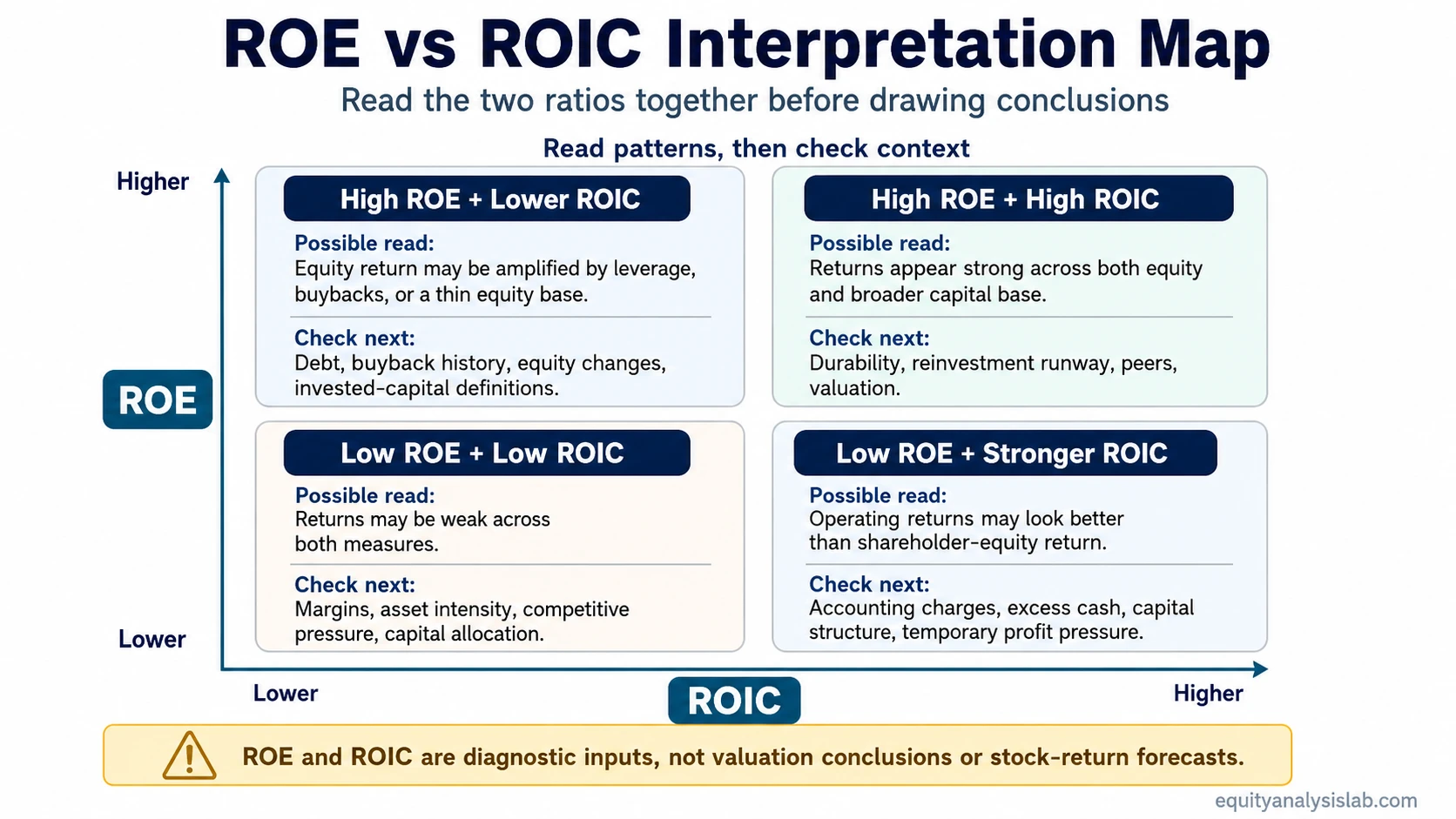
What ROE and ROIC Do Not Tell You
ROE and ROIC are profitability and capital-efficiency measures, not complete investment conclusions. They do not tell whether a stock is cheap, whether earnings will grow, whether competitive advantages will persist, or whether management will allocate future capital well.
The interpretation weakens when the numerator is temporary, the denominator is distorted, or the business requires heavy reinvestment that the ratio does not fully explain. A return ratio can look strong while cash conversion deteriorates, debt rises, competitive pressure increases, or valuation already assumes unusually strong future performance.
Investor-use boundary: use ROE and ROIC as diagnostic inputs. Neither ratio is a standalone verdict on business quality, balance-sheet safety, valuation, or expected stock returns.
Which Ratio Should Investors Use?
The choice depends on which capital base matches the analytical question. ROE and ROIC are complementary measures rather than substitutes in every situation.
| Investor Question | Better Starting Lens | Why |
|---|---|---|
| How profitable is the company relative to shareholders’ equity? | ROE | ROE directly compares net income with the equity base. |
| How efficiently does the operating business use capital? | ROIC | ROIC compares operating profit with a broader invested-capital base. |
| Could leverage, buybacks, or a compressed equity base be amplifying the return? | ROE and ROIC together | The gap can reveal whether the equity-base return is materially stronger than the operating capital return. |
| Is shareholders’ equity near zero or negative? | ROIC plus balance-sheet analysis | Conventional ROE can become difficult to interpret when its denominator is extremely small or negative. |
| Is the company attractive at the current price? | Neither ratio alone | Valuation requires price, cash flows, growth expectations, risk, and durability of returns. |
FAQ
Is ROIC better than ROE?
No. ROE is designed to measure profitability relative to shareholders’ equity, while ROIC focuses on operating returns relative to a broader capital base. The useful ratio depends on the question and the quality of the underlying denominator.
What happens to ROE when shareholders’ equity is negative?
Conventional ROE can become difficult to interpret because a negative denominator changes the normal meaning of the percentage. Investors should investigate why equity is negative and use additional balance-sheet and capital-efficiency measures rather than interpreting the ROE percentage in isolation.
Why can ROE rise without an improvement in ROIC?
ROE can rise because shareholders’ equity falls while earnings remain relatively stable. Buybacks, write-downs, accumulated losses, or changes in financing can reduce the equity denominator without producing the same improvement in operating capital efficiency.