
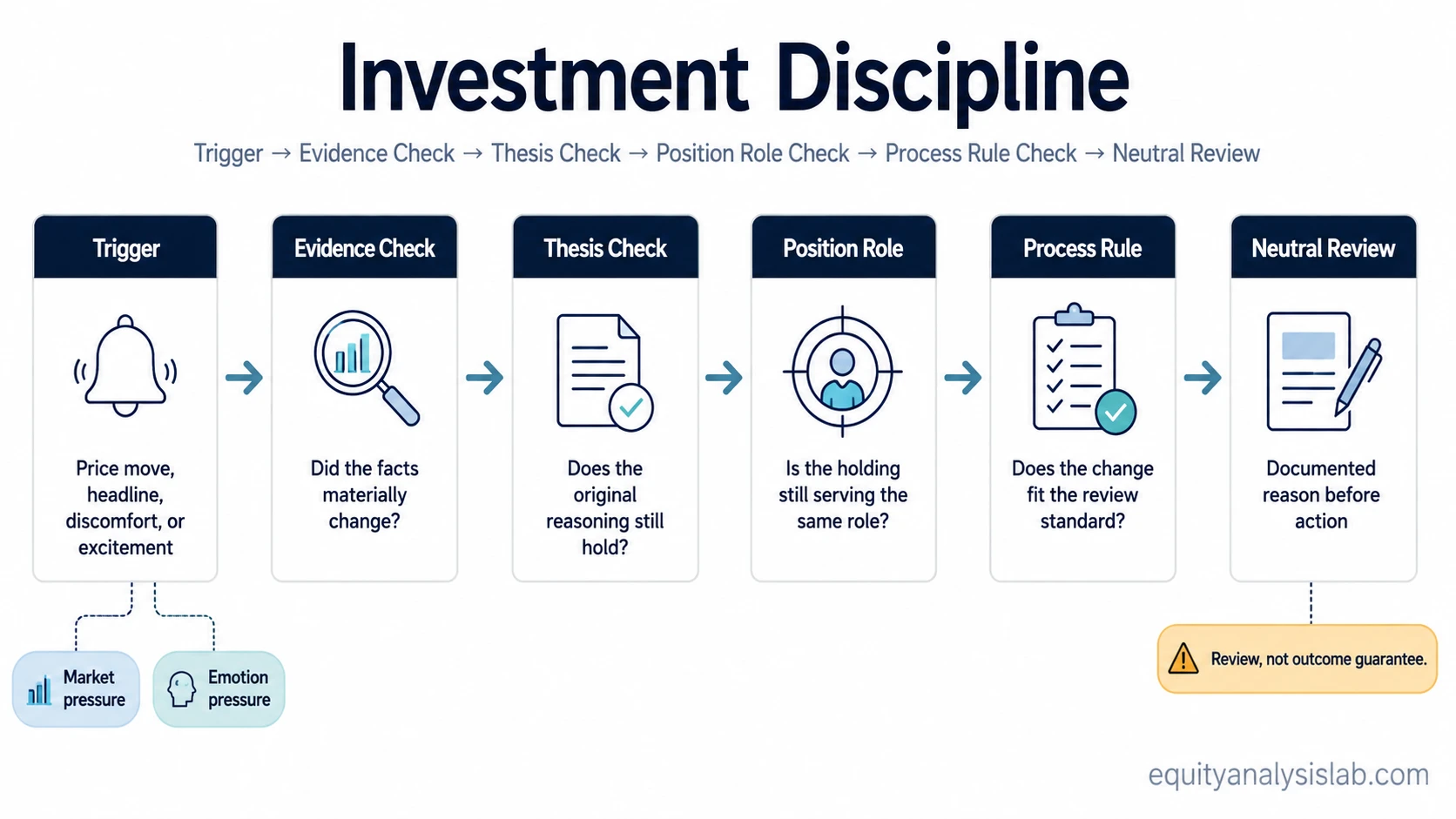
Investment discipline is the practice of applying a consistent review standard across investing decisions over time. It does not require the investor to make the same choice in every situation. It requires the investor to judge each situation through the same process before the decision changes.
Investment discipline means: keeping the review standard consistent across repeated decisions, so that fear, excitement, regret, and market pressure do not quietly replace the process.
That distinction matters because disciplined investing is not the same thing as stubborn holding, automatic selling, or repeating one response regardless of the facts. The discipline is in the consistency of the review standard, not in forcing the same action every time.
The concept sits close to emotional investing, but it is not the same idea. Emotional pressure describes the force acting on the decision. Investment discipline describes the process standard that remains in place while different decisions are reviewed over time.
Key Points
- Investment discipline is consistency of process, not consistency of action.
- The same review standard can lead to different decisions when the evidence changes.
- A disciplined investor can hold, reduce, add, or exit, as long as the same review standard was applied before the decision.
- Discipline weakens when the evidence standard changes under fear, excitement, regret, or discomfort.
- A good outcome does not automatically prove that the process was disciplined.
Investment Discipline Means Keeping the Review Standard Consistent
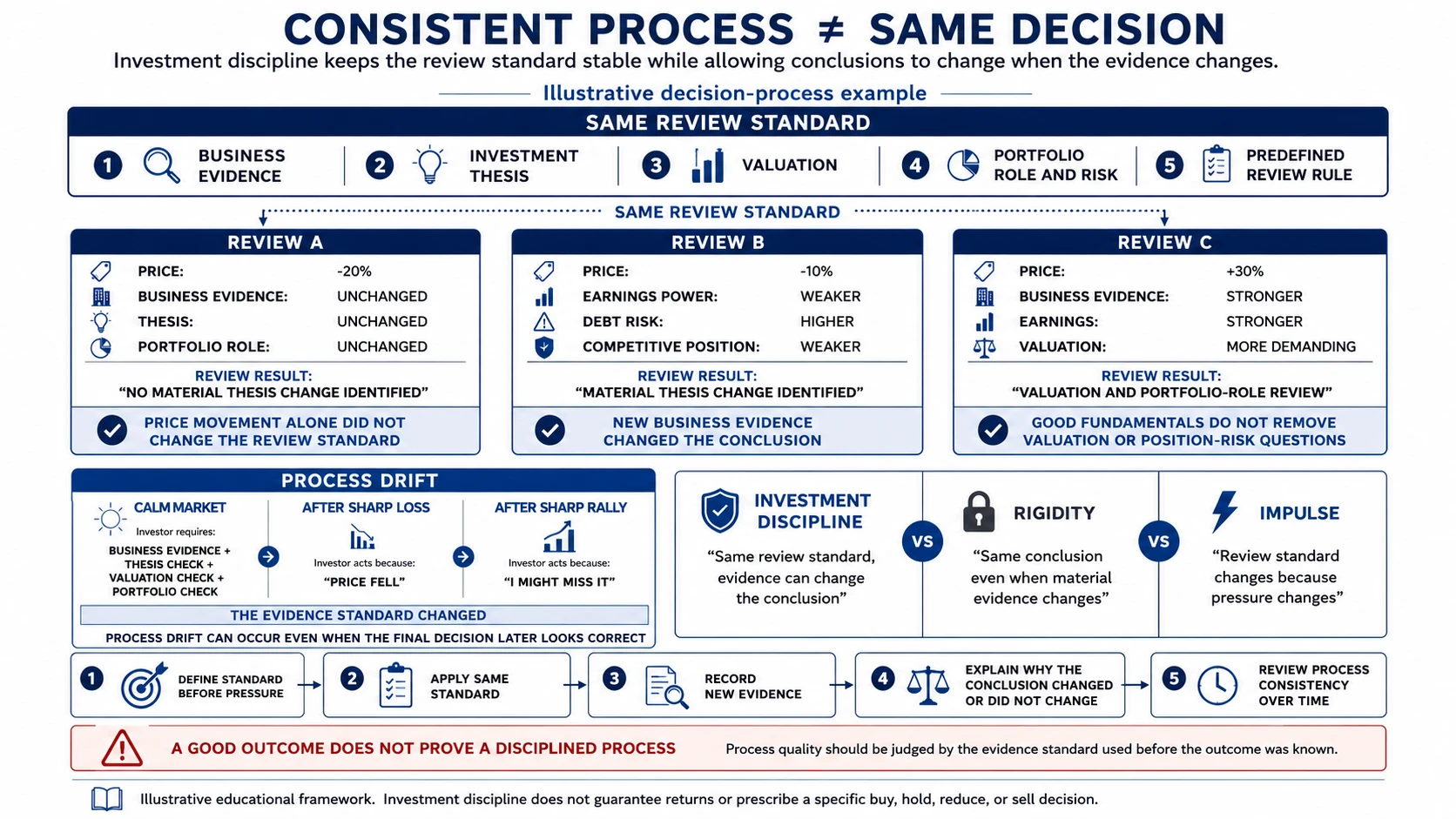
A practical review standard can remain constant even while the conclusion changes. The investor may review the same core questions every time: what changed in the business evidence, what changed in the thesis, what changed in valuation, what changed in the portfolio role, and whether the proposed action fits a predefined review rule.
The reason this matters is simple. Market events do not arrive in the same form. One event may produce a price decline without changing the business. Another may bring genuine business deterioration. A third may improve the business while making valuation much more demanding. The process stays the same. The conclusion does not have to.
Main idea: discipline means applying the same review standard to different situations. It does not mean forcing the same buy, hold, reduce, or sell decision every time.
Consistent Process Does Not Mean the Same Decision
The clearest way to understand investment discipline is to keep the review standard fixed and then compare different events.
| Review event | What happened | What the same review standard checks | Possible disciplined conclusion |
|---|---|---|---|
| Review A | The stock price falls 20%, but the business evidence and thesis remain unchanged. | Whether the price move alone changed the business case, the thesis, or the portfolio role. | No material thesis change identified. |
| Review B | The stock price falls 10%, while earnings power weakens and debt risk rises. | Whether the new business evidence changes the original reason for ownership. | Material thesis change identified. |
| Review C | The stock price rises 30%, the business improves, but valuation becomes much more demanding. | Whether stronger fundamentals still justify the current portfolio role and valuation risk. | Valuation and position-role review required. |
The disciplined feature in all three cases is not the result. It is the consistency of the review standard. Price movement alone does not automatically create a thesis change. Strong business performance does not automatically remove valuation concerns. New negative evidence does not automatically dictate one specific action without checking role and process. The process stays stable while the facts drive the conclusion.
Core distinction: a disciplined process allows the conclusion to change when the evidence changes. Repeating the same action in every case is not discipline. It is often a sign that the process is not actually being used.
Process Drift: When the Standard Changes Under Pressure
One of the biggest failures of investment discipline is process drift. This happens when the investor appears to keep reviewing decisions, but the evidence standard quietly changes once the outcome becomes emotionally uncomfortable.
Example: in a calm period, the investor requires business evidence, valuation review, thesis review, and portfolio-fit review before acting.
Process drift: after a sharp loss, the investor acts because the price fell. After a sharp rally, the investor acts because missing the move feels worse than violating the process.
In both cases, the decision may later look correct or incorrect, but that is not the first question. The first question is whether the same standard was still being used when pressure increased. If the evidence threshold changes with discomfort, confidence, fear, or FOMO, the process has drifted even before the investment outcome is known.
Important caution: a good result does not prove a disciplined process, and a disappointing result does not prove the process was weak. Process quality should be judged by the review standard used before the outcome was known.
What Investment Discipline Is Not
Investment discipline is often confused with rigid holding, forced patience, or refusal to change a view. Those ideas miss the point. A disciplined process can keep a position unchanged, reduce it, add to it, or exit it, depending on what the evidence review shows.
| Investment discipline is | Investment discipline is not | Why the distinction matters |
|---|---|---|
| A repeatable process standard | A personality label | The process can be checked across time and decisions. |
| Consistency of review | Repeating the same action in every case | Different evidence can justify different decisions. |
| A guardrail against process drift | A command to ignore new evidence | Discipline must still allow a genuine thesis change. |
| A way to test pressure before acting | A guarantee of correctness or better returns | Process quality and investment outcome are different questions. |
How Investment Discipline Shows Up Over Time
Investment discipline is easier to recognize across a sequence of decisions than in one isolated event. A single calm decision may look rational even if the process is weak. Over time, patterns reveal more. Does the investor require strong evidence when adding risk but act on emotion when reducing risk? Does the thesis review become loose after gains and unusually strict after losses? Do position-role checks disappear when confidence is high?
A disciplined investor does not need identical outcomes. The stronger sign is that the investor can explain why one case led to no action, another led to a revised thesis, and another led to a valuation or sizing review, all while using the same decision standard.
This broader consistency also supports avoiding emotional investing, because emotional decisions often become visible when the investor starts changing standards across cases rather than applying one stable process.
Common Investment Discipline Mistakes
| Mistake | Why it weakens discipline | Better review question |
|---|---|---|
| Equating discipline with never changing the view | It turns process into rigidity and can block genuine thesis change. | Did material evidence change the thesis or portfolio role? |
| Changing the evidence standard under pressure | The process becomes outcome-driven instead of review-driven. | Am I using the same standard I would use in a calm market? |
| Rewriting the reason after acting | The decision record becomes unreliable and learning weakens. | Was the reason documented before the action was taken? |
| Confusing price movement with new evidence | A price move can create urgency without changing the business case. | What actually changed apart from the price? |
| Ignoring portfolio role and size pressure | The same evidence may be judged differently because the position became emotionally too large. | Would I interpret the same evidence the same way at a smaller position size? |
Where Investment Discipline Can Fail
Investment discipline can fail when the process becomes ceremonial rather than real. A checklist can still be completed while the investor is already emotionally committed to an action. A documented process can still fail if it is used only to justify a decision after the fact.
It can also fail when the standard itself is weak. If the review rule ignores business quality, valuation, position role, or time horizon, then applying it consistently will not fix the limitation. Consistency improves process quality only if the process itself is meaningful.
Limitation: investment discipline does not guarantee strong returns, low risk, or correct decisions. It only improves whether decisions are reviewed through a visible and consistent process standard.
Investment Discipline Audit Checklist
A useful checklist for this page is not only about one decision. It is about checking whether the process standard stayed consistent across decisions.
| Audit question | What it tests |
|---|---|
| Was the review standard defined before the pressure event? | Whether the process existed before discomfort, fear, or excitement appeared |
| Did I apply the same evidence standard I would use in a calm setting? | Whether the process stayed stable under pressure |
| What new evidence changed, if any? | Whether the conclusion changed because facts changed or because pressure increased |
| If the conclusion changed, can I explain why the same standard produced a different result? | Whether the decision difference is process-consistent rather than arbitrary |
| Did the position role, valuation, or risk context materially change? | Whether the broader investment case changed beyond price movement alone |
| Was the reason documented before acting? | Whether later review can separate true process from hindsight reconstruction |
The checklist does not prescribe a buy, hold, reduce, or sell outcome. Its purpose is to make process consistency visible before the market outcome rewrites the memory of why the decision was made.
FAQ
Does investment discipline mean making the same decision every time?
No. Investment discipline means using the same review standard. Different evidence can justify different conclusions without breaking discipline.
Is investment discipline the same as never changing your mind?
No. A disciplined investor can change the decision when business evidence, thesis, valuation context, or portfolio role changes materially. Refusing to change in every case is rigidity, not discipline.
How is investment discipline different from emotional investing?
Emotional investing describes decisions driven mainly by fear, excitement, FOMO, regret, or discomfort. Investment discipline describes the consistent process standard that checks those pressures against evidence before the decision changes.
Does investment discipline guarantee better returns?
No. Investment discipline does not guarantee strong returns or prove that a decision is correct. It only improves whether the decision was reviewed through a visible and consistent process.