
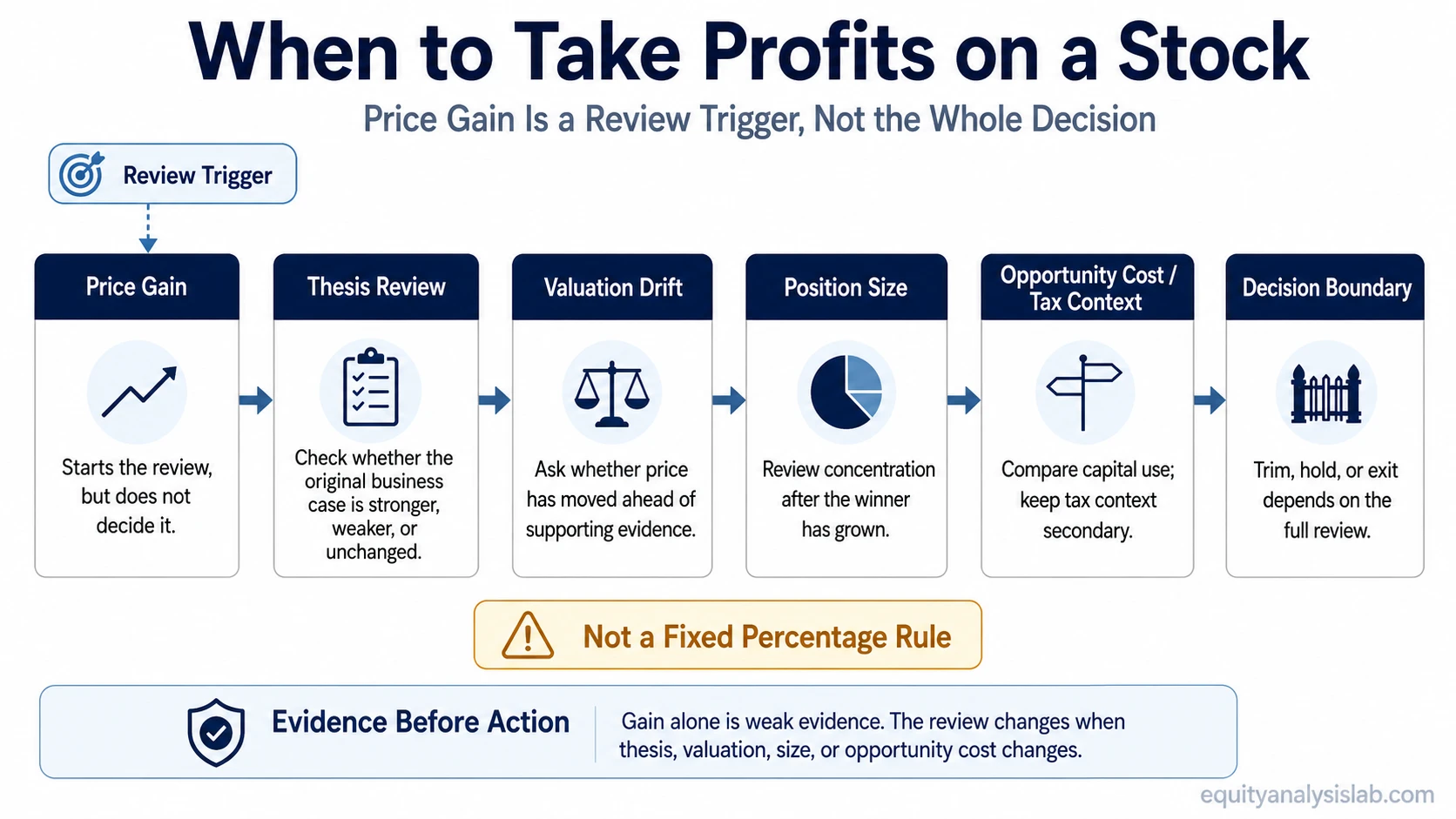
Taking profits on a stock should begin with a review of thesis evidence, valuation, position size, portfolio role, and opportunity cost. The size of the gain tells you how far the stock has moved from the purchase price, but it does not explain whether the position still deserves the same exposure.
A winning stock can still deserve ownership if the business case remains supported and valuation is reasonable relative to the updated evidence. The same winner can also deserve trimming if price appreciation has created concentration risk, reduced the expected return from the current price, or made another use of capital more attractive.
Common mistake: Treating the size of the gain as the sell signal. A 20%, 50%, or 100% profit can come from very different combinations of earnings growth, valuation expansion, business improvement, and market sentiment.
What Taking Profits on a Stock Means
Taking profits on a stock means reducing or exiting part of a winning position after its price has risen. The decision can be connected to valuation, concentration, opportunity cost, thesis change, cash needs, or portfolio policy. The gain itself does not identify which of those problems, if any, actually exists.
The practical question is whether the position still deserves the same role, size, and risk exposure after the price move. That review belongs inside an investment discipline process rather than a fixed percentage rule.
The Gain Is a Review Trigger
A stock can rise because earnings expectations improved, the business became stronger, valuation multiples expanded, a temporary catalyst changed sentiment, or several of those forces occurred together. The position may also become a much larger part of the portfolio simply because its market value increased.
Those paths should not produce the same automatic response. If the business evidence improved enough to support the higher price, the gain may be less important than it appears. If price appreciation moved far ahead of the evidence, the future return and margin for error may have changed materially.
Decision boundary: The gain becomes more relevant when the price move changes valuation, portfolio concentration, opportunity cost, or the evidence supporting continued ownership.
Same Gain, Different Reason
Two stocks can produce the same percentage gain while creating very different profit-taking questions. The difference becomes clearer when the price move is separated into earnings growth and valuation change.
| Metric | Starting Point | Path A | Path B |
|---|---|---|---|
| Earnings per share | $5.00 | $9.00 | $6.00 |
| P/E ratio | 20x | 20x | 30x |
| Share price | $100 | $180 | $180 |
| Price gain | Starting point | +80% | +80% |
In Path A, earnings per share rise from $5 to $9 while the P/E ratio remains at 20x. The 80% stock-price gain is therefore matched by an 80% increase in the earnings base used in this simplified example.
In Path B, earnings per share rise only 20%, from $5 to $6, while the P/E ratio expands from 20x to 30x. The stock reaches the same $180 price, but much more of the gain now depends on investors continuing to pay a higher valuation multiple.
Interpretation: The same percentage gain can reflect very different changes in fundamentals and valuation. Profit-taking analysis should examine what created the gain before deciding what the gain means.
Review the Thesis Before Reviewing the Profit
The first ownership question is the investment thesis. A stock that is up substantially while the business case has strengthened belongs in a different review category from a stock that is profitable even though the original thesis has weakened.
Review whether operating evidence still supports the original case, whether new risks have changed the expected payoff, and whether continued ownership now depends on assumptions that were not required when the position was initiated.
A large gain becomes more relevant when it is paired with weaker evidence, a narrower margin for error, or a thesis that increasingly depends on favorable sentiment rather than the underlying business case.
Check Valuation Drift After the Price Move
Valuation drift occurs when the stock price changes faster than the evidence supporting future earnings, cash flow, growth, or business durability. A company can remain fundamentally strong while its expected return changes because the new price requires more demanding future assumptions.
The review does not require one precise fair-value estimate. It requires asking what expectations are now embedded in the price and whether the current evidence provides enough support for those expectations.
The same company can therefore present a different investment case at $180 than it did at $100 even if the underlying business remains attractive. The relevant change is the amount of future performance already reflected in the current valuation.
Check Position Size and Concentration Risk
A winner can create a portfolio problem even when the company-specific thesis remains intact. A large gain increases the market value of the holding, which can make one stock responsible for a much larger share of total portfolio outcomes.
This is where position size after a large gain becomes part of the review. A trim can solve an exposure problem without implying that the company should no longer be owned.
How a Winner Can Change Portfolio Weight
Consider a simplified $100,000 portfolio with a $5,000 stock position. The stock initially represents 5% of the portfolio.
| Portfolio Item | Before the Gain | After the Stock Doubles |
|---|---|---|
| Stock position | $5,000 | $10,000 |
| Rest of portfolio | $95,000 | $95,000 |
| Total portfolio | $100,000 | $105,000 |
| Stock weight | 5.0% | 9.5% |
The position doubled, but its portfolio weight rose from 5.0% to approximately 9.5% because the gain also increased the value of the total portfolio.
Now assume, only for illustration, that the investor’s portfolio policy allows a maximum 6% allocation to this position. Six percent of the new $105,000 portfolio is $6,300. Reducing the $10,000 position to $6,300 would require selling approximately $3,700, or about 37% of the current position.
Portfolio boundary: A position-size problem can justify a partial trim even when the ownership thesis remains intact. The required action depends on the intended allocation, not on the percentage gain by itself.
Partial Profit-Taking vs Full Exit
Partial profit-taking and a full exit solve different problems. A trim changes exposure while preserving some participation in the thesis. A full exit removes the ownership exposure entirely and therefore requires a stronger review of whether the position still belongs in the portfolio.
| Problem | Possible Action | What the Action Addresses |
|---|---|---|
| Position became oversized | Trim | Reduces concentration while allowing the ownership thesis to remain intact. |
| Valuation became less forgiving | Hold or trim | Adjusts exposure when expected return has changed but the business case remains supported. |
| Another opportunity offers a stronger evidence-adjusted use of capital | Trim or exit | Reallocates capital based on opportunity cost. |
| Investment thesis materially weakened | Full exit review | Tests whether the ownership case itself still exists. |
Useful distinction: Trimming can solve an exposure problem. A full exit addresses whether the ownership case still deserves capital at all.
A Simple Profit-Taking Review Framework
The same unrealized gain can lead to different decisions depending on thesis strength, valuation, portfolio exposure, and competing uses of capital. Reviewing those inputs separately reduces the risk of turning a profitable price move into an automatic sell rule.
| Review Question | What It Checks | What Can Support Trimming | What Can Support Holding |
|---|---|---|---|
| Has the thesis changed? | Whether the original ownership case still has evidence behind it. | The business case is weaker, more speculative, or more dependent on optimistic assumptions. | The thesis remains supported or has strengthened. |
| Has valuation moved faster than fundamentals? | Whether price appreciation has outrun earnings, cash flow, growth, or business evidence. | The valuation requires substantially stronger future performance or leaves little room for disappointment. | The current valuation remains supported by the updated evidence and uncertainty range. |
| Has the position become too concentrated? | Whether the winner now represents more portfolio risk than intended. | The position has moved above the investor’s intended allocation or risk limit. | The position remains inside the intended exposure range. |
| Is there a better use for the capital? | Whether another opportunity offers a stronger use of portfolio capital. | The current position has less expected upside relative to uncertainty than another well-supported opportunity. | The current stock still compares favorably with available alternatives. |
| Does implementation context affect timing? | Whether cash needs, portfolio policy, transaction costs, or tax context change execution. | A practical portfolio requirement supports reducing exposure. | Implementation costs or timing factors favor waiting when the investment case itself has not changed. |
Decision boundary: The case for reducing a winner becomes stronger when several independent review inputs point in the same direction rather than when the gain appears alone.
What Taking Profits Should Not Mean
Taking profits should not mean selling automatically when a fixed percentage gain appears. A 20%, 50%, or 100% gain can have different implications depending on what happened to earnings, valuation, portfolio concentration, risk, and the available opportunity set.
A target price can also be useful as a planning reference without becoming an automatic sell instruction. Updated evidence can make the original target too optimistic, too conservative, or no longer relevant.
Tax context can affect implementation timing, but specific tax decisions depend on jurisdiction, account type, holding period, and personal circumstances. Tax considerations should remain separate from the underlying investment review.
Boundary: A profit-taking process cannot remove uncertainty or future regret. Its role is to determine whether the position still deserves its current exposure after the gain.
FAQ
Should I take profits after a stock doubles?
A doubled stock should be reviewed rather than automatically sold. Check what caused the gain, whether the thesis remains supported, whether valuation has become more demanding, and whether the position has become too large relative to the portfolio.
Is taking profits the same as trimming a position?
Not necessarily. Taking profits can involve a partial trim or a full exit. A trim can address position size or valuation risk while preserving the ownership thesis, while a full exit requires a stronger review of whether the position should remain owned at all.
Can a stock become too large even if the thesis is still strong?
Yes. A large price gain can increase the position’s portfolio weight even when the business case remains intact. In that situation, trimming can be a portfolio-risk decision rather than a judgment that the company has become unattractive.