
Business model analysis examines how a company creates, delivers, and captures value. For investors, the description becomes useful when it can be connected to observable evidence in revenue, margins, cash flow, customer behavior, and required reinvestment.
A company can describe an attractive model without having strong economics. Revenue mix, cost structure, unit economics, cash conversion, customer durability, capital intensity, and competitive context determine whether growth is strengthening the business or simply making the business larger.
Definition: Business model analysis is the process of evaluating how a company turns its products, customers, operations, and resources into revenue, profit, and cash flow.
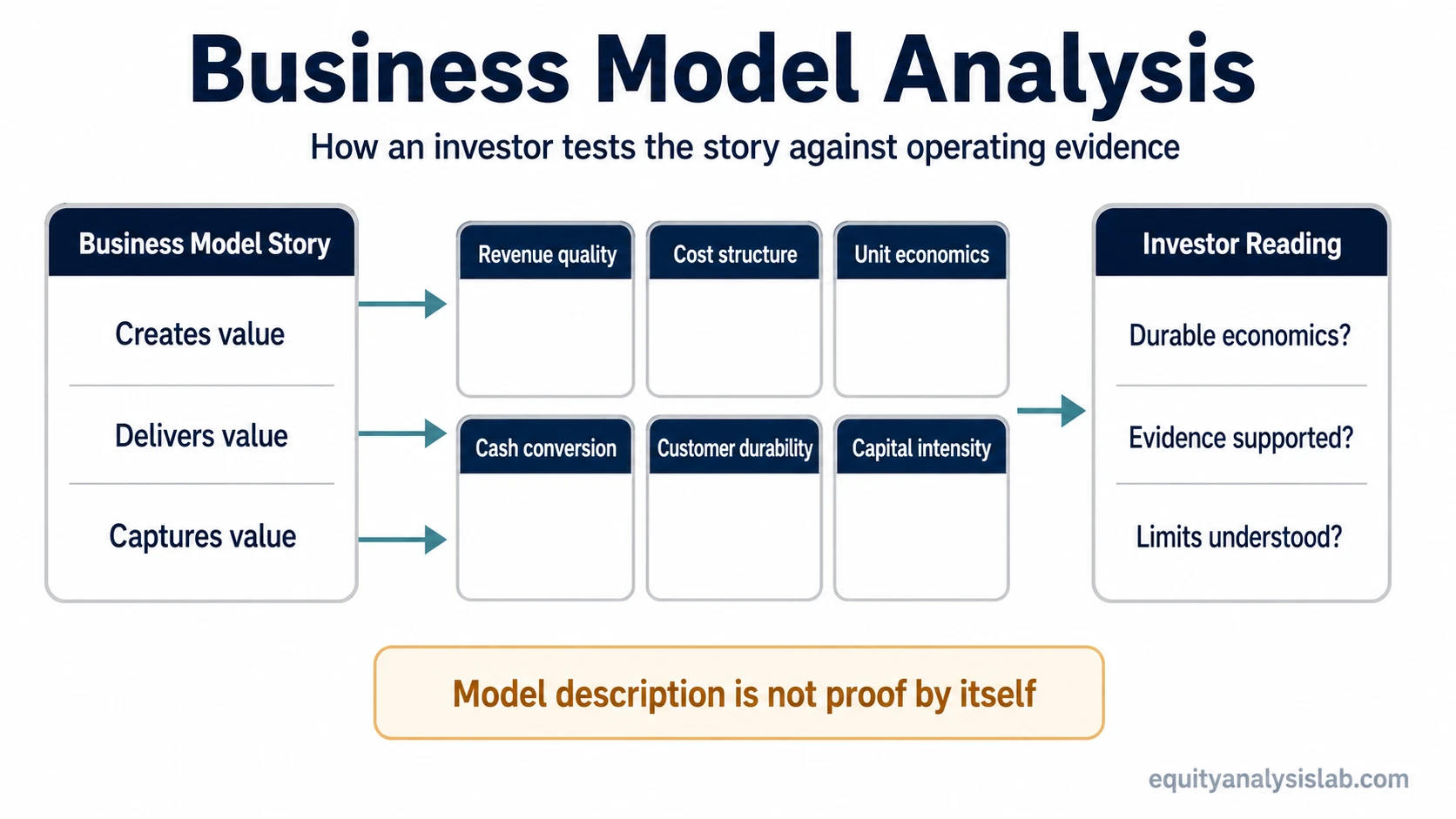
- Business model analysis starts with how a company creates, delivers, and captures value.
- The model should be visible in revenue behavior, margins, cash conversion, customer economics, and reinvestment requirements.
- Two companies can report similar growth while producing very different operating and cash-flow economics.
- A strong business model does not automatically prove durable competitive advantage or good capital allocation.
What Business Model Analysis Means for Investors
For investors, the task is not only to identify what a company sells or how customers pay. The analysis should trace the economic path from customer demand to revenue, from revenue to profit, and from profit to cash that can be retained or reinvested.
A subscription company, marketplace, manufacturer, retailer, advertising platform, and professional-services firm can all grow revenue, but they may require very different levels of customer acquisition spending, inventory, infrastructure, working capital, and capital expenditure. Those differences affect how valuable each additional dollar of revenue may be.
The analysis therefore combines the operating description with financial evidence. If management describes the model as scalable, asset-light, recurring, or highly efficient, the financial statements and operating disclosures should provide evidence consistent with that description.
Business Model Claims Must Show Up in the Evidence
A useful business model analysis turns descriptive claims into testable observations. The relevant evidence depends on the type of business, but the core question is the same: does the economic behavior of the company support the way the model is being described?
| Business Model Claim | Evidence to Check | What Would Weaken the Claim |
|---|---|---|
| Recurring or predictable revenue | Revenue mix, retention, repeat purchasing, contract structure, and deferred or contracted revenue where relevant. | High churn, volatile transaction volume, weak renewal behavior, or dependence on continual new-customer acquisition. |
| Scalable economics | Gross margin, operating expenses relative to revenue, operating margin, and incremental profitability as the company grows. | Costs rise as fast as or faster than revenue, preventing operating margins from improving. |
| Asset-light model | Property and equipment, capital expenditure, capitalized costs, working-capital requirements, and free cash flow. | Growth repeatedly requires large infrastructure spending, inventory investment, or other capital commitments. |
| Strong pricing power | Revenue per customer or unit, gross margin behavior, retention, volumes, discounts, and contract terms. | Price increases are offset by customer losses, lower volumes, heavier discounts, or margin pressure. |
| Efficient customer acquisition | Sales and marketing intensity, customer acquisition costs where available, payback periods, retention, and contribution economics. | Increasing spending is required to produce each unit of incremental growth, or acquired customers become less valuable. |
| Strong cash conversion | Operating cash flow, receivables, inventory, other working-capital accounts, capital expenditure, and free cash flow. | Revenue and earnings grow while working capital or reinvestment absorbs most of the cash benefit. |
| Diversified customer demand | Customer mix, revenue concentration, distribution channels, customer retention, and end-market exposure. | Customer concentration risk, channel dependency, or a narrow customer base makes reported growth dependent on a small number of relationships. |
Evidence test: a business model claim becomes more credible when the operating data and financial statements behave in a way that the model would reasonably predict.
Follow the Economics From Revenue to Cash Flow
Revenue growth is only one stage of the business model. The same dollar of additional revenue can create very different economic value depending on the gross profit it generates, the operating costs required to support it, the capital needed to produce it, and the amount that ultimately becomes cash.
| Stage | Investor Question | Evidence |
|---|---|---|
| Customer demand | Why is the customer buying? | Retention, repeat purchases, usage, pricing, market share, and customer concentration. |
| Revenue | How does demand become reported sales? | Revenue mix, volume, pricing, subscriptions, transactions, contracts, or other revenue drivers. |
| Gross profit | How much economic value remains after direct delivery costs? | Gross margin level, gross margin trend, product mix, fulfillment costs, and service costs. |
| Operating profit | How much spending is required to support and expand the business? | Sales and marketing, R&D, G&A, operating leverage, and operating margin. |
| Cash flow | Does reported profit convert into cash? | Operating cash flow, working capital, capital expenditure, and free cash flow. |
| Reinvestment | How much capital must return to the business to maintain or expand it? | Capex, acquisitions, inventory, technology investment, customer acquisition, and other growth spending. |
This sequence helps separate a model that produces attractive economics from one where strong top-line growth requires increasingly expensive operating or capital inputs.
Same Revenue Growth, Different Business Model Economics
Consider two illustrative companies that both grow revenue by 20%. Looking only at the growth rate would make their operating performance appear similar.
| Metric | Company A | Company B |
|---|---|---|
| Revenue growth | 20% | 20% |
| Gross margin | 78% | 46% |
| Sales & marketing / revenue | 24% | 34% |
| Operating margin | 18% | 4% |
| Capital expenditure / revenue | 3% | 12% |
| Free cash flow margin | 16% | 1% |
Company A retains more revenue as gross profit, spends less of its revenue on sales and marketing, produces a stronger operating margin, and requires less capital expenditure. Its 20% revenue growth therefore reaches cash flow through a relatively efficient economic path.
Company B has the same headline growth rate, but a larger share of revenue is absorbed by direct costs, customer acquisition, and capital expenditure. The 20% growth rate alone does not demonstrate that its business model is equally scalable or economically productive.
Business model interpretation: similar growth rates can create very different economics. The analysis should follow the path from revenue growth to margins, cash generation, and the capital required to sustain that growth.
When Business Model Analysis Can Mislead Investors
Business model analysis becomes misleading when descriptive language is treated as evidence. Terms such as scalable, recurring, asset-light, platform, and large addressable market describe characteristics or expectations, but the economics still need to be tested.
| Potential Misread | What to Check Instead |
|---|---|
| A large addressable market implies an attractive business | Customer acquisition economics, market share, pricing, margins, and the cost of reaching that market. |
| Recurring revenue implies durable economics | Retention, renewal behavior, pricing, gross margins, acquisition costs, and customer dependency. |
| Fast growth proves scalability | Incremental margins, operating expenses, capital requirements, working capital, and cash conversion. |
| Asset-light means little reinvestment | Capitalized software, content, customer acquisition, working capital, lease commitments, and other recurring investment needs. |
| Attractive economics prove durability | Competitive threats, switching costs, pricing power, customer behavior, and whether the company has an economic moat. |
Business Model Analysis vs Revenue Model
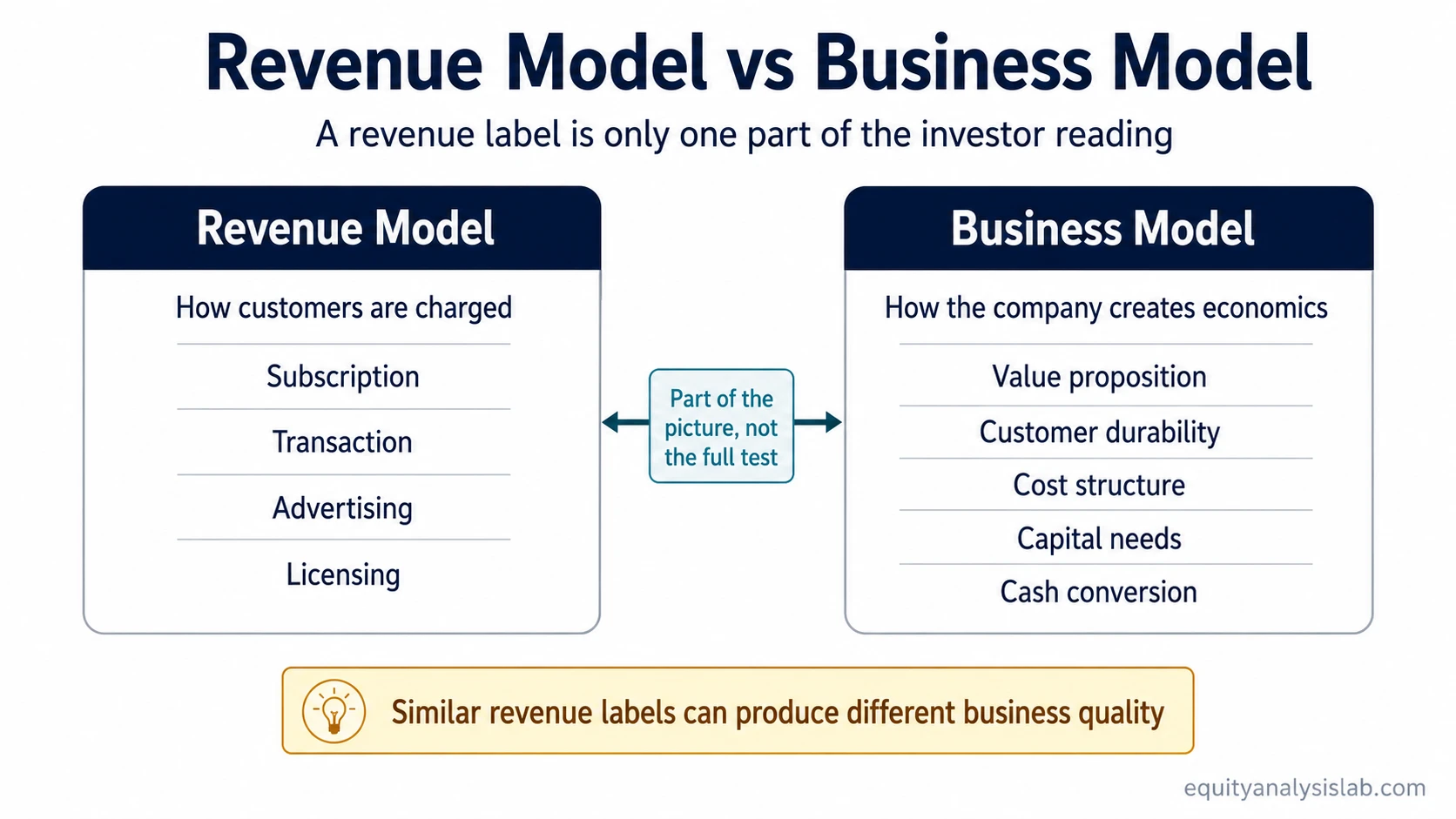
A revenue model explains how a company charges customers. A business model explains the broader economic system that makes those revenues possible, including the customer relationship, value proposition, cost structure, operations, capital requirements, and cash conversion.
Two companies can therefore use the same revenue model and still have very different business economics. Two subscription businesses may both collect recurring payments, but one may have low churn, high gross margins, and efficient customer acquisition while the other requires heavy discounting, expensive sales efforts, and continuous reinvestment to retain customers.
The revenue label identifies how money enters the company. Business model analysis examines what must happen before and after that revenue is collected for the company to create attractive economics.
How Business Model Analysis Connects to Capital Decisions
A business model determines how the company generates economic resources, but management still decides what happens to those resources. Cash can be reinvested internally, used for acquisitions, applied to debt reduction, returned through dividends or repurchases, or retained on the balance sheet.
That is where business model analysis connects to capital allocation. The model can produce attractive cash flows while poor reinvestment or financing decisions reduce the value ultimately created for shareholders.
Business Model Analysis FAQ
Is business model analysis the same as business quality analysis?
No. Business model analysis focuses on how the company creates revenue, profit, and cash flow and what resources are required to do so. Business quality analysis also considers competitive durability, financial strength, management decisions, and other risks.
Can two companies with the same revenue growth have very different business models?
Yes. One company may convert growth into high margins and free cash flow with limited reinvestment, while another may require heavy sales spending, working capital, or capital expenditure to produce the same growth rate.
Does a strong business model automatically make a stock attractive?
No. Business model quality is one part of investment analysis. Valuation, competitive change, financial risk, management decisions, and future expectations can still affect the investment outcome.