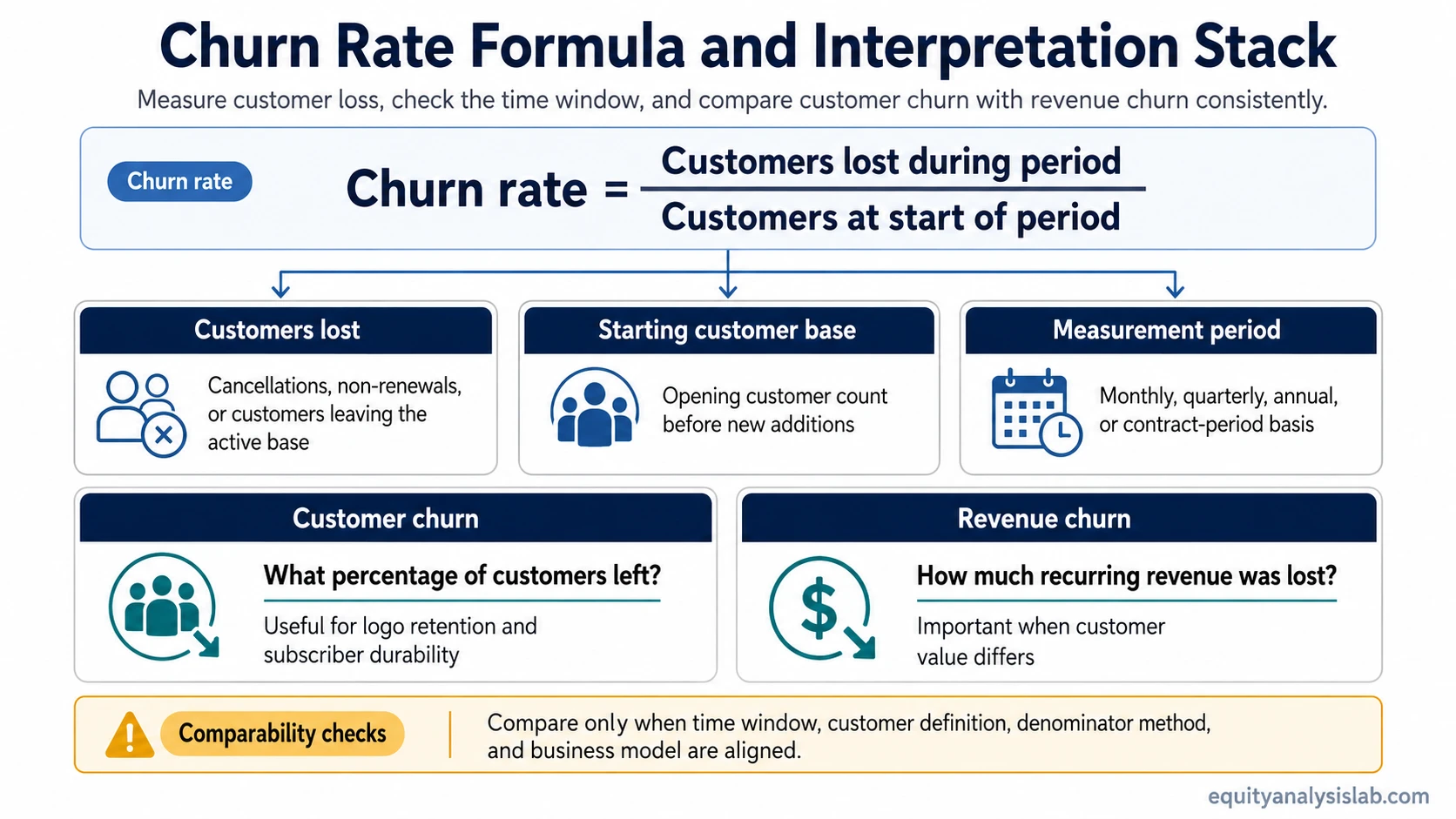
Churn rate is the percentage of customers or subscribers a company loses during a defined period. For investors, it is a retention-quality metric, not a standalone verdict on business quality.
Definition: Churn rate measures customer or subscriber loss from an existing base during a specific measurement period.
Formula: Churn rate = Customers lost during the period / Customers at the start of the period
The result is usually expressed as a percentage. Before comparing churn rates, the time period, denominator method, and customer definition should match.
A company that begins a month with 1,000 customers and loses 50 during that month has a basic customer churn rate of 5% for that monthly period. A monthly churn rate, annual churn rate, customer churn rate, and revenue churn rate can describe different things even when the wording sounds similar.
Key points
- Churn rate measures customer or subscriber loss over a defined period.
- The basic customer churn formula divides customers lost by customers at the start of the period.
- Investors use churn rate to evaluate retention quality, recurring-revenue durability, and business-model stability.
- Customer churn and revenue churn can tell different stories when customer sizes, pricing, upgrades, or downgrades differ.
- Churn rate should be compared using the same time window, customer definition, denominator method, and business-model context.
What churn rate measures
Churn rate measures loss from an existing customer base. In a subscription or recurring-revenue business, the lost customer may be a cancelled account, a non-renewing subscriber, or another customer relationship that no longer contributes to the active base.
For investors, churn helps test whether reported growth is supported by durable customer relationships or offset by replacement demand. A company can keep adding new customers while showing weak retention quality if many existing customers leave in the same period.
The interpretation depends on the business model. A consumer subscription, enterprise software company, telecom provider, and membership business may all use churn language, but the economic meaning depends on contract length, customer value, renewal timing, and pricing structure.
How to calculate churn rate
The simplest customer churn calculation uses customers lost during a period as the numerator and customers at the start of that same period as the denominator.
| Formula part | What it means | Why it matters |
|---|---|---|
| Customers lost during the period | Customers who cancelled, failed to renew, or otherwise left the active base during the measurement window. | This defines the loss being measured. Mixing cancellations, downgrades, and inactive accounts without a clear rule can make the metric harder to compare. |
| Customers at the start of the period | The opening customer base before new additions during the period. | Using the beginning base keeps the formula focused on how much of the starting base was lost. |
| Time period | The monthly, quarterly, annual, or contract-period window used for the calculation. | Churn rates from different time periods should not be compared as if they were the same metric. |
| Percentage format | The decimal result multiplied by 100. | A 0.05 result is normally shown as 5% churn for the defined period. |
Some companies or analysts use variations, such as average customers during the period or ending customers as the denominator. Those variations are not automatically wrong, but the chosen method should be consistent before the metric is compared across time or against peers.
Compare churn rate only when these inputs match:
- the same time window, such as monthly with monthly or annual with annual;
- the same customer definition, such as active subscribers, paying accounts, or contracted customers;
- the same denominator method, such as starting customers or average customers;
- a similar business model, contract structure, and customer-value mix.
Simple churn rate example
A company starts the quarter with 2,000 customers. During the quarter, 120 customers cancel or fail to renew. Using the basic customer churn formula, quarterly churn is 120 divided by 2,000, or 6%.
The 6% figure does not explain the full business by itself. The reading becomes clearer when compared with the company’s prior quarters, customer acquisition pace, revenue lost from those customers, and the type of customers that left.
Customer churn vs revenue churn
Customer churn counts lost customers. Revenue churn focuses on the revenue lost from existing customers. The distinction matters because customers are rarely equal in economic value.
| Metric | Main question | Investor interpretation |
|---|---|---|
| Customer churn | What percentage of customers left? | Helps assess logo retention, subscriber durability, and the stability of the customer base. |
| Revenue churn | How much recurring revenue was lost from existing customers? | Matters when customer size varies or when enterprise accounts carry much higher value than smaller accounts. |
| Expansion offset | Did upgrades or seat expansion offset lost revenue? | Important because a company can lose some customers while still expanding revenue from retained customers. |
A low customer churn rate can still hide pressure if the customers leaving are high-value accounts. A higher customer churn rate may be less damaging if the lost customers are low-value accounts and retained customers expand meaningfully. Customer churn is the broad customer-loss concept; SaaS churn rate applies that concept more specifically to software subscription models.
Why churn rate can mislead
Churn rate becomes less reliable when the formula is not comparable. A monthly churn rate should not be treated like an annual churn rate. A customer-count churn rate should not be treated like revenue churn. A small-business subscription model should not be compared directly with an enterprise contract model without adjusting for customer value, renewal cycles, and sales motion.
Blended churn can also hide cohort effects. A fast-growing company may report a stable overall churn figure while older customer cohorts behave differently from newer cohorts. Promotions, price increases, customer mix changes, and changes in contract terms can also change the interpretation.
For investors, the safer reading is diagnostic: churn rate can indicate retention pressure or customer durability, but it should be tested against revenue retention, gross margin, customer acquisition cost, payback period, and the company’s broader recurring-revenue model.
Related retention metrics
Churn rate is one part of a retention-quality stack. Gross revenue retention focuses on how much recurring revenue is retained before expansion. Net revenue retention includes expansion, upgrades, contractions, and churn within the existing customer base. SaaS churn rate applies the churn concept more specifically to software subscription models.
The analysis sequence is to start with the basic churn definition, then check whether the business is losing customers, losing revenue, or offsetting losses through expansion from retained accounts.