
Revenue churn is the recurring revenue a SaaS or subscription company loses from existing customers during a period through cancellations, non-renewals, downgrades, or contraction.
It is usually measured against beginning monthly recurring revenue or annual recurring revenue, so the denominator matters as much as the lost-revenue numerator. Revenue churn is useful as a recurring-revenue quality input, but it does not prove business quality, valuation attractiveness, stock safety, or future return by itself.
Definition: Revenue churn measures lost recurring revenue from the existing customer base over a defined period, usually before or after any expansion revenue is considered.
Key Points
- Revenue churn focuses on lost recurring revenue, not just the number of customers lost.
- The denominator is normally beginning-period MRR or ARR, depending on the reporting period.
- Gross revenue churn excludes expansion revenue, while net revenue churn allows expansion to offset lost revenue.
- Customer churn and revenue churn can diverge when larger and smaller customers behave differently.
- The metric needs cohort, customer mix, contract-size, and reporting-period context before it can support an investor view.
What Revenue Churn Measures
Revenue churn measures the dollar value of recurring revenue that disappears from existing customers. The loss can come from a customer canceling, failing to renew, moving to a cheaper plan, reducing seats, lowering usage, or contracting a subscription commitment.
The metric is most relevant for SaaS and subscription businesses because recurring revenue can change even when the customer count looks stable. A company can lose only a few accounts but still report meaningful revenue churn if those accounts were large. Another company can lose many small accounts while preserving most of its recurring revenue base.
For investor analysis, the metric helps separate customer-count churn from revenue-quality pressure. It is one input in recurring-revenue durability, not a complete thesis about the company.
Revenue Churn Formula Inputs
The basic gross revenue churn formula compares lost recurring revenue during a period with beginning recurring revenue for the same base. The cleanest version uses the beginning customer base, not new customer revenue added during the period.
Formula: Revenue churn rate = lost recurring revenue from existing customers ÷ beginning-period recurring revenue × 100.
| Formula part | What it means | Why it matters |
|---|---|---|
| Churned recurring revenue | Revenue lost from cancellations, non-renewals, downgrades, seat reductions, or contraction | Defines the numerator and should not include new customer revenue |
| Beginning MRR or ARR | Recurring revenue at the start of the measurement period | Defines the denominator and keeps the rate tied to the existing base |
| Measurement period | Monthly, quarterly, annual, or another stated period | Changes comparability across companies and across time |
| Expansion treatment | Whether upsells, cross-sells, seat expansion, or usage expansion are excluded or offset against losses | Separates gross revenue churn from net revenue churn |
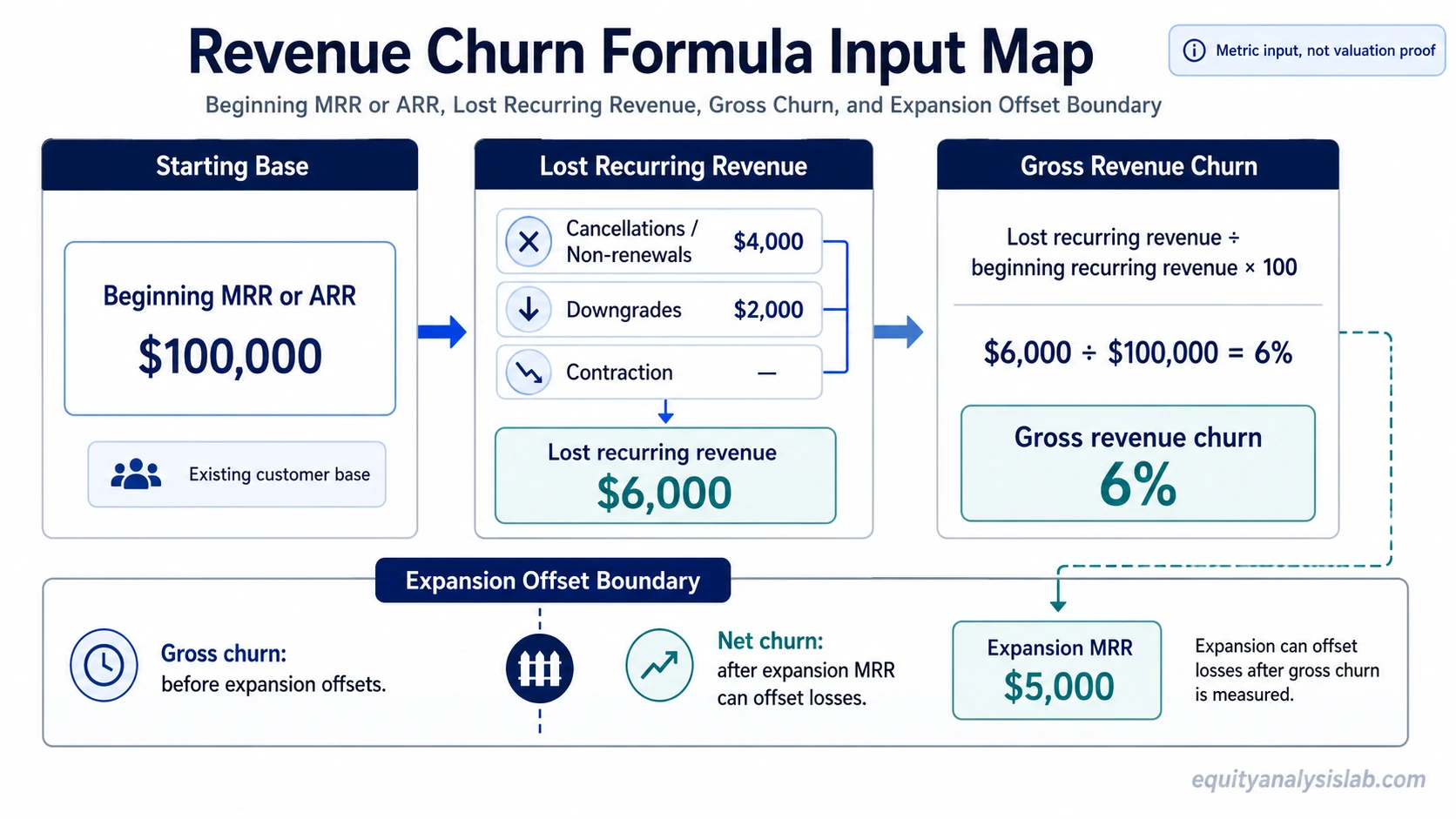
A simple gross revenue churn rate can be written as lost recurring revenue from existing customers divided by beginning recurring revenue. If beginning MRR is $100,000 and lost recurring revenue is $6,000, gross revenue churn is 6% for that period.
Gross Revenue Churn vs Net Revenue Churn
Gross revenue churn looks only at recurring revenue lost from the existing customer base. Expansion revenue is excluded, which makes the metric useful for isolating the drag from cancellations, downgrades, and contraction.
Gross revenue retention expresses the retained side of that same pre-expansion logic. If gross revenue churn is high, gross retention is pressured before any upsell or expansion activity can mask the loss.
Net revenue churn adds the expansion offset. Upsells, cross-sells, usage growth, or seat expansion can reduce the reported net churn rate and can even push it below zero when expansion from retained customers exceeds lost revenue.
Net revenue retention is the related retained-revenue metric after expansion, contraction, and churn are all considered. That makes it useful for understanding expansion economics, but it should not be confused with the cleaner gross churn view of lost recurring revenue.
Boundary: Gross revenue churn answers how much recurring revenue was lost before expansion offsets. Net revenue churn answers how much loss remains after expansion offsets. Mixing the two can make a customer base look healthier than the underlying contraction data suggests.
Revenue Churn vs Customer Churn
Revenue churn is dollar-based. Customer churn is account-based or logo-based. The two can move differently because customers do not all carry the same contract value.
A company may lose 2% of customers but 8% of recurring revenue if the lost accounts are large enterprise customers. Another company may lose 8% of customers but only 2% of revenue if the lost accounts are small, low-ARPA customers.
That difference is why SaaS churn rate needs careful interpretation. A logo-based churn rate can describe customer retention, while revenue churn describes the dollar value lost from the recurring revenue base.
Simple Revenue Churn Example
Example: A SaaS company starts the month with $100,000 in MRR from existing customers. During the month, canceled subscriptions remove $4,000 of MRR and downgrades remove another $2,000. Gross revenue churn is $6,000 divided by $100,000, or 6% for the month.
If retained customers add $5,000 of expansion MRR during the same period, the net churn picture changes, but the gross churn pressure has not disappeared. The company still lost $6,000 of existing recurring revenue before expansion offsets.
The same 6% figure can mean different things depending on customer mix. Losing revenue from a few large enterprise contracts may signal a different retention issue than losing the same dollar amount across many smaller accounts. The percentage is only the starting point; the source of the loss determines the interpretation.
How Investors Can Interpret Revenue Churn
Revenue churn can help investors evaluate whether recurring revenue is durable, whether customer value is holding up, and whether growth depends heavily on replacing lost revenue. A high or rising revenue churn rate may show that headline revenue growth is being offset by leakage inside the existing customer base.
A low or improving revenue churn rate can still require confirmation. Cohort behavior, pricing power, contract length, customer concentration, expansion revenue, gross retention, and cash-flow conversion can all change the meaning of the metric.
Revenue churn is more reliable when it is tied to reported retention, cohort behavior, contract changes, and cash-flow durability rather than management narrative alone. It helps test whether the recurring-revenue story is supported by customer behavior, but it should be read alongside margin quality, sales efficiency, billing durability, and the company’s own metric definitions.
What Revenue Churn Does Not Prove
Limitation: Revenue churn does not prove that a company is high quality, undervalued, safe, or likely to generate a specific return. It is a diagnostic input inside recurring-revenue analysis.
The metric can look strong because a company serves larger customers, reports a short period, benefits from temporary renewals, or uses a definition that differs from peers. It can also look weak during a customer cleanup period even if the remaining base is more attractive.
Comparability is especially important. Monthly churn, annual churn, gross churn, net churn, MRR-based churn, ARR-based churn, logo churn, and cohort-specific churn can all describe different views of the customer base. A number without the calculation base can be misleading.
Common Mistakes When Reading Revenue Churn
Common mistake: Treating one churn number as a full business-quality verdict. Revenue churn is more useful when the numerator, denominator, period, expansion treatment, and customer mix are clear.
| Mistake | Why it matters | Cleaner interpretation |
|---|---|---|
| Mixing gross and net churn | Expansion revenue can hide lost recurring revenue | Separate pre-expansion loss from post-expansion offset |
| Ignoring beginning-period revenue | The denominator controls the rate | Check whether the calculation uses beginning MRR, beginning ARR, or another base |
| Comparing periods loosely | Monthly and annual rates are not directly equivalent without normalization | Match the period before comparing companies or trend lines |
| Ignoring customer size | Small-customer churn and enterprise-customer churn can have different revenue impact | Look at customer mix, ARPA, cohort retention, and concentration |
| Reading churn as valuation proof | A metric can support analysis without determining fair value | Combine churn with revenue durability, margins, cash flow, growth quality, and valuation assumptions |
Related SaaS Metrics
Revenue churn sits between several nearby SaaS metrics. The cleanest interpretation comes from separating lost recurring revenue, retained recurring revenue, customer count loss, and expansion economics.
Use gross retention logic when the goal is to understand how much recurring revenue remains before expansion offsets.
Use net retention logic when the goal is to understand whether expansion from existing customers offsets churn and contraction.
Use customer churn logic when the goal is to understand how many customers or accounts are leaving, rather than how many revenue dollars are disappearing.
FAQ
What is revenue churn?
Revenue churn is recurring revenue lost from existing customers during a period through cancellations, non-renewals, downgrades, or contraction.
What is the basic revenue churn formula?
The basic gross revenue churn formula is lost recurring revenue from existing customers divided by beginning-period MRR or ARR.
Can revenue churn be negative?
Gross revenue churn is not negative because it measures lost recurring revenue before expansion offsets. Net revenue churn can be negative when expansion revenue from retained customers exceeds lost recurring revenue.
Why can revenue churn differ from customer churn?
Revenue churn measures dollars lost, while customer churn measures accounts or logos lost. The two can diverge when large and small customers have different retention behavior.