
Status quo bias is a behavioral bias where an investor gives too much weight to the existing holding, default allocation, or previous decision before checking the current evidence.
Definition: Status quo bias means the existing choice feels easier, safer, or more acceptable than a new decision, even when fresh evidence deserves a current evidence review.
In investing, the bias is not simply holding a position. It appears when the current state starts to replace analysis. A legacy holding, inherited allocation, or long-standing thesis can become the default answer before the investor checks whether the evidence still supports it.
Key Points
- Status quo bias belongs to investor psychology and behavioral-bias analysis.
- The bias centers on current-state preference, default choices, and resistance to switching.
- A current position can still be rational when updated evidence supports it.
- The practical risk is skipped review, not the mere fact that nothing changes.
- A neutral checklist separates portfolio inertia from evidence-based holding.
What Is Status Quo Bias?
Status quo bias describes a preference for leaving a decision unchanged. The current choice becomes psychologically easier than reconsidering alternatives, collecting new information, or accepting the discomfort of a revised decision.
For investors, that can affect how existing holdings, default allocations, watchlists, and past conclusions are reviewed. A position may remain in a portfolio because it already exists, not because the current evidence has been checked against the original thesis, valuation assumptions, business quality, risk profile, and portfolio role.
| Classification point | Status quo bias meaning | Investor review implication |
|---|---|---|
| Behavioral category | Preference for the existing state | The current holding or allocation may receive an automatic benefit of the doubt. |
| Main distortion | No-action pressure | Doing nothing can feel more neutral than making a new decision, even when both are decisions. |
| Typical investor setting | Legacy positions, default allocations, delayed reviews | The review may start from ownership comfort instead of updated evidence. |
| Correct boundary | Unchanged does not automatically mean biased | Holding remains rational when a fresh review still supports the decision. |
How Status Quo Bias Shows Up in Investing
Status quo bias often appears quietly. The investor does not need to make an emotional argument for keeping the current position. The existing state can become the path of least resistance.
A legacy holding may remain in the portfolio after the original business case has weakened. A default allocation may continue because it was set years earlier. A rebalance may be delayed because changing the mix feels like a more active decision than leaving it alone. A thesis review may be postponed because the investor already owns the asset and wants more evidence before changing course.
| Investor situation | Status quo pressure | Neutral review question |
|---|---|---|
| Legacy holding | The position feels familiar because it has been owned for a long time. | Would the thesis still be acceptable if the position were not already owned? |
| Default allocation | The existing mix feels normal because it is already in place. | Does the allocation still match the intended role, risk exposure, and evidence? |
| Delayed rebalancing | No change feels less risky than an active adjustment. | Is the delay based on evidence, costs, taxes, or simple inertia? |
| Long-standing thesis | The original decision continues to anchor the review process. | Which assumptions have changed since the decision was made? |
Why the Current Position Can Feel Safer Than a Fresh Review
Status quo bias can be reinforced by several mechanisms. Loss aversion can make a change feel like admitting a mistake or locking in a less comfortable outcome. Regret avoidance can make the investor delay action because a changed decision is easier to blame than a passive one.
Familiarity also matters. An existing position is known, documented, and already explained in the investor’s mind. A new review requires informational effort: reading new evidence, testing old assumptions, comparing alternatives, and deciding whether the current position still deserves its role.
Switching friction can be rational in some cases. Taxes, transaction costs, liquidity, portfolio rules, and timing constraints may all matter. The bias appears when those frictions become a blanket excuse for avoiding review instead of inputs inside the review.
Important distinction: Status quo bias is not the same as patience. Patience is evidence-aware. Status quo bias is review avoidance disguised as neutrality.
Status Quo Bias vs Rational Holding
Keeping a current position can be rational. A company may still meet the investor’s thesis requirements, valuation assumptions may still be reasonable, the portfolio role may still be clear, and the cost of change may be higher than the benefit of action.
Status quo bias becomes more likely when the investor cannot clearly state why the current decision still fits the updated evidence. The unchanged position is not the problem by itself. The missing review is the problem.
Rational holding: The position remains unchanged after updated evidence, risks, costs, and alternatives are reviewed.
Biased inertia: The position remains unchanged because the current state feels easier than reopening the decision.
Checklist for Reviewing Current Positions
A checklist helps separate no-action pressure from evidence-based review. The goal is not to force a change. The goal is to make the current decision explicit.
| Review step | Question to ask | Status quo bias warning sign |
|---|---|---|
| Decision trigger | What event, data point, valuation change, or portfolio change started the review? | The review is delayed because nothing forces a decision today. |
| Updated thesis | Which original assumptions still hold, and which ones have changed? | The long-standing thesis is repeated without checking new evidence. |
| Evidence ignored | What evidence would challenge the current position? | Contradictory evidence is treated as less important because the position already exists. |
| Current-position pressure | Would the same decision look reasonable if the position were not already owned? | Ownership itself becomes the main reason for continued ownership. |
| Portfolio role | Does the position or allocation still serve its intended role? | The role has drifted, but the review remains postponed. |
| Neutral record | Can the decision be written as a current evidence review rather than a defense of the past? | The explanation focuses more on avoiding regret than on current evidence. |
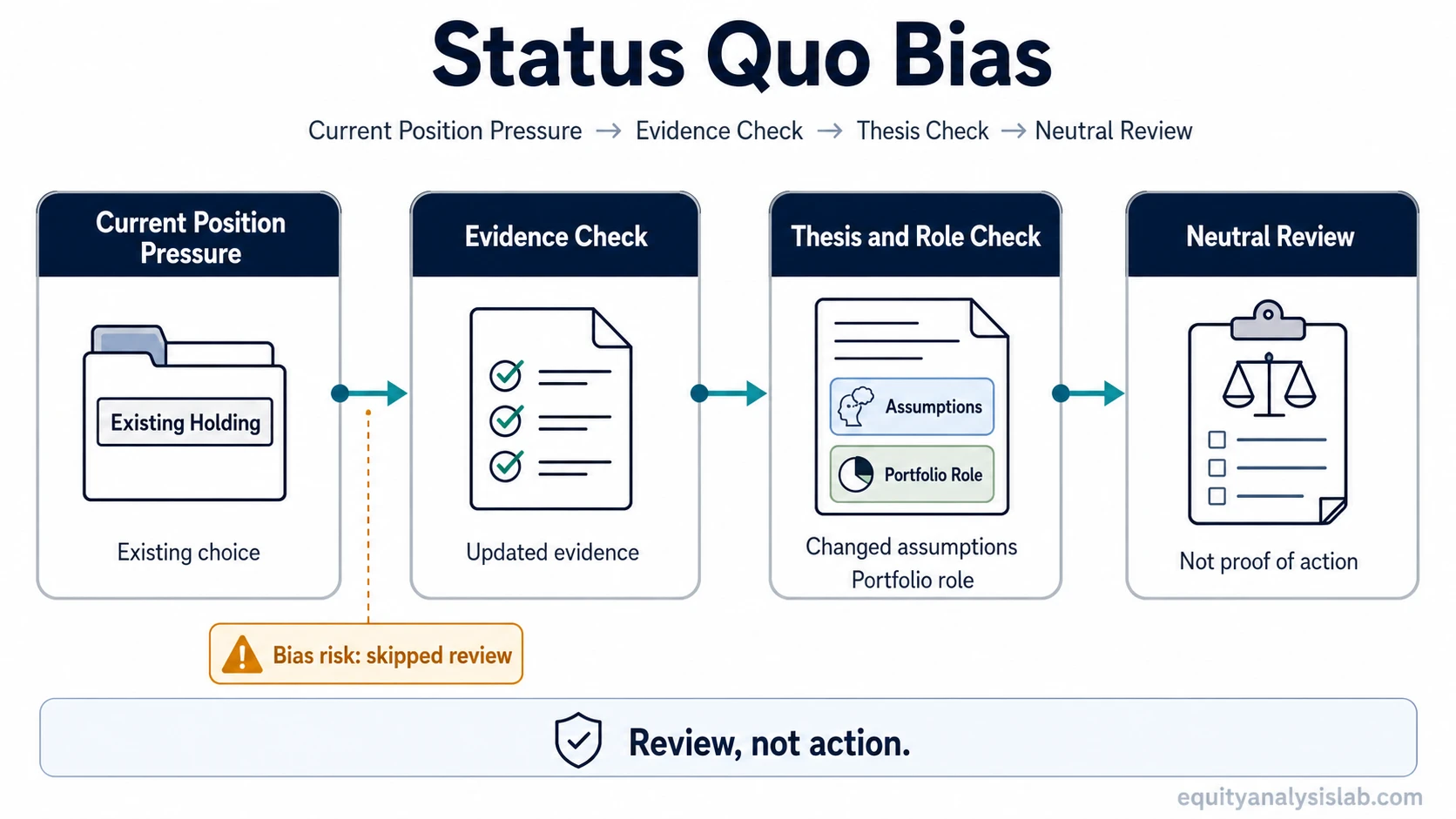
Example: Default Position Pressure Before Evidence Review
An investor has held the same position for several years. The original thesis was based on steady earnings quality, manageable balance-sheet risk, and a reasonable valuation. Later, earnings quality becomes less predictable, margins weaken, and the valuation leaves less room for forecast error.
Status quo pressure appears if the investor keeps treating the position as a default holding without reopening the thesis. A neutral review would separate three questions: what changed in the evidence, what role the position still serves, and whether the current decision would still make sense without the comfort of existing ownership.
The outcome of that review is not predetermined. The position may remain justified, require closer monitoring, or no longer fit the evidence. The bias is the skipped review, not any single portfolio action.
Status Quo Bias and Related Investor Biases
Status quo bias overlaps with other investor psychology patterns, but the distortion is specific. It gives the current state extra weight before the evidence review is complete.
Anchoring bias is different because it centers on a reference point, such as a prior price, valuation, estimate, or original assumption.
A related availability bias problem occurs when recent or memorable information receives too much weight because it is easier to recall.
Evidence review can also be distorted by selectively confirming an existing thesis, which connects status quo pressure to confirmation bias without making the two concepts identical.
FAQ
What is status quo bias in investing?
Status quo bias in investing is the tendency to give extra weight to an existing holding, default allocation, or previous decision before reviewing updated evidence.
Is keeping a current position always status quo bias?
No. Keeping a position can be rational when updated evidence still supports the thesis, portfolio role, costs, and risks. The bias appears when the current state replaces the review.
How can investors check for status quo bias?
A neutral check starts by asking what has changed, what evidence is being ignored, whether ownership itself is influencing the decision, and whether the current position still has a clear role.