
Enterprise Value vs Market Cap

Market cap measures the equity market value of common shares. Enterprise value starts with that equity value, then adjusts for debt-like claims and cash to estimate the value assigned to the operating enterprise.

The useful distinction is not that one metric is always better. Market cap answers an equity ownership question. Enterprise value answers an operating business question after capital structure adjustments. Neither metric is a fair value estimate by itself.

Market capitalization fits best when the investor wants a public equity snapshot. Enterprise value fits best when the investor wants to compare operating businesses with different debt and cash structures.

Enterprise Value vs Market Cap at a Glance

  • Market cap: share price multiplied by shares outstanding.
  • Enterprise value: market cap plus debt-like claims, preferred stock, and minority interest, minus cash and cash equivalents.
  • Market cap question: what value is the stock market assigning to common equity?
  • Enterprise value question: what value is being assigned to the operating enterprise after adjusting for financing structure?
  • Main mistake: treating enterprise value as the true value of the company rather than a different valuation input.
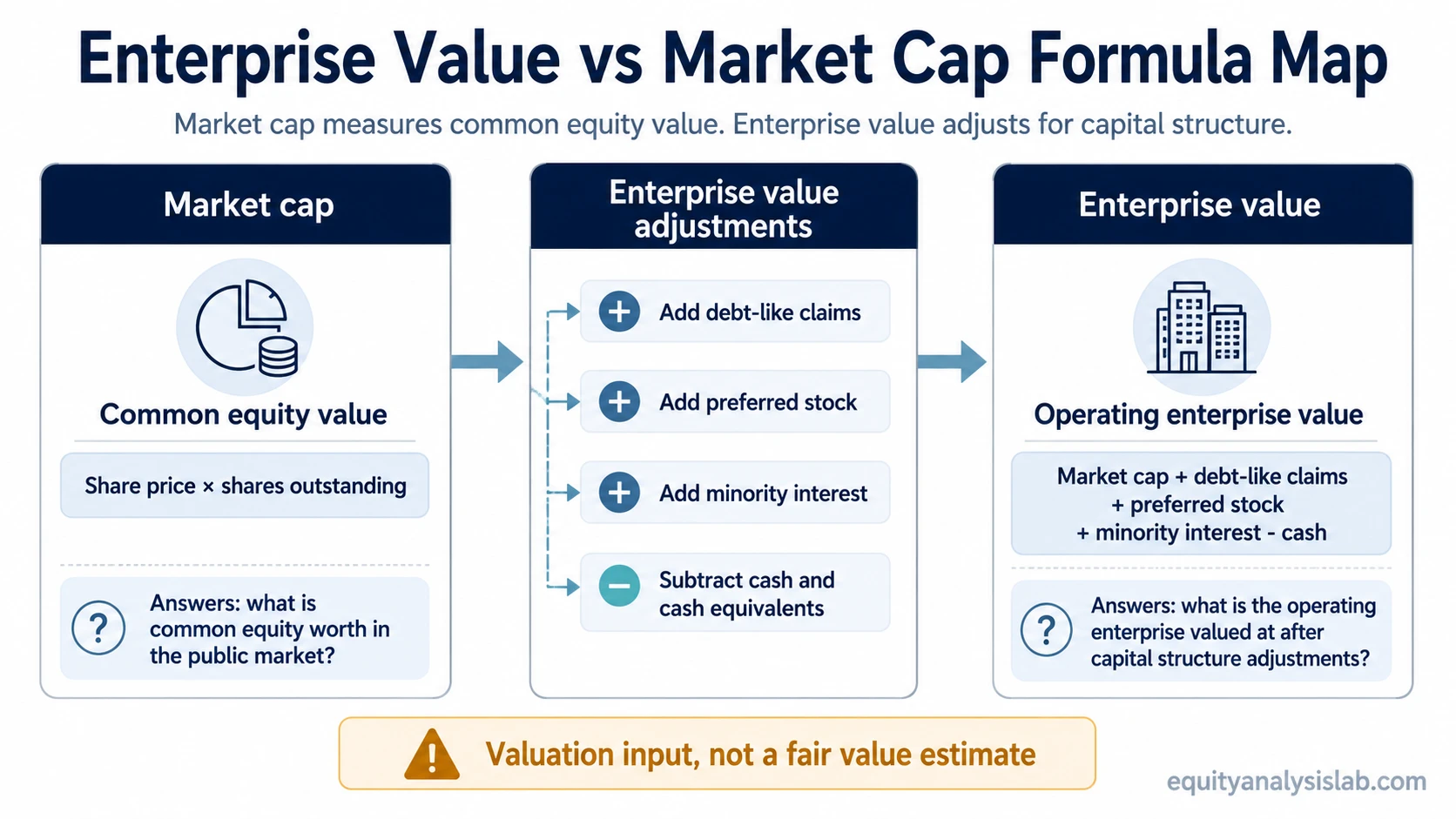
Enterprise value vs market cap diagram showing market cap as common equity value and enterprise value as market cap plus debt-like claims minus cash.
Market cap measures common equity value, while enterprise value adjusts for debt-like claims and cash to estimate operating enterprise value.

Enterprise Value vs Market Cap Comparison

Criterion Market cap Enterprise value
Core question What is common equity worth in the public market? What is the operating enterprise valued at after capital structure adjustments?
Starting input Share price × shares outstanding Market cap
Debt treatment Not included directly Added because debt-like claims are part of the enterprise capital structure.
Cash treatment Not subtracted Subtracted because excess cash can reduce the net cost of the operating enterprise.
Best use Equity-size comparison, index weight, public equity snapshot. Operating business comparison, valuation multiples, acquisition-style analysis.
Main limitation Ignores debt, cash, preferred stock, and other capital claims. Depends on complete and current debt, cash, preferred stock, minority interest, and share-count inputs.

What Market Cap Measures

Market cap measures the value the public market assigns to a company’s common equity. The basic calculation is simple:

Market cap = share price × shares outstanding

If a company has 100 million shares outstanding and the share price is $20, the market cap is $2 billion. That figure represents the market value of the common equity, not the value of every claim on the business.

Market cap is useful when the question is about equity size. It can help compare public companies by stock-market value, understand index weight, or frame how much the public equity market is assigning to common shareholders.

The limitation is that market cap does not directly show how the company is financed. Two companies can have the same market cap while one carries heavy debt and the other holds a large cash balance.

What Enterprise Value Adds and Subtracts

Enterprise value begins with market cap and then adjusts for claims and cash that change the value assigned to the operating business.
Enterprise value = market capitalization + debt + preferred stock + minority interest – cash and cash equivalents

Debt is added because lenders have claims on the enterprise. Preferred stock and minority interest may also be added when they represent claims that sit outside common equity but still affect the total enterprise value view.

Cash is subtracted because cash and cash equivalents can reduce the net value assigned to the operating business. A company with excess cash is not economically identical to a company with the same market cap and no cash.

Enterprise value is especially useful when comparing operating businesses through metrics such as EV/EBITDA, EV/EBIT, or EV/sales. Those comparisons try to match the value of the enterprise with operating results before focusing only on common equity.

Same Market Cap, Different Enterprise Value

Two companies can have the same market cap and still have very different enterprise values.

Illustrative company Market cap Debt Cash Enterprise value
Company A $2.0 billion $1.0 billion $0.2 billion $2.8 billion
Company B $2.0 billion $0.1 billion $0.8 billion $1.3 billion

Both companies have the same equity market value in this simplified comparison. Company A has a higher enterprise value because it carries more debt and less cash. Company B has a lower enterprise value because its cash balance offsets more of the operating enterprise value calculation.

The comparison does not prove that one company is cheaper or better. It only shows why market cap alone can hide capital structure differences, while enterprise value brings debt and cash into the analysis.

Why Investors Confuse the Two Metrics

The confusion usually starts because both metrics are described as ways to measure company value. The more precise question is which claim or business layer is being measured.

Common mistake: Enterprise value is not simply a better version of market cap. Market cap measures common equity value. Enterprise value adjusts that equity value to estimate the value assigned to the operating enterprise.

Market cap can look incomplete because it ignores debt and cash. Enterprise value can look more complete because it incorporates capital structure. But more complete does not mean always more useful. The right metric depends on the investor question.

For an equity-size snapshot, market cap may be enough. For comparing operating businesses with different debt and cash profiles, enterprise value usually gives a more relevant starting point.

When Market Cap Fits Best

Market cap fits best when the focus is common equity ownership rather than total enterprise structure.

Use case Why market cap fits
Public equity size It shows the market value assigned to common shares.
Index weight or size category Public equity benchmarks commonly use market capitalization to classify and weight companies.
Shareholder ownership lens It focuses on common equity rather than the full capital structure.
Quick public-market snapshot The calculation is simpler and directly tied to share price and share count.

Market cap becomes less complete when the companies being compared have very different debt loads, large cash balances, preferred stock, or other capital claims.

When Enterprise Value Fits Best

Enterprise value fits best when the investor wants to compare operating businesses rather than common equity alone.

Use case Why enterprise value fits
Operating business comparison It adjusts for debt and cash differences that can distort market-cap-only comparisons.
EV-based valuation multiples It pairs enterprise value with operating measures such as sales, EBIT, EBITDA, or free cash flow variants.
Capital-structure comparison It makes leveraged and cash-rich companies easier to compare on a more consistent basis.
Acquisition-style perspective It approximates the value assigned to the operating enterprise after considering debt-like claims and cash.

Enterprise value becomes less useful when the inputs are stale, incomplete, or mismatched with the metric being compared. A precise-looking EV multiple can still be misleading if debt, cash, minority interest, lease obligations, or share count inputs are wrong.

Limits of Enterprise Value and Market Cap

Neither metric is a fair value estimate by itself. Market cap and enterprise value are valuation inputs, not investment conclusions.

  • Market cap can miss financing risk: a company with high debt can look similar to a cash-rich company if only equity market value is compared.
  • Enterprise value depends on input quality: debt, cash, preferred stock, minority interest, leases, and share count data can change the result.
  • Cash is not always excess cash: some cash may be needed to run the business, so subtracting all cash can overstate the adjustment in certain analyses.
  • Enterprise value is not a stock conclusion: lower enterprise value does not automatically mean undervalued, and higher enterprise value does not automatically mean overvalued.
  • Multiple context still matters: EV/sales, EV/EBITDA, and other ratios depend on margins, growth, cyclicality, accounting quality, and business risk.

The strongest use of both metrics is comparative. Market cap clarifies the equity market view. Enterprise value clarifies the operating-enterprise view. The valuation work begins after choosing the metric that matches the question.

How to Choose the Right Metric

Start with the question being asked.

Investor question Metric that fits Reason
How large is the company’s public equity value? Market cap It measures common equity value directly.
How does the operating business compare with another company? Enterprise value It adjusts for debt-like claims and cash.
How much value is assigned to common shareholders? Market cap It focuses on equity ownership, not total capital claims.
Which company looks cheaper on an operating multiple? Enterprise value It can be matched with operating earnings, sales, or cash flow measures.

The practical rule is simple: use market cap for the common equity view, and use enterprise value for the operating enterprise view.

Enterprise Value vs Market Cap FAQ

Is enterprise value the same as market cap?

No. Market cap measures the market value of common equity. Enterprise value starts with market cap and adjusts for debt-like claims, preferred stock, minority interest, and cash to estimate operating enterprise value.

Why is enterprise value often higher than market cap?

Enterprise value is often higher than market cap when a company has debt or other capital claims that exceed its cash adjustment. If a company has more cash than debt-like claims, enterprise value can be lower than market cap.

Is enterprise value better than market cap?

Enterprise value is not automatically better. It is better for operating business comparisons and EV-based multiples. Market cap is better when the question is about common equity value, public equity size, or shareholder ownership value.

Does enterprise value show whether a stock is cheap?

No. Enterprise value is an input for valuation analysis. It does not show whether a stock is cheap or expensive without comparing it to earnings quality, cash flow, growth, margins, risk, and the specific valuation multiple being used.