
Stocks create direct ownership exposure, while options create contract-based exposure with defined terms such as premium, strike price, expiration, and payoff boundaries. The same view on a company can therefore produce very different capital requirements, risks, rights, time constraints, and outcomes depending on whether it is expressed through shares or options.
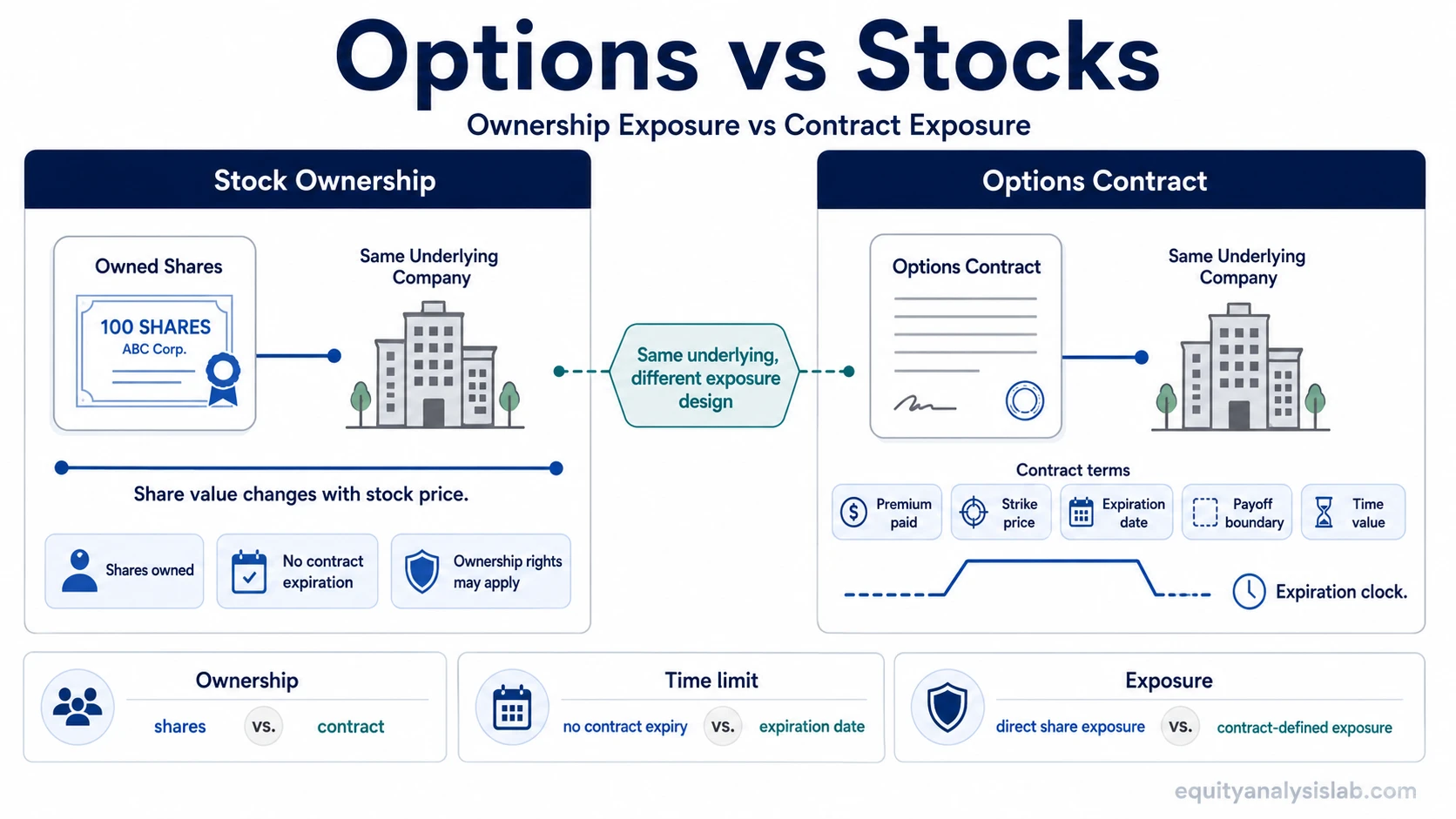
The useful comparison is not whether stocks or options are universally better. It is whether the exposure design matches the investor’s objective, time horizon, capital constraints, and willingness to accept the risks created by the instrument.
Key Points
- Stocks represent direct ownership, while options represent contractual rights or obligations tied to an underlying security.
- Shares do not have a built-in option expiration date; standard options do.
- Options can require less upfront capital while introducing time decay, volatility sensitivity, strike selection, and expiration risk.
- Defined option loss does not automatically mean low risk.
- The same bullish or bearish view can produce very different payoff structures through stock and options.
- Capital efficiency should be evaluated together with time horizon, liquidity, probability of loss, and the amount of exposure actually created.
See Stock Exposure Converted Into Call Option Exposure
This real Lyft case shows a position in which shares were sold after a gain and part of the proceeds were used to purchase call options so upside exposure could remain while less capital stayed committed to the original stock position.
Important context: the approximately $85 downside shown in this video is the net result of one specific case that included an earlier stock position and realized gains. It is not the maximum loss of a long call in general. A purchased call can lose the full premium paid if the contract expires without sufficient value.
The phrase “call stacking” in the video describes the author’s case-specific way of adding call exposure. It should not be treated as a standardized options strategy name or as a general recommendation to replace shares with calls.
Options vs Stocks Comparison
| Comparison Point | Stocks | Options |
|---|---|---|
| Basic exposure | Direct ownership of shares. | A contract linked to an underlying security. |
| Upfront capital | Usually share price multiplied by the number of shares purchased. | Option buyers pay premium; sellers may require collateral or margin depending on the structure. |
| Expiration | Shares do not expire as instruments. | Options have defined expiration dates. |
| Time decay | No contractual time decay exists in ordinary share ownership. | Long options can lose time value as expiration approaches. |
| Leverage | Exposure generally scales directly with shares owned. | A smaller premium can create larger notional exposure, but the contract can also lose most or all of its value. |
| Ownership rights | Shareholders may have voting and dividend rights depending on the security. | Option ownership alone does not provide shareholder rights. |
| Payoff | Value changes directly with the market value of the shares. | Payoff depends on contract type, strike, premium, expiration, and underlying price. |
| Liquidity | Depends on trading activity in the shares. | Can vary significantly across strikes and expirations, with bid-ask spread becoming important. |
| Main additional risk | Business, valuation, market, concentration, and permanent-capital-loss risk. | Expiration, time decay, volatility, liquidity, leverage, and contract mechanics in addition to underlying-market risk. |
Why Lower Option Cost Does Not Mean the Same Exposure
Options can appear attractive because the premium required to establish a position may be much lower than the cash needed to buy an equivalent number of shares. The lower upfront amount does not mean the investor has purchased a cheaper version of the stock.
Shares and options respond to different variables. Stock exposure has no built-in expiration clock. An option’s value depends not only on the underlying share price but also on strike, time remaining, implied volatility, and liquidity.
| Question | Stock Position | Long Call Position |
|---|---|---|
| What is purchased? | Shares. | A contractual right to buy shares under defined terms. |
| Can the position expire? | No built-in contract expiration. | Yes. |
| Can the full initial outlay be lost? | The stock can theoretically lose most or all of its value. | The entire premium can be lost if the option expires without sufficient value. |
| Does a slow bullish thesis still help? | The investor can continue owning the shares if the thesis remains valid. | A correct directional thesis can still fail economically if the move occurs too slowly for the selected expiration. |
| Does volatility affect market value? | Volatility affects the stock price but is not a separate contractual pricing input. | Implied volatility directly affects option pricing before expiration. |
Defined Risk Does Not Mean No Risk
One advantage of a purchased option is that the contract can create a defined maximum premium loss. That definition is useful for risk budgeting, but the possibility of losing the entire premium can still make the position economically aggressive.
| Statement | Correct Interpretation |
|---|---|
| “My maximum loss is defined.” | The maximum contractual loss of the purchased option can usually be identified before entry. |
| “Therefore the trade has almost no risk.” | Not necessarily. Losing 100% of a smaller premium is still a real loss. |
| “The option requires less capital.” | Capital at risk may be smaller, but leverage and expiration can make the outcome more sensitive. |
| “The stock can fall much further than the option premium.” | True for a purchased call’s contractual loss, but stock and option positions do not provide identical exposure or time horizons. |
Risk principle: compare the probability and size of loss, not only the maximum dollar amount shown on a payoff chart.
Using Calls Instead of Shares
A long call can sometimes be used to maintain bullish exposure while committing less upfront capital than a stock position. This changes the risk geometry rather than reproducing share ownership exactly.
The dedicated Long Call page covers premium, breakeven, maximum loss, time decay, implied volatility, and expiration in more detail.
| Potential Benefit | Trade-Off Created |
|---|---|
| Lower initial cash outlay | The contract has an expiration date. |
| Defined premium loss for a purchased call | The entire premium can be lost. |
| Upside exposure with less capital committed | The option may not track the stock one-for-one. |
| Ability to choose strike and expiration | Strike and expiration selection introduce additional ways for the thesis to fail. |
| Potential to keep unused cash elsewhere | The economic comparison should include what that cash earns and whether the option premium is repeatedly replaced. |
Capital Efficiency vs Leverage
Capital efficiency and leverage are related but not identical. Using less cash to create exposure can improve flexibility, but increasing notional exposure relative to capital can also amplify the percentage impact of an adverse outcome.
| Question | Useful Interpretation |
|---|---|
| How much capital is committed? | Compare the stock cost with the option premium or collateral required. |
| How much underlying exposure exists? | Compare notional exposure rather than premium alone. |
| What can be lost? | Measure the dollar loss and the percentage of committed capital that can disappear. |
| How long does the thesis have? | Stock ownership and option expiration create different time constraints. |
| What happens if the thesis is correct but late? | A stockholder may still own the shares, while an option can expire before the expected move develops. |
Same Underlying, Different Exposure Design
The most useful way to compare stocks and options is to hold the underlying company view constant and change only the instrument.
| Exposure Design | Economic Position | Main Risk Boundary |
|---|---|---|
| Own shares | Direct participation in the stock price with no contract expiration. | Downside remains tied to the value of the shares. |
| Buy a call | Time-limited bullish contract exposure. | Premium can be lost if the move is insufficient or too late. |
| Own stock + protective put | Share ownership with a contractual downside hedge. | The hedge costs premium and expires. |
| Own stock + collar | Share ownership with downside protection and capped upside. | Risk is reshaped by both the long put and short call. |
A Protective Put and a Collar demonstrate how options can modify an existing stock position instead of replacing it.
When Options vs Stocks Comparisons Become Misleading
| Common Comparison Error | Why It Misleads | Better Comparison |
|---|---|---|
| Comparing only upfront cost | A smaller premium can hide expiration and leverage risk. | Compare capital, notional exposure, maximum loss, and holding period. |
| Comparing only maximum dollar loss | A small dollar loss can still represent 100% of the capital committed to the option. | Compare both dollar risk and percentage-of-capital risk. |
| Assuming calls are cheaper stock | A call has strike, expiration, time decay, and volatility sensitivity. | Compare ownership mechanics with contract mechanics. |
| Ignoring timing | An option can fail before a long-term company thesis has time to develop. | Match instrument life with the expected thesis horizon. |
| Ignoring unused cash | Replacing stock with options can free capital, but the economic result depends on how the remaining cash is treated. | Include cash yield, funding cost, and repeated option premium in the comparison. |
| Calling a case-specific payoff “riskless” | Prior profits can offset a new position economically, but the new option contract still carries its own loss risk. | Separate realized gains, current capital at risk, and contract maximum loss. |
Related Ownership and Option Concepts
For direct share ownership, the broader equity investing framework connects the stock position with business quality, valuation, earnings durability, cash flow, capital allocation, and portfolio role.
For options, the option premium is the upfront price paid by the buyer and received by the seller. Comparing only that premium with the cash required for shares can understate the importance of expiration, leverage, volatility sensitivity, and contract terms.
Options can also create exposure without current share ownership. A cash-secured put structure is built around reserved cash and a potential purchase obligation, which makes its mechanics different from both owning shares and buying a call.
Common Options vs Stocks Mistakes
| Common Mistake | Why It Weakens the Decision | Better Check |
|---|---|---|
| Choosing options only because they provide leverage | Leverage does not show whether the contract fits the timeframe, liquidity, or risk budget. | Check instrument fit before notional upside. |
| Ignoring expiration | The thesis can remain valid while the contract runs out of time. | Compare expected thesis duration with option life. |
| Ignoring implied volatility | The underlying stock can move favorably while option value is affected by a volatility change. | Evaluate option pricing, not only stock direction. |
| Ignoring bid-ask spread | Theoretical payoff can differ from practical execution. | Check liquidity by strike and expiration. |
| Assuming defined loss means conservative exposure | Repeated full-premium losses or oversized notional exposure can still damage a portfolio. | Evaluate total portfolio risk and position size. |
| Using stock and option returns as if they were directly comparable | The instruments can have different capital bases, durations, and payoff shapes. | Compare the full economic exposure rather than raw percentage return alone. |
How to Choose Between Stock and Option Exposure
- Start with the underlying thesis. Decide why the company or security is attractive before choosing the instrument.
- Define the expected time horizon. A long-duration thesis and a short-dated option can be a poor match even when the directional view is correct.
- Compare capital required. Measure the share cost, premium, collateral, and any cash released or reserved by the structure.
- Compare total exposure. Look beyond premium to the notional size and sensitivity of the option position.
- Define the maximum acceptable loss. Use the actual portfolio risk budget rather than assuming the smaller upfront instrument is automatically safer.
- Check liquidity and contract mechanics. Review strike, expiration, spread, implied volatility, exercise, and assignment where relevant.
- Compare what happens if the thesis is early, late, or wrong. Instrument choice should remain useful across more than the ideal scenario.
Limitations of the Options vs Stocks Comparison
There is no universal risk ranking between stocks and options. A diversified stock position, a concentrated stock position, a long call, a short option, and a defined-risk spread can have completely different economic profiles.
The comparison also changes with the investor’s time horizon, portfolio size, tax situation, liquidity needs, broker rules, and ability to manage option expiration and exercise mechanics.
Options and stocks are therefore best compared as exposure-design tools. The same underlying thesis can be packaged in different ways, but lower capital required, higher leverage, or a defined contractual loss does not make one instrument universally superior.