
Long-term and short-term investing differ mainly in when capital may be needed and how much time the investment decision has to develop. Shorter horizons give more weight to liquidity, near-term path risk, and events that can affect the position before the money is required. Longer horizons give business results, valuation, reinvestment, and compounding more time to influence the outcome.
The relevant period follows from the financial goal and the expected use of the capital. The same stock, fund, or portfolio position can therefore be evaluated through different horizons when the investor purpose and cash need are different.
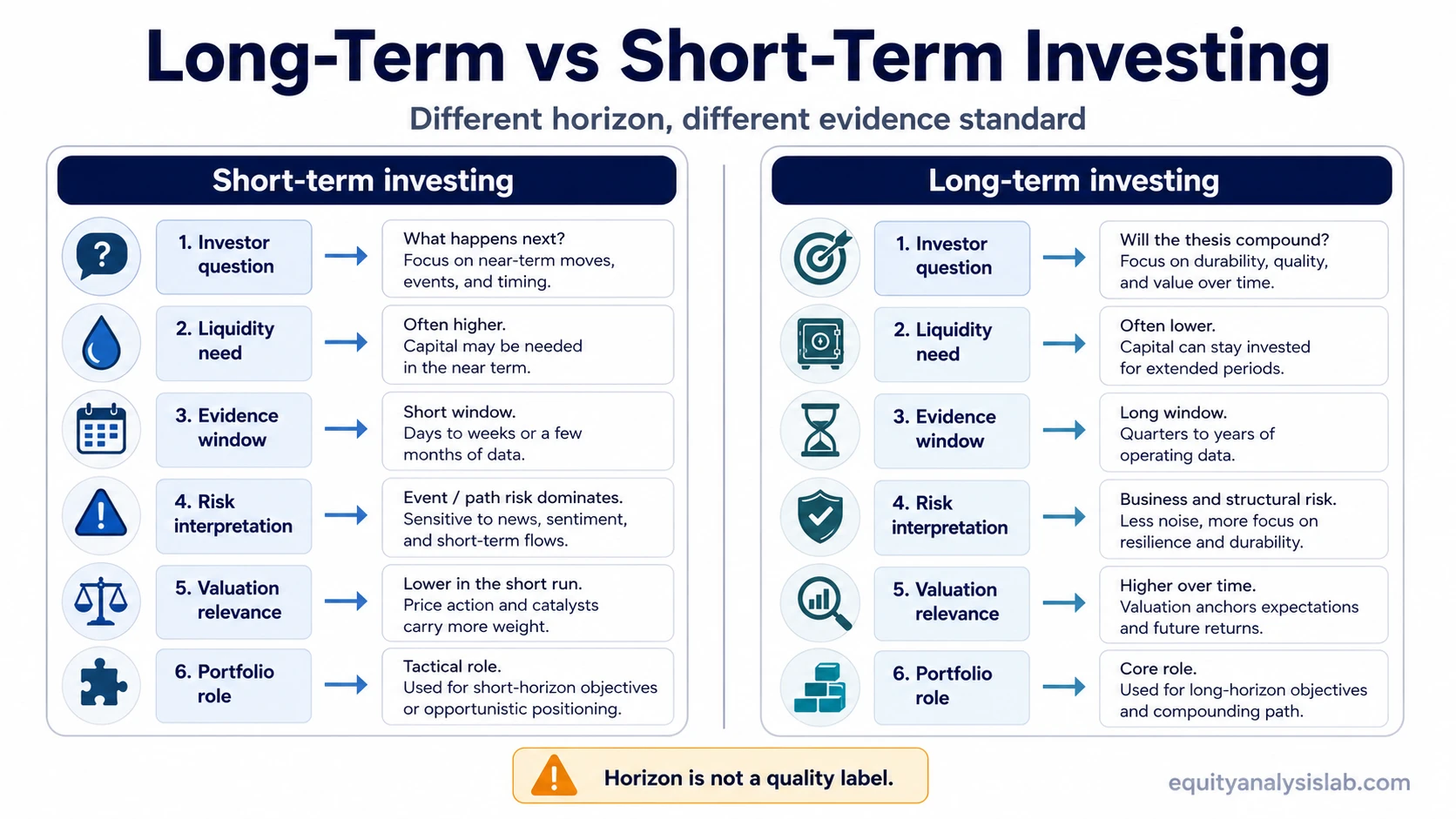
Key Differences Between Long-Term and Short-Term Investing
| Comparison area | Short-term investing | Long-term investing |
|---|---|---|
| Primary decision frame | Whether the position can serve a nearer-term purpose without creating unacceptable liquidity or path risk. | Whether the position remains supported by the investment thesis, valuation, and underlying economic evidence over a longer period. |
| Liquidity need | Access to capital can become a central constraint because the position may need to be sold within a limited window. | Near-term liquidity may carry less weight when the capital has no scheduled use, although liquidity still remains relevant. |
| Evidence window | Near-term events, price path, market conditions, and exit conditions can materially affect whether the position still serves its purpose. | Business durability, cash flow, balance-sheet strength, capital allocation, reinvestment, and valuation have more time to affect the thesis. |
| Price path | Interim movement can matter directly when the investor may need to exit soon. | Interim movement may carry less immediate consequence when capital is not required, while thesis deterioration still matters. |
| Valuation | Valuation remains relevant, although a short outcome window can be dominated by events, liquidity, and market repricing. | Starting valuation interacts with a longer stream of business results and can materially affect the return ultimately realized. |
| Risk expression | Timing error, event risk, liquidity pressure, and a forced sale can become important. | Business deterioration, overvaluation, dilution, weak capital allocation, and permanent impairment can become more important to the thesis. |
| Portfolio role | The position may serve a defined near-term exposure or liquidity-related objective. | The position may form part of a multi-year ownership, allocation, or investment thesis. |
The Same Asset Can Be Evaluated Through Different Horizons
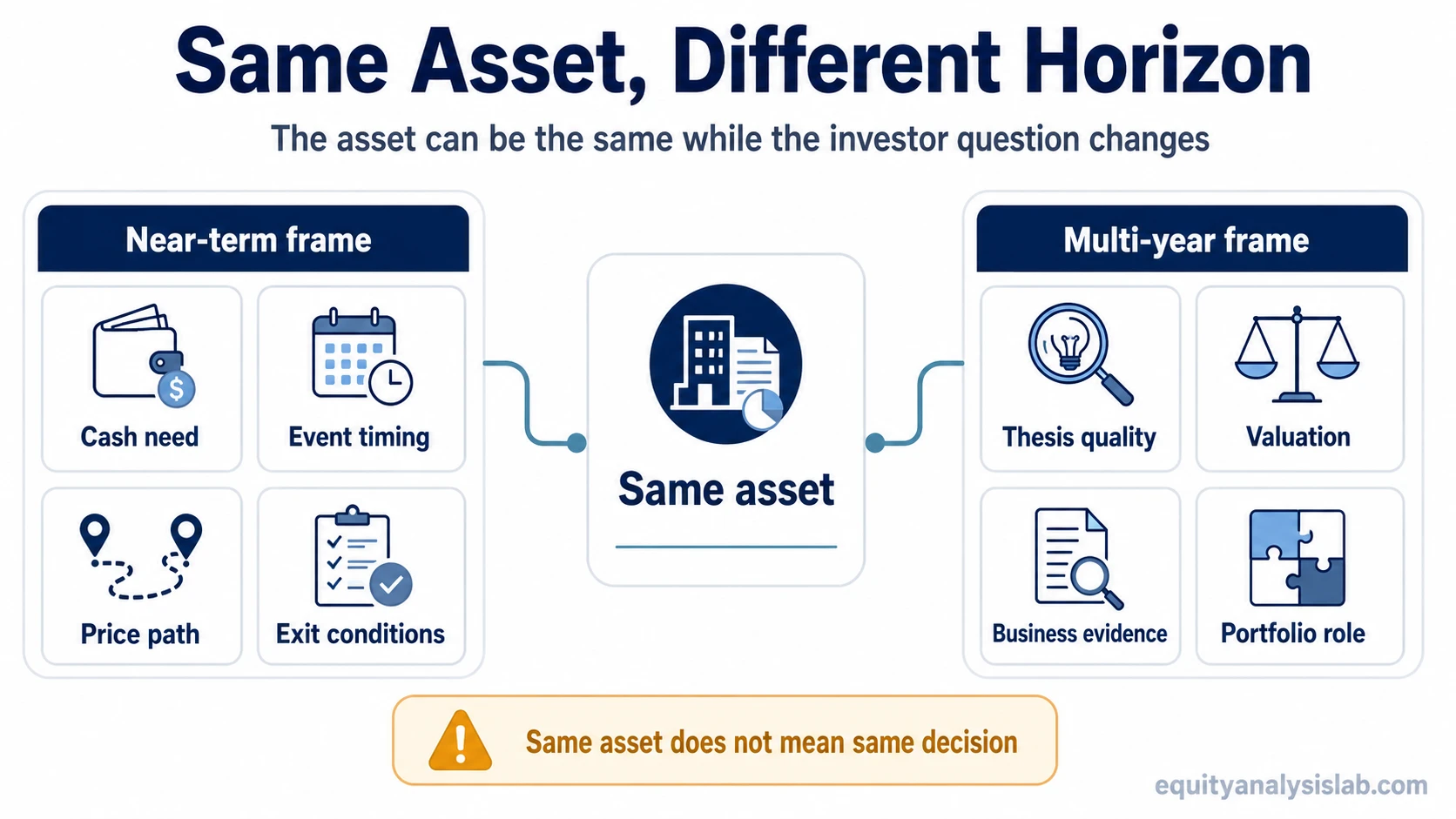
Consider the same hypothetical company held by two investors.
One investor expects to use the capital relatively soon. An upcoming earnings release, exit liquidity, and the effect of a near-term drawdown on that cash requirement may carry substantial weight in the decision.
Another investor has no scheduled near-term withdrawal and is testing a multi-year thesis. Margins, cash generation, dilution, reinvestment, valuation, and the durability of the business can carry more weight because there is more time for those factors to develop.
The company has not changed between the two cases. The purpose of the capital and the period available to evaluate the position have changed.
Horizon, Liquidity, and Risk Tolerance Are Separate Inputs
FINRA treats investment time horizon, liquidity needs, and risk tolerance as separate parts of an investor profile. Its guidance notes that a longer horizon can reduce liquidity pressure in general, but the relationship is not absolute, and some investors with long horizons may still need liquidity or may not want or be able to take greater risk.
Investor.gov similarly defines the investment horizon by the months, years, or decades available to achieve a financial goal and treats risk tolerance as a separate consideration.
What Changes as the Horizon Lengthens
The separate time horizon concept defines how long capital can remain invested before the goal requires it. That period changes which observations can reasonably affect the decision.
A short window gives business fundamentals less time to offset poor entry timing, a liquidity problem, or an adverse event before the capital is needed. A longer window gives business results more time to develop, while also giving competition, capital allocation mistakes, valuation errors, and thesis deterioration more time to become visible.
The horizon therefore changes the evidence window. It does not replace the evidence itself.
Risk, Valuation, and Compounding Across Different Horizons
A broader risk and return framework helps separate temporary price movement from liquidity pressure, business impairment, valuation risk, and the return expected for taking those risks.
Longer horizons also make compounding more relevant because retained gains and reinvestment have more periods in which to affect the capital base. The realized result still depends on the returns actually earned, the valuation paid, the quality of reinvestment, costs, dilution, and losses along the way.
Holding Horizon and Investing Style Are Different Decisions
The period is shaped by the financial goal, expected cash need, and the time available before the capital may be required.
Active or passive implementation, security selection, trading frequency, and research process describe a different part of the decision. A passive fund can be held for a shorter goal, while an individual company position can be evaluated through a multi-year thesis.
Limits of the Comparison
Horizon can change the consequences of volatility and the time available for evidence to develop. It does not establish asset quality, valuation, liquidity, diversification, suitability, or future return. A short horizon also does not make an investment automatically speculative or inappropriate.
Contribution Timing Is a Separate Decision
An investor using dollar-cost averaging can have a long-term financial objective while individual contributions enter the investment at different prices and market conditions.
The contribution schedule changes the path into the position. The investment horizon still follows from the goal, the expected cash need, and the period available to evaluate the investment.