
Dollar cost averaging vs lump sum compares two ways to deploy cash that is already available for investment. Dollar cost averaging stages the money across scheduled purchases. Lump sum investing puts the full amount into the market immediately.
The asset and total cash amount can be identical in both cases. What changes is how quickly market exposure is created and how much money remains uninvested while deployment is still in progress.
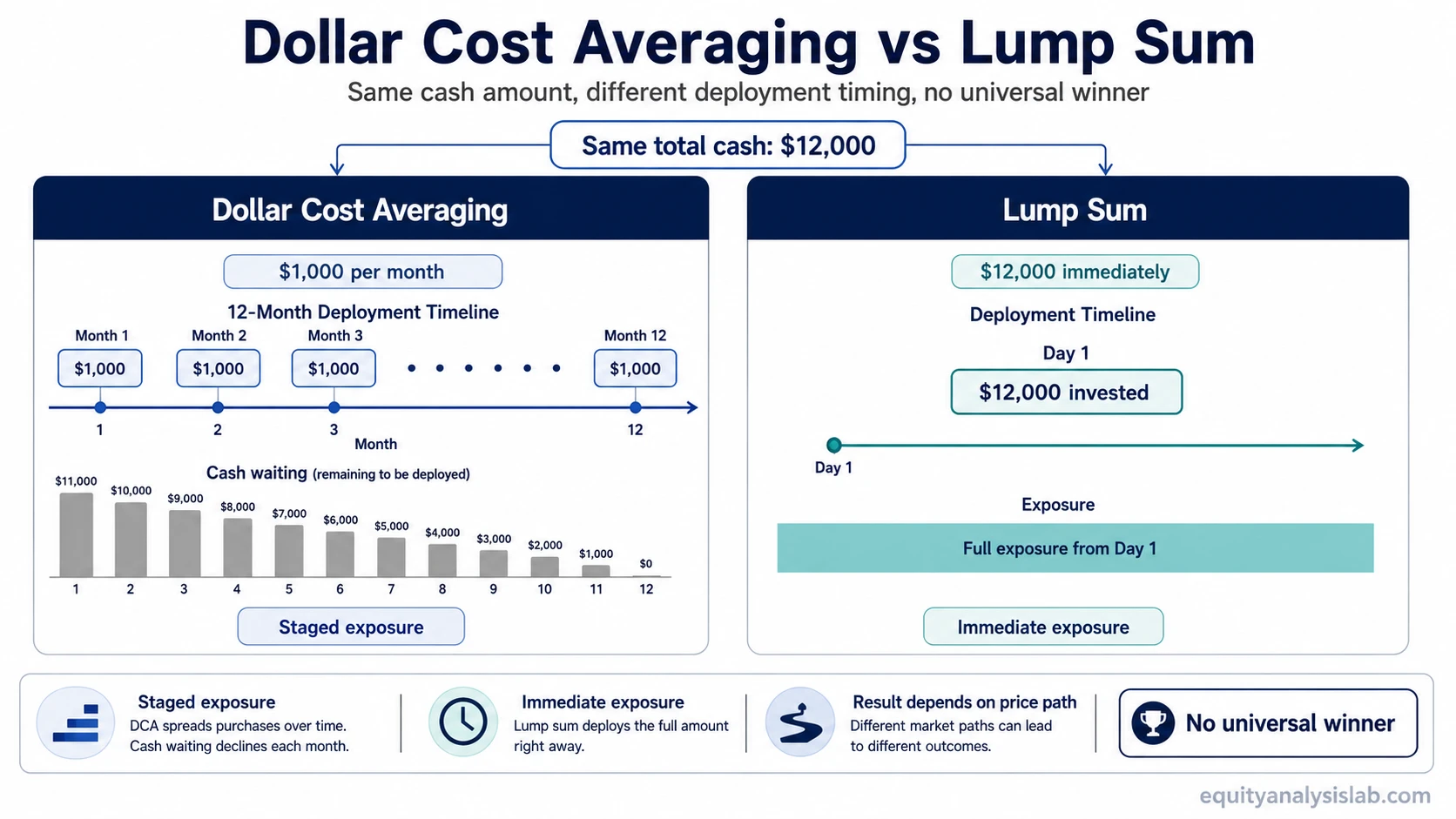
The Core Difference
The available cash is divided across scheduled purchase dates. Only the amount already deployed is exposed to market movement, while the remaining cash waits for later purchases.
The available cash is invested immediately. The full amount participates in subsequent gains or losses from the first deployment date.
How DCA and Lump Sum Change Exposure
| Criterion | Dollar cost averaging | Lump sum |
|---|---|---|
| Initial market exposure | Only the first scheduled contribution is invested. | The full available amount is invested immediately. |
| Entry-date concentration | Purchase prices are spread across several dates. | The full amount depends on one initial deployment date. |
| Cash during deployment | Part of the available cash remains outside the investment until later purchases. | No scheduled deployment cash remains after the initial investment. |
| If prices rise during deployment | Later contributions enter at higher prices and some cash misses earlier gains. | The full amount participates in the rise from the beginning. |
| If prices fall early | Later scheduled purchases can occur at lower prices. | The full amount participates in the decline from the beginning. |
| Implementation trade-off | Reduces dependence on one entry date but creates a period of partial market exposure. | Maximizes immediate exposure but concentrates the initial timing decision. |
What Historical Evidence Adds
Vanguard research comparing immediately available lump-sum cash with staged cost averaging across historical markets and simulated return paths found that lump-sum strategies outperformed common cost-averaging approaches roughly two-thirds of the time. The main cost of staging was the period in which part of the capital remained in cash. The same research found that cost averaging may still be more suitable for investors with strong loss aversion because it temporarily reduces market exposure during the deployment period.
The evidence changes the interpretation of the comparison. The two methods do not have equal historical odds simply because either one can win in a particular market path. Lump sum has had the higher historical hit rate in this research, while dollar cost averaging trades some immediate exposure for less concentration in the first purchase date.
Same Cash, Different Market Path
Illustrative example: An investor has $12,000 available for the same diversified investment. A lump sum approach invests the full $12,000 immediately. A staged approach invests $1,000 each month for 12 months.
If prices rise steadily, the lump sum has more capital participating earlier. If prices fall during the first part of the year, the staged approach makes some later purchases at lower prices. If prices move sharply in both directions and finish near the starting level, the sequence of purchase prices can still create a different result even though the final market level is similar.
This example isolates deployment timing. It does not assume that either market path will occur.
Expected Return and Time in the Market
Expected return describes an estimate built from assumptions about future outcomes. Lump sum investing gives the full amount immediate exposure to whatever return the asset subsequently produces. Dollar cost averaging temporarily keeps part of the available cash outside that exposure.
When returns are positive, earlier exposure gives more capital more time to participate. Dividends, distributions, and reinvested gains can also become part of a broader compounding process. If the asset falls soon after deployment, the same full exposure works in the opposite direction and the lump sum absorbs the decline from the start.
What the Comparison Does Not Decide
DCA and lump sum answer how available cash enters an investment. They do not determine asset quality, valuation, portfolio allocation, liquidity needs, personal suitability, or the return that will actually be earned. A weak investment case remains weak regardless of how the purchases are scheduled.