
A sector ETF is an exchange-traded fund that concentrates equity exposure in companies from one market sector or industry group. It gives narrower exposure than a broad market ETF, so the fund label should be checked against holdings, weighting, costs, liquidity, tracking, distributions, and portfolio overlap.
Sector ETF definition: A sector ETF holds a basket of stocks connected to a specific part of the equity market, such as a sector or industry group, while trading through the ETF wrapper.
Key Points About Sector ETFs
- A sector ETF narrows equity exposure to one market sector or industry group.
- The sector label describes the exposure area, not the full risk profile of the fund.
- Holdings, weighting, index rules, costs, liquidity, tracking, and distributions all affect interpretation.
- A sector ETF can increase concentration or overlap when it is added to an existing broad equity allocation.
- The ETF structure does not automatically make the position diversified, low cost, liquid, or suitable for every investor.
What Is a Sector ETF?
A sector ETF is an ETF that focuses on companies tied to a particular economic sector or industry area rather than holding the whole equity market. The fund may track a sector index, follow a defined selection methodology, or use another published strategy, depending on how the ETF is built.
The exposure starts with a sector lens. A technology-focused fund, a health-care-focused fund, or an energy-focused fund may all use the ETF wrapper, but each one can behave differently because the underlying companies, revenue drivers, valuation sensitivity, and sector cycles are different.
Investors may see sector classification frameworks, but the exact implementation depends on the classification system, index provider, and fund methodology used by a specific ETF.
How Sector ETF Exposure Works
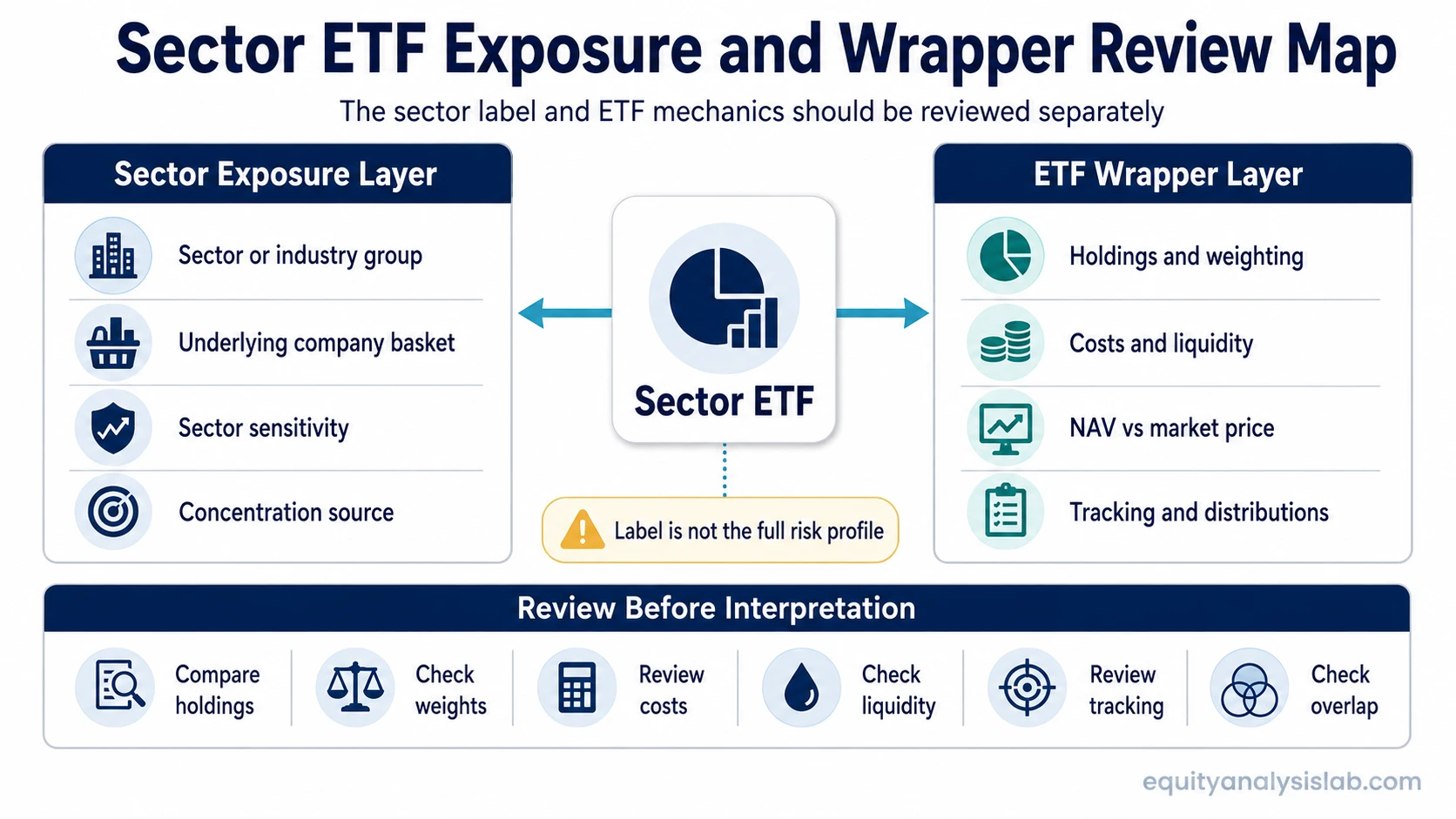
Sector ETF exposure comes from the fund’s underlying basket. A sector name on the fund does not show how concentrated the portfolio is, which companies dominate the weight, whether the fund is market-cap weighted, or whether the strategy uses a different weighting method.
The exposure layer identifies which part of the equity market the fund is trying to represent. The wrapper layer shows how the ETF delivers that exposure through holdings, weighting, trading liquidity, expenses, tracking, and distributions.
| Layer | What it tells you | Why it matters |
|---|---|---|
| Sector exposure layer | The economic sector, industry group, or sector-linked basket the fund is designed to represent. | It shows the main source of equity concentration. |
| Holdings layer | The actual companies inside the ETF and how much weight each company receives. | Two funds with similar sector labels can still have different concentration and company exposure. |
| ETF wrapper layer | The fund mechanics, including costs, liquidity, NAV behavior, tracking, and distributions. | The wrapper affects how the exposure is implemented and interpreted. |
Sector ETF vs Broad Market ETF
A broad market ETF usually spreads exposure across many sectors. A sector ETF narrows the exposure to one sector or industry group, which can make the fund more sensitive to that sector’s earnings cycle, valuation changes, regulation, commodity inputs, interest-rate sensitivity, or business conditions.
| Comparison point | Sector ETF | Broad market ETF |
|---|---|---|
| Main exposure | One sector or industry group. | Many sectors across a broader equity market. |
| Diversification profile | Usually narrower and more concentrated. | Usually broader across sectors and companies. |
| Main interpretation risk | Assuming the ETF label removes concentration risk. | Assuming broad exposure explains every sector-level driver inside the fund. |
| Useful check | Top holdings, sector purity, weighting, costs, liquidity, and overlap. | Index coverage, sector weights, total cost, tracking, and market exposure. |
Sector ETF vs Thematic ETF
A sector ETF starts from a sector or industry classification. A thematic ETF starts from an investment theme, business trend, or structural idea that may cut across several sectors.
For example, a sector ETF may focus on companies inside one classified sector. A thematic ETF may include companies from different sectors if they are connected to the same theme. The difference matters because the name of a fund can sound narrow while the actual holdings may be broader, or it can sound broad while the portfolio is concentrated in a small group of companies.
Practical distinction: sector exposure is classification-led; thematic exposure is theme-led. Both still require holdings, weighting, liquidity, cost, and overlap checks before the fund can be interpreted properly.
What to Check Before Interpreting a Sector ETF
The sector name is only the starting point. A useful review separates the exposure question from the ETF implementation question.
| Check | Question to ask | What it can reveal |
|---|---|---|
| Holdings | Which companies does the ETF actually own? | Whether the fund is broad within the sector or dominated by a small number of companies. |
| Weighting | Are holdings market-cap weighted, equal weighted, or weighted by another rule? | Whether large companies dominate the fund or exposure is spread more evenly. |
| Index or strategy | Is the fund tracking a sector index, following a rules-based screen, or using active decisions? | How the fund decides what belongs inside the portfolio. If the fund uses active selection, compare the structure with an actively managed ETF. |
| Expense ratio | What ongoing fund cost is charged? | How much the wrapper costs before considering market performance. |
| Fund size and trading activity | Is there enough asset base and trading activity for the investor’s use case? | Whether the fund may be easier or harder to transact in normal market conditions. |
| Bid-ask spread | How wide is the gap between buying and selling quotes? | How trading costs may appear beyond the stated expense ratio. |
| NAV and market price | Does the ETF trade close to the value of its underlying holdings? | Whether the market price is aligned with the fund’s underlying portfolio value. |
| Tracking difference and tracking error | How closely does the ETF follow its stated benchmark or strategy? | Whether the fund’s realized behavior matches the exposure it claims to represent. |
| Distributions | Does the fund distribute income or capital gains, and how should those distributions be interpreted? | How cash distributions can affect return interpretation and tax context. This requires individual tax review, not a general rule from the fund label. |
| Portfolio overlap | Does the ETF duplicate companies or sector exposure already held elsewhere? | Whether the position increases concentration instead of adding meaningful diversification. |
Why Portfolio Overlap Matters
Common mistake: assuming that “ETF” automatically means broad diversification. A sector ETF can hold many stocks and still create concentrated exposure if those stocks come from the same economic sector or if the largest holdings carry most of the fund weight.
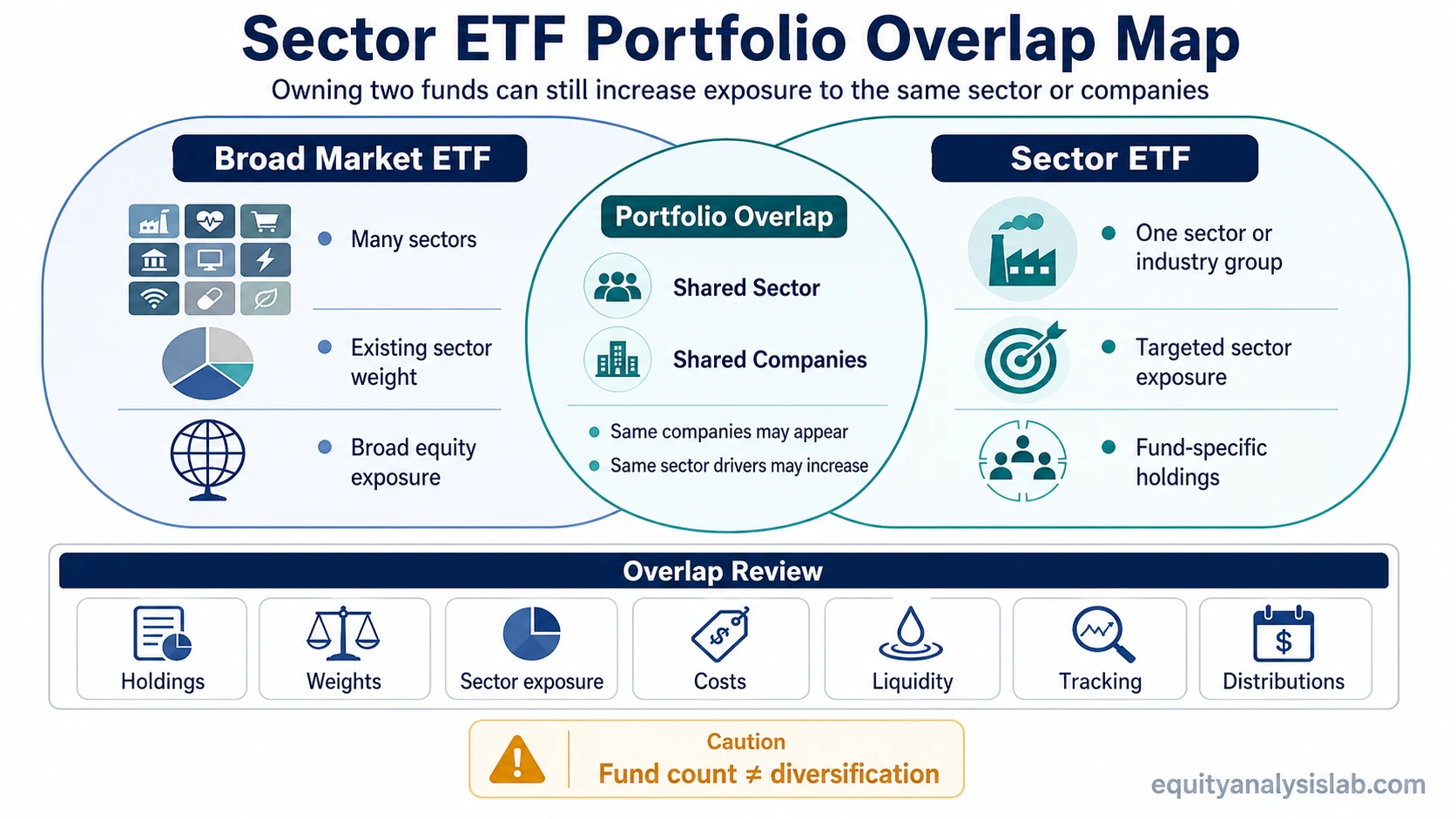
Overlap becomes especially important when a sector ETF is added beside a broad equity ETF. The broad fund may already contain large companies from the same sector. Adding the sector ETF can increase exposure to the same business drivers, even if the investor now owns two different funds.
The issue is not that overlap is automatically wrong. The issue is that overlap changes interpretation. A portfolio that appears diversified by fund count may still be concentrated by sector exposure, company exposure, earnings driver, or valuation sensitivity.
Short Illustrative Scenario
An investor owns a broad market ETF and later adds a sector ETF because the sector label looks like a targeted way to express an equity view. A holdings review shows that several of the largest companies in the sector ETF already appear inside the broad market ETF, and the sector weight of the total portfolio rises more than the investor first expected.
The new fund does not simply add a separate sleeve. It increases exposure to the same sector and some of the same companies. A stronger review compares holdings, weights, costs, liquidity, tracking, distributions, and overlap before treating the ETF as a distinct exposure.
Limitations of the Sector ETF Label
A sector ETF label does not guarantee diversification, company quality, low cost, trading liquidity, tax efficiency, benchmark precision, positive return, or suitability. It only indicates that the fund is organized around a sector or industry exposure.
A sector fund can be useful for understanding targeted equity exposure, but the label should not replace fund-level review. The same sector category can contain funds with different holdings, concentration, index rules, rebalancing methods, expenses, distribution patterns, and liquidity profiles.
Sector interpretation also changes with context. A sector may be sensitive to earnings expectations, input costs, interest rates, regulation, commodity prices, or business-cycle conditions. Those factors can matter, but they do not turn a sector ETF into a prediction or a recommendation.
Related ETF Types
Sector ETFs are one part of the ETF type universe. Other ETF types can be organized around different exposure or implementation questions.
- Actively managed ETF: focuses on how portfolio decisions are made rather than only what sector the fund represents.
- Bond ETF: focuses on fixed-income exposure rather than equity-sector exposure.
- Commodity ETF: focuses on commodity-linked exposure rather than companies in an equity sector.
FAQ
Is a sector ETF diversified?
A sector ETF may hold many securities, but it is usually less diversified than a broad market ETF because its exposure is concentrated in one sector or industry group. Diversification depends on the fund’s holdings, weighting, and overlap with the rest of the portfolio.
What should investors check in a sector ETF?
Important checks include holdings, weighting, index or strategy rules, expense ratio, fund size, trading liquidity, bid-ask spread, NAV versus market price, tracking behavior, distributions, tax context, and portfolio overlap.
How is a sector ETF different from a thematic ETF?
A sector ETF starts from a sector or industry classification. A thematic ETF starts from a theme or trend and may hold companies from several sectors if they fit that theme.
Does a sector ETF guarantee exposure to every company in a sector?
No. A sector ETF holds the companies selected by its index, rules, or management process. Some funds may be broad within a sector, while others may be more concentrated in large companies or specific industry groups.