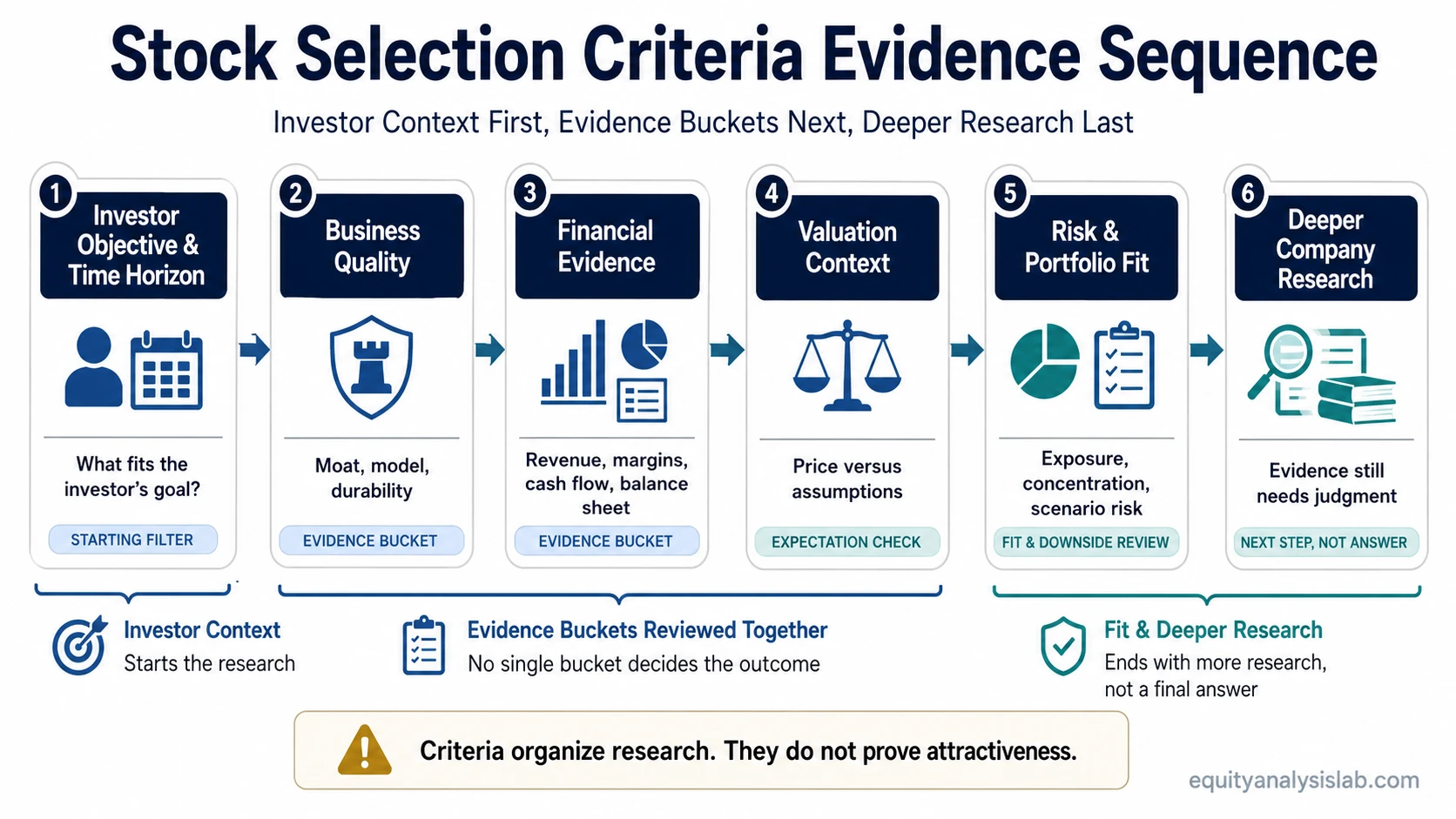
Stock selection criteria are the attributes investors use to evaluate and compare companies before deeper analysis begins. They are not stock picks, predictions, or buy and sell signals. They create a common basis for looking at one company next to another, so comparison starts from defined characteristics instead of vague impressions or market narratives.
In practice, stock selection criteria help narrow attention to observable features such as business quality, profitability, financial strength, growth profile, valuation, capital allocation, and risk exposure. Each criterion isolates one part of the picture. That makes criteria useful at the classification stage of research, where the goal is to organize possible candidates rather than reach a final investment conclusion. Within the broader Screening and Comparison subhub, this concept sits at the foundation because it explains what is being judged before any screening process or review structure is applied.
What stock selection criteria mean
Stock selection criteria are analytical lenses. They define which characteristics matter when a company is being assessed at an early stage. A criterion may focus on how durable the business looks, how profitable it is, how much debt it carries, how fast it is growing, or how the market is pricing it relative to fundamentals. The criterion itself does not tell an investor what to do. It identifies what is being examined.
That distinction matters because criteria belong to the level of attributes, not decisions. A stock tip points toward an action. A forecast points toward an expected outcome. A criterion does neither. It names a trait that can be observed, compared, and weighed against other traits. This keeps the concept neutral and analytical.
Criteria also make comparison more coherent. Without them, two companies may be judged through different standards without that shift being made explicit. One stock may look appealing because of a narrative around industry growth, while another may be dismissed because of weak recent sentiment. Criteria reduce that inconsistency by giving analysis a defined structure from the beginning.
Main categories of stock selection criteria
One major category is business quality. These criteria focus on the strength of the enterprise itself, including durability of demand, resilience of margins, competitive position, pricing power, and the soundness of capital allocation. Business-quality criteria are concerned with whether the company appears structurally robust across changing conditions.
Another category is valuation. Valuation criteria examine the relationship between market price and some economic reference point such as earnings, cash flow, assets, or sales. This is different from judging whether the business is strong. A company can be high quality and still trade at a demanding price, while a weaker business can look statistically cheap. Keeping valuation separate from business quality helps preserve analytical clarity.
Profitability forms its own category. These criteria describe how effectively the business converts revenue into earnings or cash generation. Capital efficiency is related but distinct. It focuses on how well the company uses invested capital, equity, or retained earnings to produce returns. A business can show strong margins but still require heavy capital support, so these two dimensions should not be treated as interchangeable.
Financial strength is another important category. Here the emphasis is on leverage, liquidity, refinancing risk, balance sheet flexibility, and the company’s ability to absorb strain. Growth criteria belong elsewhere. They deal with expansion in revenue, earnings, cash flow, or operating scale over time. Financial strength describes resilience. Growth describes change in economic size.
Some stock selection criteria are more qualitative. These include the structure of the business model, customer concentration, cyclicality, regulatory exposure, switching costs, operating complexity, or dependence on outside financing. These features are still part of stock selection even though they are not always captured cleanly by a ratio.
Why categories should stay separate
The categories above often interact, but they should not collapse into a single vague idea of attractiveness. Business quality, valuation, profitability, financial strength, growth, and risk each describe a different dimension of a company. If those dimensions are blended too early, analysis becomes less precise.
A profitable company is not automatically financially strong. A fast-growing company is not automatically efficient. A cheap stock is not automatically a good business. The value of stock selection criteria lies partly in keeping these distinctions visible. They give analysts a cleaner framework for understanding what exactly is favorable, weak, demanding, or resilient in a given company.
This separation also improves comparability. When companies are viewed through clearly defined categories, differences become easier to interpret. Instead of relying on a broad impression that one business looks better than another, the analysis can specify whether that difference comes from quality, valuation, growth, balance sheet strength, or another dimension.
How stock selection criteria interact
No single criterion captures the whole case. A company can score well on one dimension and poorly on another without any contradiction. Strong growth can exist alongside weak profitability. High quality can exist alongside expensive valuation. A statistically cheap stock can still have a fragile balance sheet or a weak business model.
Some criteria reinforce each other. Margin stability and revenue growth, for example, describe different but complementary aspects of economic strength. Capital efficiency and balance sheet discipline can work in a similar way, since one highlights return generation while the other highlights financial resilience.
Other criteria create tension. A low valuation may reflect real concerns about the company’s growth or durability. A premium valuation may reflect unusually strong business economics. In these cases, the criteria are not simply adding up in the same direction. They are describing tradeoffs inside the same company.
This is why stock selection criteria should be understood as intersecting perspectives rather than as one mechanical score. Each criterion contributes something real, but each also remains incomplete on its own. The concept is useful precisely because it reveals that companies have multiple analytical dimensions that do not always align neatly.
Why investors emphasize different criteria
Stock selection criteria exist independently of any one investing style, but different investors rank them differently. A valuation-focused investor may treat the relationship between price and fundamentals as the central issue. A quality-focused investor may care more about durability, capital allocation, and earnings consistency. A growth-oriented investor may assign greater weight to expansion and reinvestment potential.
The underlying attributes do not change when the framework changes. Revenue growth, return on capital, leverage, margins, cash generation, and valuation multiples still describe the same company. What changes is the hierarchy imposed on those observations. The company remains the same object of analysis, but the analytical emphasis shifts.
That explains why different investors can review the same stock and come away with different conclusions while still relying on the same underlying facts. The disagreement often comes less from the data itself and more from which criteria are treated as most decisive.
What stock selection criteria are not
Stock selection criteria are not the same thing as a screening process. A screening process is procedural. It involves entering filters, narrowing a list, and reviewing results. Criteria come earlier. They are the underlying dimensions that the filters are built on.
They are also not the same thing as a review structure. Once the topic shifts from defining the criteria to deciding how to apply them in sequence, the subject has moved away from the entity itself and into strategy.
Criteria remain a definitional concept centered on what is being assessed, how the dimensions differ, and why they matter as selection dimensions.
Why stock selection criteria matter
Stock selection criteria matter because they bring structure to the front end of research. Public markets offer more companies than any investor can study with equal depth, so some method of narrowing attention is unavoidable. Criteria make that narrowing more consistent by replacing ad hoc selection with defined dimensions of comparison.
This does not eliminate judgment or guarantee better outcomes. What it does is make the early stage of analysis more legible. It reduces the influence of mood, recent headlines, and loosely formed preferences by creating a stable frame for initial examination.
That makes stock selection criteria important in structured investing. They help determine where research begins, even though they do not determine where it ends. Deeper work on business economics, competitive position, management quality, valuation, and risk still has to follow. Criteria establish the first analytical layer in a more disciplined way.
FAQ
Are stock selection criteria the same as a stock screener?
No. Stock selection criteria are the dimensions used to evaluate companies, while a stock screener is a tool or process that applies those dimensions as filters.
Do stock selection criteria tell you which stock to buy?
No. They help organize comparison and early-stage evaluation, but they do not produce a recommendation by themselves.
Can one stock meet some criteria and fail others?
Yes. That is common. A company can look strong in growth and weak in profitability, or attractive in quality but expensive in valuation.
Are stock selection criteria always numerical?
No. Some are quantitative, such as margins or leverage, while others are qualitative, such as business model structure, cyclicality, or customer concentration.
Why do different investors use different criteria?
They usually work from the same broad categories but rank them differently. One investor may prioritize valuation, while another may place more weight on durability, growth, or balance sheet strength.