
Cyclical vs defensive stocks separates companies by how much their demand, earnings, and market behavior tend to depend on the economic cycle. The distinction is useful, but it is not a shortcut for business quality, valuation, or investment safety.
Cyclical companies usually have more exposure to discretionary spending, credit conditions, business investment, and economic acceleration or slowdown. Defensive companies usually sell products or services with steadier demand, but that does not make them risk-free, fairly valued, or immune to weak company fundamentals.
Cyclical stock: a stock whose business performance is usually more exposed to changes in the economic cycle, consumer spending, credit conditions, or business investment.
Defensive stock: a stock whose business performance is usually tied to more stable demand for necessary goods or services, making it less economically sensitive than a typical cyclical company.
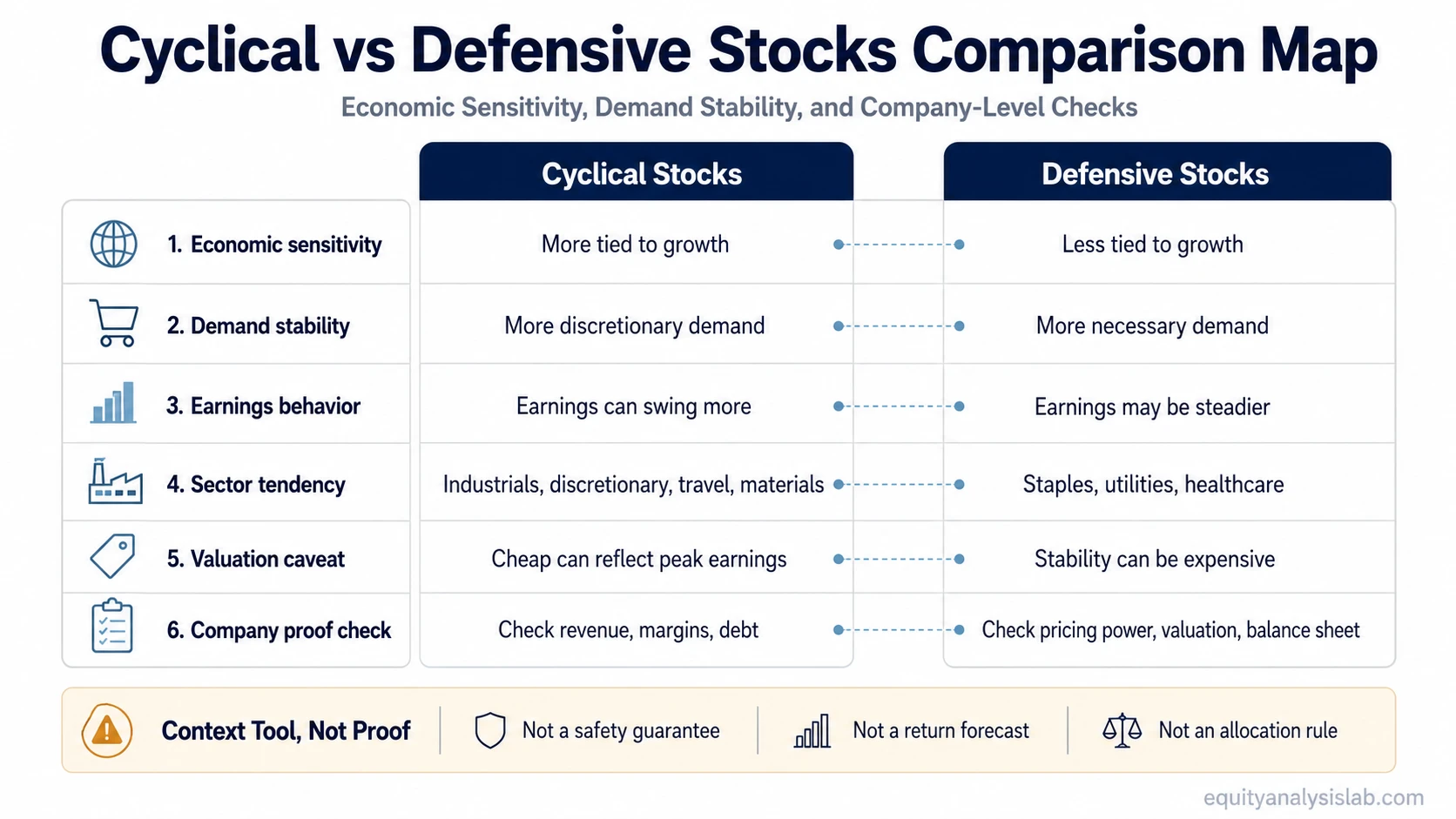
Key Points
- Cyclical stocks usually have more sensitivity to economic growth, consumer confidence, credit availability, and earnings swings.
- Defensive stocks usually have more stable demand, but the defensive label does not remove valuation, balance-sheet, margin, or company-specific risk.
- The most useful comparison is not the sector label alone, but how economic conditions transmit through demand, revenue, margins, earnings, and expectations.
- Business cyclicality and stock-price defensiveness are not the same thing.
- The distinction is most useful as an investor context check, not as a prediction tool or allocation rule.
Cyclical Stocks vs Defensive Stocks in One Distinction
The core difference is economic sensitivity. Cyclical stocks tend to depend more on economic expansion, discretionary demand, and business confidence. Their revenue and earnings may improve sharply when conditions strengthen, but they may also weaken faster when demand slows.
Defensive stocks tend to depend more on recurring or necessary demand. Their businesses may hold up better when consumers or companies reduce discretionary spending, but their share prices can still fall if valuation is stretched, margins weaken, debt pressure rises, or investor expectations reset.
Main distinction: cyclical versus defensive is not mainly a sector label. It is a question of how strongly a company’s demand, earnings, and investor expectations react to changes in the economic environment.
How an Economic Change Reaches Cyclical and Defensive Earnings
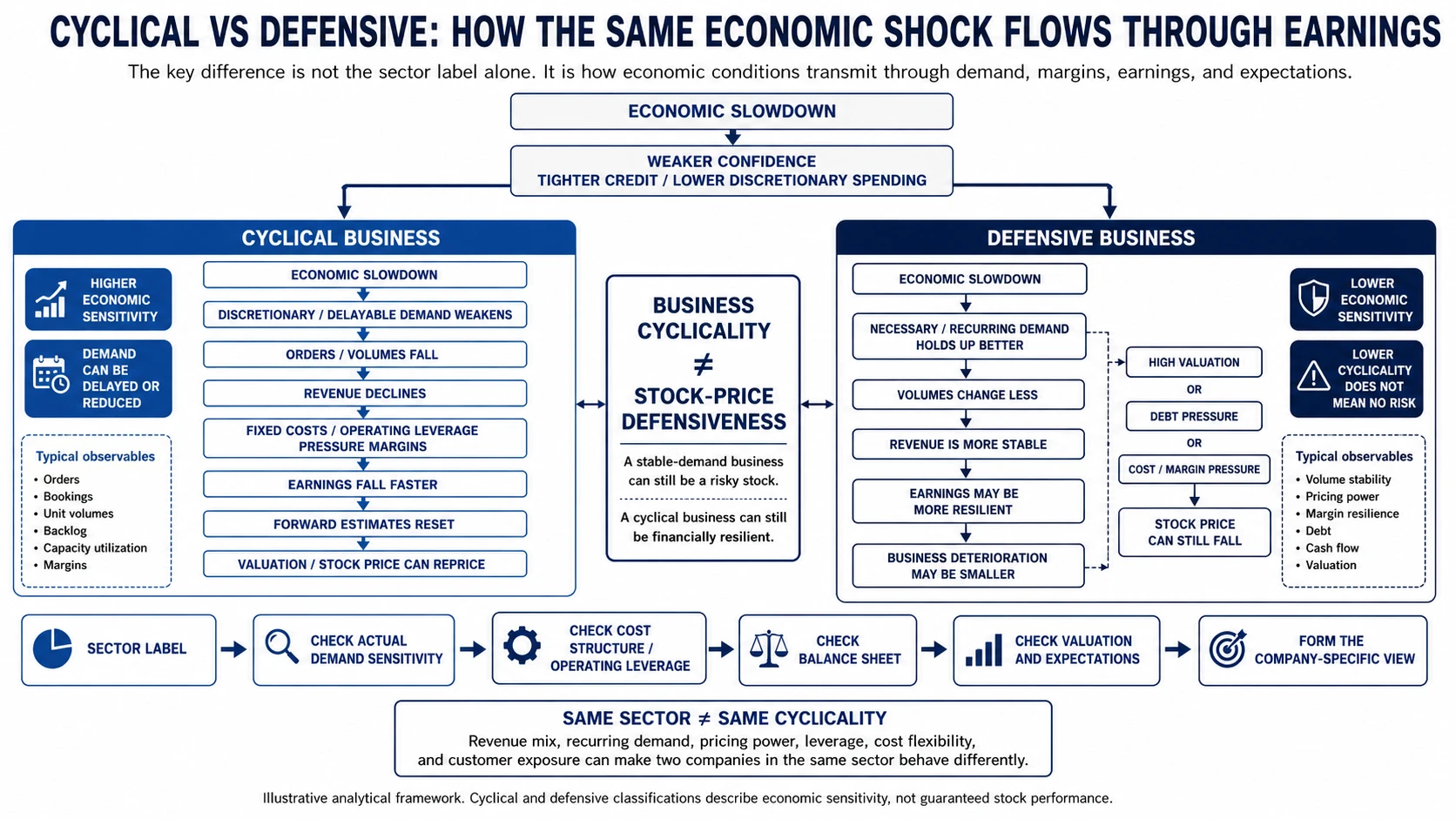
A useful comparison starts with a common macro change, then follows the transmission path through the business. In a slowdown, cyclical companies are often hit first through weaker discretionary demand, lower volumes, delayed purchases, or reduced business investment. That weaker demand can pressure revenue, operating leverage, margins, and ultimately earnings expectations.
Defensive companies usually face a different transmission chain. Demand for necessary or recurring products may hold up better, so revenue and earnings can be more stable. But stability of demand does not eliminate risk. Margins can still weaken, leverage can still matter, and a stock can still reprice if it was already valued for too much perfection.
| Transmission step | Cyclical stocks | Defensive stocks |
|---|---|---|
| Economic change | More exposed to slowdowns and recoveries | Usually less exposed to the same cycle change |
| Demand response | Purchases may be delayed, reduced, or canceled more quickly | Demand for essential or recurring categories may change more slowly |
| Revenue impact | Sales can move more sharply with the cycle | Sales may be steadier, though not immune |
| Margin and earnings impact | Operating leverage can amplify earnings swings | Earnings may be steadier, but input costs, pricing, and debt still matter |
| Market interpretation | Forward estimates and valuation expectations can reset quickly | Stocks can still fall if valuation, margins, or balance-sheet pressure become a problem |
Diagnostic use: when a stock is labeled cyclical or defensive, the next step is to identify how an economic change would realistically flow through demand, revenue, margins, earnings, and expectations.
Business Cyclicality Is Not the Same as Stock-Price Defensiveness
One of the most common mistakes is to confuse a stable-demand business with a defensive stock in market terms. A company can sell essential products and still be a vulnerable stock if valuation is stretched, debt is heavy, or margins are under pressure.
The reverse can also happen. A cyclical business may be economically sensitive, but its stock can hold up better than expected if the balance sheet is strong, cost flexibility is high, and the market had already discounted a weak scenario.
Important distinction: business cyclicality describes economic sensitivity. Stock-price defensiveness depends on more than demand stability. Valuation, leverage, margin durability, expectations, and balance-sheet quality can all change how the stock behaves.
This is why the label should start the analysis, not finish it. Investors still need to test what kind of slowdown or recovery is being priced, how the company is financed, and whether the expected resilience is already reflected in the share price.
Key Differences Between Cyclical and Defensive Stocks
The comparison works best when the labels are treated as a sensitivity framework. The question is not which type is automatically better. The question is how much the company’s revenue, earnings, valuation, and investor expectations depend on the economic backdrop.
| Comparison point | Cyclical stocks | Defensive stocks |
|---|---|---|
| Economic sensitivity | Usually higher. Results often move more with expansions, slowdowns, credit cycles, and confidence. | Usually lower. Demand may be steadier because the product or service is less discretionary. |
| Demand type | Often linked to purchases that can be delayed, upgraded, financed, or reduced when conditions weaken. | Often linked to recurring needs, essential services, or categories where demand changes more slowly. |
| Earnings behavior | Earnings may expand faster in recoveries and contract faster during downturns. | Earnings may be steadier, but they can still decline if costs rise, pricing power weakens, or company execution deteriorates. |
| Valuation behavior | Valuation can look cheap near peak earnings or expensive near depressed earnings, so cycle position matters. | Valuation can become demanding when investors pay a premium for stability, so steadier demand does not guarantee a better entry point. |
| Investor interpretation | Useful for judging economic leverage, earnings upside, and downside exposure, not for assuming outperformance. | Useful for judging demand resilience and business stability, not for assuming safety. |
Common Confusion Traps
Defensive does not mean safe. A defensive business can still be overvalued, poorly managed, heavily indebted, margin-pressured, or exposed to regulatory and company-specific risk.
Cyclical does not mean better in expansions. A cyclical stock can disappoint if the recovery is already priced in, if earnings quality is weak, if the balance sheet is fragile, or if demand recovers more slowly than expected.
Sector labels are not company analysis. A company inside a defensive sector can have cyclical revenue drivers, and a company inside a cyclical sector can have recurring revenue, pricing power, or balance-sheet strength that changes the interpretation.
How Sector Labels Can Help Without Becoming Proof
Sector groupings are useful as a first filter because some industries are naturally more tied to economic growth than others. Auto manufacturers, airlines, hotels, homebuilders, materials producers, and industrial suppliers often have more cycle-sensitive demand. Food, household essentials, utilities, healthcare services, and other necessary categories often have more stable demand.
The problem is that broad sector labels can hide the company-level facts that matter most. Revenue mix, customer base, operating leverage, debt maturity, pricing power, margin durability, and valuation can make two companies in the same broad sector behave very differently.
For an investor, the label should start the question, not end it. The next step is to test whether the company’s actual revenue, earnings, cash flow, and balance sheet support the label.
How Investors Can Use the Distinction
The cyclical versus defensive distinction is most useful as a context check. It helps investors ask whether a company’s thesis depends on economic acceleration, resilient demand, stable margins, lower rates, stronger credit conditions, or a recovery in business confidence.
It can also clarify portfolio exposure without turning into an allocation rule. A portfolio concentrated in economically sensitive companies may react differently to a slowdown than one built around businesses with more stable demand. That observation does not say which portfolio is better. It only shows what kind of conditions could help or hurt the underlying earnings base.
The strongest use is comparative. When two companies look attractive for different reasons, the cyclical or defensive label can help separate earnings leverage from demand resilience. The final judgment still depends on valuation, business quality, balance sheet, competitive position, and the investor’s time horizon.
FAQ
Are defensive stocks safer than cyclical stocks?
No. Defensive stocks may have steadier demand, but they can still lose value because of valuation risk, company-specific problems, weak margins, debt, regulation, or broader market pressure.
Are cyclical stocks better during economic expansions?
Only under the right conditions. Cyclical stocks may benefit more from improving demand, but the outcome depends on valuation, earnings quality, expectations, balance-sheet strength, and how much of the recovery is already priced in.
Is sector classification enough to identify a cyclical or defensive stock?
No. Sector classification is only a starting point. Investors still need to review the company’s revenue drivers, customer demand, margins, debt, pricing power, and valuation.
What is the simplest way to compare cyclical and defensive stocks?
The simplest comparison is demand sensitivity. Cyclical stocks usually depend more on economic conditions, while defensive stocks usually depend more on stable or necessary demand. The stronger version of that comparison is to trace how an economic change flows through demand, earnings, and valuation expectations.