
Defensive stocks are shares of companies whose products or services tend to face steadier demand across the economic cycle. The label describes lower business sensitivity to cycle pressure, not guaranteed safety, undervaluation, quality, or timing.
Definition: A defensive stock is an equity whose underlying business is less dependent on strong economic growth because customers continue buying its core products or services in weaker conditions.
The classification starts with the business, not the share price. A company may sell essential goods, regulated services, recurring healthcare products, or other necessities, but the stock can still fall if expectations, valuation, debt costs, margins, or company execution deteriorate.
The term also does not mean “defense stocks.” Defense-sector companies are tied to military, aerospace, or government-contract activity. Defensive stocks are defined by demand resilience, not by national defense exposure.
Key Points
- Defensive stocks usually have business demand that is less sensitive to recessions, income pressure, or weaker consumer confidence.
- Common defensive areas include consumer staples, utilities, and parts of healthcare, but sector membership alone is not enough.
- The label does not prove that a company is high quality, attractively valued, or immune to losses.
- Defensive behavior depends on the stress type: demand weakness, rate pressure, credit stress, valuation compression, or company-specific problems.
- The strongest analysis separates the label from valuation, earnings durability, balance-sheet risk, and cycle context.
What Makes a Stock Defensive?
A stock is usually called defensive when the company’s revenue base depends on products or services that customers need even when economic conditions weaken. Food, household products, electricity, water, basic healthcare, and certain recurring services can be less discretionary than travel, luxury goods, housing-linked purchases, or industrial capital spending.
The useful chain is simple: steadier demand can support steadier revenue, steadier revenue can support earnings and cash-flow durability, and that durability can change how investors interpret the stock during different cycle phases. The chain is not automatic. Margins, pricing power, debt structure, regulation, competitive pressure, and valuation still matter.
The label is therefore an analytical starting point. It can help an investor ask better questions about cycle sensitivity, but it does not replace business-quality analysis or valuation work.
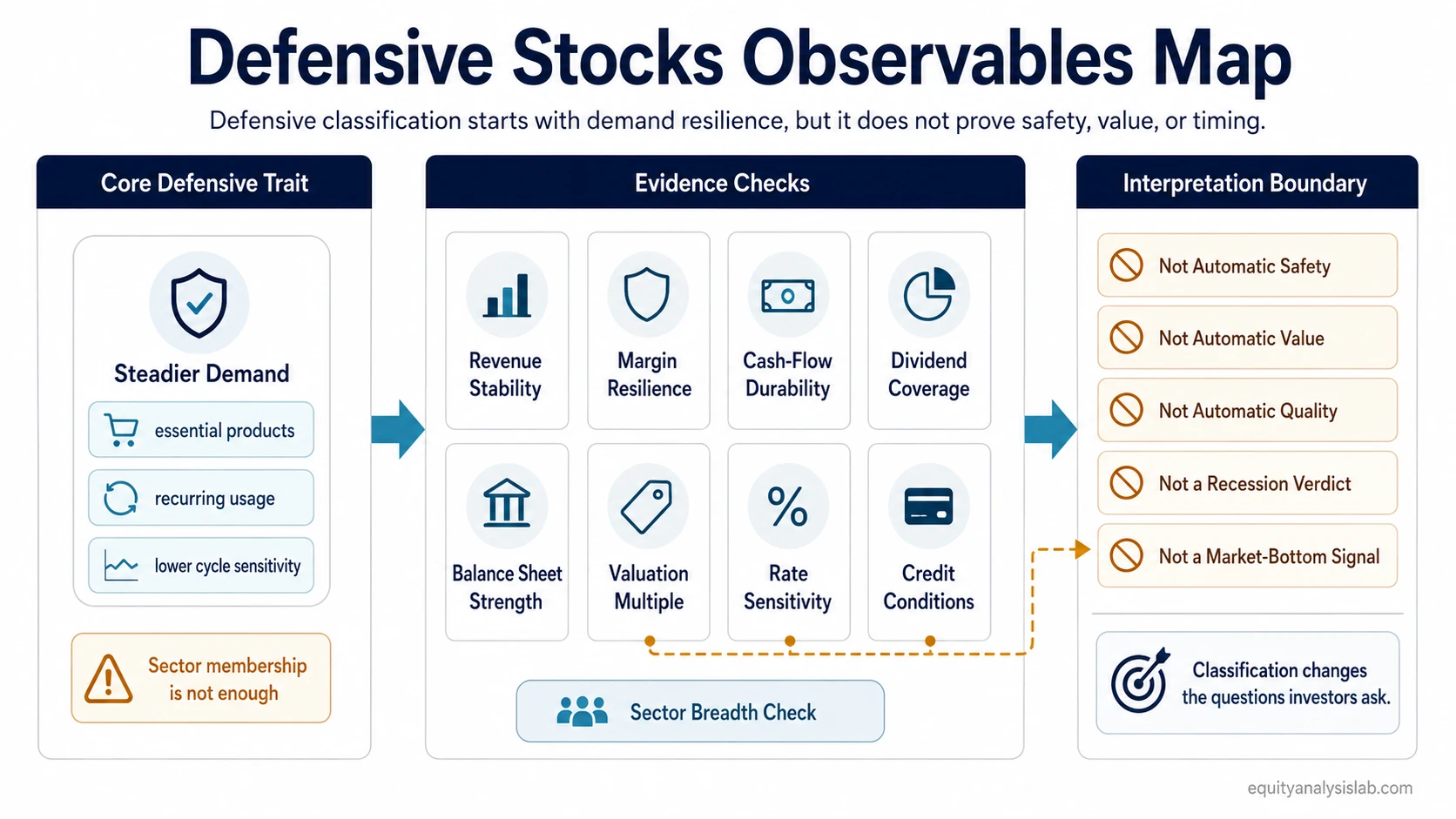
Defensive-Stock Observables Map
The most useful way to identify defensive characteristics is to look at observable business and market behavior together. No single item below turns a company into a defensive stock on its own.
| Observable | What to Check | Why It Matters | Common Misread |
|---|---|---|---|
| Demand cyclicality | How much demand changes when growth slows or household budgets tighten. | Lower demand cyclicality is the core defensive trait. | Assuming every company in a defensive sector has stable demand. |
| Revenue stability | Whether sales remain relatively steady across weak and strong periods. | Stable revenue can reduce earnings volatility, though it does not eliminate it. | Reading past stability as a guarantee of future stability. |
| Margin resilience | Whether the company can manage input costs, wages, regulation, and pricing pressure. | Defensive demand has less value if margins compress sharply. | Ignoring cost pressure because the product is essential. |
| Earnings and cash-flow durability | Whether profits and operating cash flow remain supported when conditions weaken. | Durability matters more than the defensive label itself. | Treating accounting earnings as enough without checking cash conversion. |
| Dividend coverage | Whether dividends are supported by cash flow, not only by a long payout history. | Many defensive stocks are associated with dividends, but coverage quality matters. | Assuming a dividend makes the stock defensive. |
| Beta and volatility | Whether the stock has historically moved less than the broad market. | Lower volatility can support defensive interpretation, but market behavior can change. | Using low beta as a complete business analysis. |
| Balance sheet | Debt maturity, interest costs, liquidity, and refinancing needs. | Rate or credit pressure can weaken even a stable-demand business. | Ignoring leverage because demand appears resilient. |
| Valuation multiple | Whether investors already price the stock as highly resilient. | A defensive business can still disappoint if the valuation leaves little margin for error. | Confusing defensive classification with undervaluation. |
| Rate sensitivity | How the stock reacts to higher yields, debt costs, and income alternatives. | Some defensive areas can be sensitive to rates because investors compare them with income assets. | Assuming weak growth is the only stress that matters. |
| Credit conditions | Whether financing conditions pressure the company, customers, or sector peers. | Credit stress can affect equity risk appetite even when demand is stable. | Separating defensive stocks from the broader equity-risk environment entirely. |
| Sector breadth | Whether resilience appears across many companies or only a few leaders. | Broad resilience gives stronger evidence than isolated outperformance. | Using one strong stock as proof for the whole sector. |
Common Defensive Stock Sectors
Consumer staples, utilities, and healthcare are often described as defensive because many companies in those areas provide products or services that households, businesses, or patients continue using during weaker economic conditions. The classification remains company-specific, not automatic.
| Area | Why It Can Be Defensive | What Still Needs Checking |
|---|---|---|
| Consumer staples | Demand for basic food, household goods, and personal-care products can be steadier than discretionary spending. | Pricing power, input costs, brand strength, private-label competition, and valuation. |
| Utilities | Electricity, gas, and water demand can be more stable than many cyclical industries. | Regulation, debt levels, capital spending, allowed returns, and rate sensitivity. |
| Healthcare | Some healthcare demand is tied to ongoing medical need rather than consumer confidence. | Patent risk, reimbursement pressure, regulation, research spending, and company-specific execution. |
| Recurring services | Subscription, maintenance, or contracted revenue can reduce demand volatility when customers have limited ability to cut usage quickly. | Customer churn, pricing flexibility, contract quality, and balance-sheet strength. |
Sector rotation follows regime conditions, not a fixed calendar. A defensive sector can lead during one stress phase and lag during another if rates, liquidity, earnings expectations, or valuation pressure change the interpretation.
Defensive Stocks vs Cyclical Stocks
Defensive stocks and cyclical stocks differ mainly in how their businesses respond to the economic cycle. Defensive companies tend to have steadier demand when growth weakens. Cyclical companies usually depend more on expansion, capital spending, consumer confidence, commodity demand, or discretionary purchases.
Core distinction: defensive stocks are analyzed for demand resilience, while cyclical stocks are analyzed for sensitivity to economic acceleration and slowdown.
The full comparison belongs in defensive vs cyclical stocks. The key boundary is that the defensive label does not make a stock better by default. It only changes the questions an investor asks about earnings stability, valuation, risk appetite, and cycle context.
What Defensive Stocks Do Not Prove
A defensive label can be useful, but several conclusions do not follow from the label alone.
- Not automatic safety: the stock can still decline with the broader market or because of company-specific issues.
- Not automatic undervaluation: stable demand can already be reflected in a high valuation multiple.
- Not automatic quality: a business can be less cyclical and still have weak margins, poor capital allocation, or balance-sheet risk.
- Not a recession verdict: defensive leadership can appear for reasons other than a confirmed downturn.
- Not a market-bottom signal: defensive behavior does not identify when a drawdown is ending.
- Not an allocation rule: classification does not determine how much exposure belongs in any portfolio.
During a bear market, defensive stocks may show lower business sensitivity than more economically exposed companies, but equity-risk pressure can still pull them lower. The difference is usually about relative sensitivity, not immunity.
Why a Defensive Stock Can Still Fall
A consumer staples, healthcare, or utility company may keep demand relatively steady during a weak economy. Its share price can still fall if the stock was priced for perfection, margins compress, interest costs rise, debt refinancing becomes harder, regulation changes, or investors reduce equity exposure broadly.
This is why defensive analysis needs two layers. The first layer asks whether the business is less cycle-sensitive. The second asks whether the stock price, valuation, financial structure, and expectations already account for that resilience.
When Defensive Stocks Can Lag or Fail
Defensive stocks can lag during a strong bull market when investors favor faster earnings growth, higher operating leverage, or more economically sensitive companies. A stable business may look less attractive when risk appetite rises and cyclical earnings are improving.
Defensive stocks can also fail defensively when the stress is not mainly about demand. Higher interest rates can pressure debt-heavy companies, valuation multiples can compress, dividend coverage can weaken, and credit stress can affect equity prices even when customers continue buying the product or service.
The stronger interpretation comes from matching the label to the stress type. Demand weakness, rate pressure, credit stress, inflation pressure, and company execution do not affect every defensive business in the same way.
How Investors Can Use the Defensive Label
The defensive label is most useful as a classification tool. It helps separate businesses that depend heavily on economic acceleration from businesses with more stable end demand. That can improve cycle interpretation, earnings-quality review, and risk comparison across sectors.
The label becomes weak when it substitutes for analysis. A defensive stock still needs review of revenue durability, cash flow, margin quality, balance-sheet risk, dividend coverage, valuation multiple, and the surrounding market cycle.
Useful framing: the label can explain why a business may be less cycle-sensitive, but valuation and quality analysis decide whether that resilience is already priced in.
FAQ
Are defensive stocks the same as defense stocks?
No. Defensive stocks are companies with business demand that tends to be less sensitive to the economic cycle. Defense stocks are companies tied to military, aerospace, or government-defense activity.
Can defensive stocks still lose money?
Yes. Defensive demand does not prevent valuation compression, margin pressure, rate sensitivity, credit stress, dividend weakness, or company-specific execution problems.
Are defensive stocks always undervalued?
No. A defensive business can trade at a high valuation if investors already expect stable earnings, durable cash flow, or lower volatility.
Are defensive stocks the same as holding cash?
No. Defensive stocks remain equities, so they still carry market risk, company risk, and valuation risk. Cash does not have the same equity exposure or business ownership profile.