
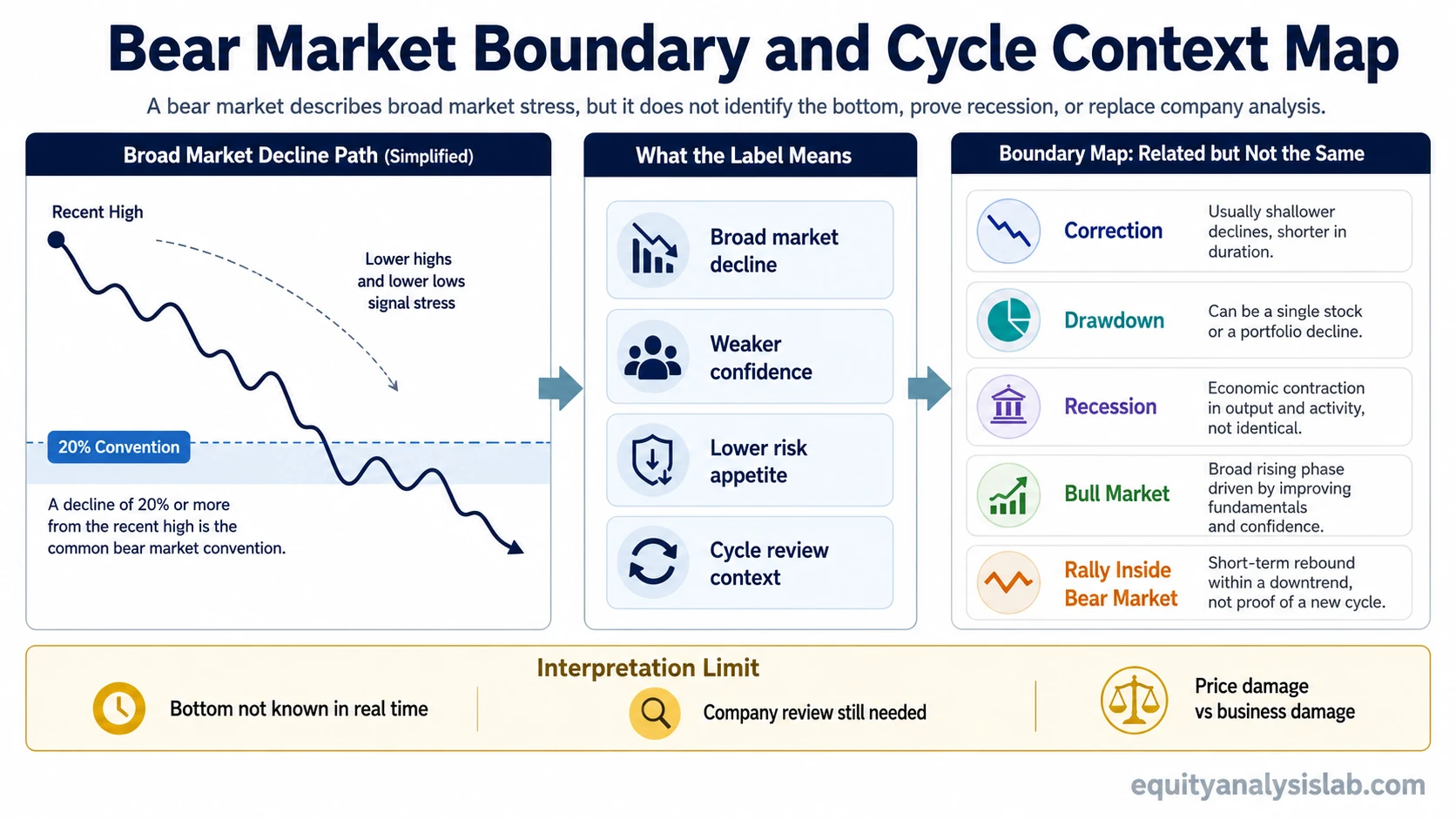
A bear market is a broad decline in market prices, commonly described as a fall of 20% or more from recent highs in a major index. The condition is usually associated with weaker investor sentiment, lower risk appetite, and pressure across many stocks.
A bear-market classification helps frame market-cycle analysis, but it does not prove that a recession has started, identify the bottom, or decide what an investor should do. It creates a context for analysis: breadth, earnings expectations, valuation pressure, liquidity conditions, and company-specific resilience still need to be reviewed.
Definition: A bear market is a market-wide decline, often measured by a 20% or greater drop in a broad index from a recent high, combined with weaker confidence and reduced willingness to take risk.
Key Points
- A bear market usually refers to a broad market decline, not a single weak stock.
- The common 20% threshold is a convention, not a perfect real-time timing tool.
- A correction is usually shallower than a bear market, while a recession describes the economy rather than the stock market alone.
- A bear market can pressure valuations, earnings expectations, liquidity, and investor psychology.
- The classification does not prove that every company is equally weak or that the cycle bottom is known.
What Counts as a Bear Market?
The usual bear-market threshold is a decline of about 20% or more from a recent high in a broad market index. The broad index condition matters because a large drop in one company, sector, or theme may be a stock-specific drawdown rather than a market-wide bear phase.
Duration is less mechanical than the percentage threshold. A sharp decline can reach bear-market territory quickly, while a slower decline may reveal itself through weakening breadth, falling risk appetite, lower valuation multiples, and more cautious earnings expectations. The broader market cycle helps place that decline inside a longer sequence of expansion, stress, contraction, and recovery.
The classification becomes more useful when price decline, market breadth, sentiment, valuation compression, and earnings pressure point in the same direction. It becomes less useful when the percentage threshold is treated as a complete explanation by itself.
Bear Market Boundary and Interpretation Table
The same decline can be described differently depending on breadth, depth, economic context, and the comparison being made.
| Concept | Core meaning | Common confusion | Investor-analysis use |
|---|---|---|---|
| Bear market | A broad market decline, commonly around 20% or more from recent highs. | The condition can be mistaken for a bottom signal or a recession verdict. | Use it as cycle context for valuation, earnings, liquidity, and sentiment review. |
| Correction | A meaningful decline that is usually shallower than a bear market. | A correction can feel severe before it reaches bear-market territory. | Check whether weakness remains contained or spreads across the market. |
| Drawdown | A decline from a prior high in an index, portfolio, sector, or individual security. | A single-stock drawdown is not automatically a bear market. | Separate market-wide pressure from company-specific price damage. |
| Recession | An economic contraction, usually evaluated through activity, employment, income, and production data. | A bear market can occur around recession risk, but the two are not identical. | Compare market pricing with earnings, credit, demand, and economic data. |
| Bull market | A broad rising market phase associated with stronger confidence and risk appetite. | A short rally inside a bear market can be confused with a durable bull phase. | Look for whether breadth, earnings expectations, and risk appetite are improving together. |
What Bear-Market Conditions Change for Investor Analysis
A bear market changes the background conditions around analysis. It does not replace company-level work. A business can remain durable while its stock price falls, and a weak business can look temporarily cheaper without becoming higher quality.
| Review area | What to check | Why it affects interpretation |
|---|---|---|
| Breadth | Whether the decline is concentrated or spread across many sectors and stocks. | Broad weakness gives the bear-market classification more relevance than isolated price damage. |
| Earnings expectations | Whether forward revenue, margins, cash flow, or guidance assumptions are weakening. | Price declines are more serious when business expectations deteriorate at the same time. |
| Valuation compression | Whether multiples are falling because discount rates, growth expectations, or risk appetite changed. | A lower price does not automatically mean lower valuation risk if earnings also fall. |
| Credit and liquidity | Whether financing conditions, spreads, or market liquidity are becoming more restrictive. | Liquidity pressure can make pricing less stable even when a company’s fundamentals have not changed much. |
| Interest-rate channel | Whether discount-rate pressure is part of the decline, especially when interest rates rise. | Higher required returns can compress equity valuations even before earnings fall. |
| Company cyclicality | Whether sales, margins, financing needs, or customer demand are sensitive to the cycle. | Cyclical stocks can face both market-wide pressure and business-cycle pressure. |
Common Misunderstanding: The Market Condition Is Not the Decision
Common mistake: Treating a bear market as proof that every company is broken, every stock is equally risky, or the market bottom is already visible.
A bear market describes broad market stress. It does not answer whether an individual company has weaker revenue quality, weaker margins, fragile financing, poor capital allocation, or a damaged competitive position. Those questions still belong to company analysis.
The opposite mistake is ignoring market-wide stress entirely. Broad pressure can affect valuation multiples, financing access, investor patience, and the margin of safety required for a thesis to remain attractive. The useful balance is to treat the condition as a review context, not as an automatic verdict.
Bear-Market Rally and Bottom-Identification Limits
A rally can occur inside a bear market. That move may reflect short covering, temporary relief, policy hopes, oversold conditions, or improving expectations. A rally becomes more meaningful only if breadth, earnings expectations, credit conditions, and risk appetite begin to improve together.
The bottom is not known in real time just because a decline has crossed a percentage threshold. Bear-market recognition often becomes clearest after a large part of the decline has already happened, which is why it should not be treated as a timing tool.
Limitation: A bear market is easier to label than to use. It can describe the environment, but it cannot by itself separate temporary panic from durable business deterioration.
Simple Bear Market Example in Investor Context
A broad index has fallen into bear-market territory while an individual company still reports stable margins, positive free cash flow, and a manageable balance sheet. The market environment creates pressure because valuation multiples and risk appetite may be falling, but the company still needs its own review.
Resilience is easier to defend when demand, cash flow, debt, and valuation still hold up under lower-growth assumptions. The review becomes less favorable if revenue quality, margins, financing access, or competitive position deteriorate alongside the market decline.
The practical distinction is price damage versus business damage. A broad selloff can force a thesis review, but it does not answer the thesis by itself.
Cyclical and Secular Bear Markets
Bear markets are sometimes described as cyclical or secular. The distinction is useful only if it clarifies time horizon and underlying pressure.
| Type | Typical meaning | Interpretation limit |
|---|---|---|
| Cyclical bear market | A decline tied to the normal business, earnings, credit, or sentiment cycle. | The label does not define the exact duration or recovery path. |
| Secular bear market | A longer period where broad valuations, inflation, rates, earnings pressure, or structural conditions restrain returns. | The label can become too broad if it replaces company-specific valuation and quality work. |
Related Concepts
A bear market is one part of cycle interpretation. A bull market describes the opposite broad direction, when prices, confidence, and risk appetite are generally rising.
The market cycle gives the larger framework for connecting expansion, contraction, liquidity, earnings, and sentiment.
Cyclical stocks add the company-level layer because some businesses are more exposed to changing demand, margins, financing conditions, and investor risk appetite.
FAQ
What is a bear market?
A bear market is a broad decline in market prices, commonly described as a 20% or greater fall from recent highs in a major index, often with weaker sentiment and reduced risk appetite.
Is a bear market the same as a correction?
No. A correction is usually a meaningful but smaller decline, while a bear market usually refers to a deeper and broader decline that reaches about 20% or more from recent highs.
Is a bear market the same as a recession?
No. A bear market describes market prices, while a recession describes economic activity. They can overlap, but one does not automatically prove the other.
Does a bear market mean every stock is weak?
No. Broad market pressure can affect many stocks, but each company still needs its own review of business quality, valuation, cash flow, balance-sheet strength, and cyclicality.