
A bull market is a sustained rise in broad stock prices, usually discussed when a major index has advanced by about 20% or more from a prior low. That 20% threshold is a common market convention, not a forecast model or proof that the advance will continue.
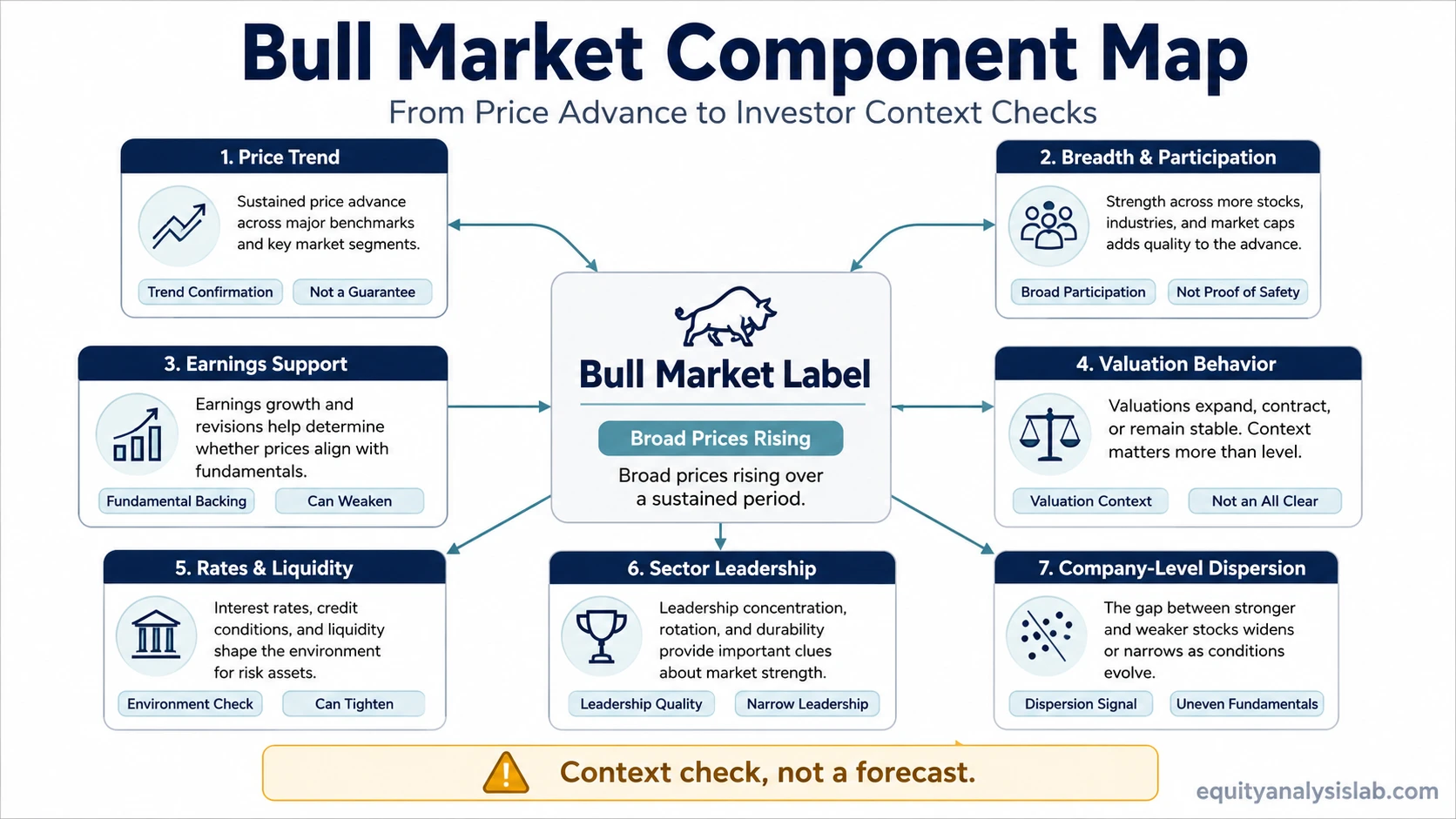
The market backdrop is only one input. Breadth, earnings revisions, valuation behavior, financial conditions, and company-level fundamentals decide whether the advance is broad, durable, or concentrated.
Definition: A bull market is a sustained upward phase in broad stock prices, normally associated with improving confidence, stronger risk appetite, and rising participation across parts of the equity market.
Key Points
- A bull market describes a broad upward market phase, not a guarantee of future returns.
- The 20% threshold is a common convention used to describe a large recovery or advance.
- Investor interpretation depends on breadth, earnings support, valuation, rates, liquidity, and sector leadership.
- A rising index can hide weaker participation or uneven company fundamentals beneath the surface.
- The term is most useful when it is treated as market context, not as an investment conclusion.
What Is a Bull Market?
A bull market is an extended period when broad equity prices rise and investors generally become more confident about future conditions. The term is usually applied to major indexes rather than a single company, because a single stock can rise for company-specific reasons while the broader market remains weak or mixed.
The widely used 20% threshold helps separate a large advance from a normal short-term rebound. It is still only a labeling convention. A market can cross that threshold and later weaken, or it can begin improving before the bull-market label becomes obvious in hindsight.
The better use of the term is descriptive. It can show that the broad market environment has changed, but it does not prove that stocks are cheap, that earnings are durable, or that every company is participating equally.
Bull Market Components Investors Usually Check
A bull-market reading becomes more useful when it is broken into observable components. Price trend is the starting point, but the quality of the advance depends on what supports it.
| Bull Market Component | What It Can Suggest | What It Does Not Prove |
|---|---|---|
| Price trend | Broad market prices are rising across a sustained period. | Future returns are guaranteed. |
| Breadth and participation | More industries, sectors, or stocks may be joining the advance. | Every stock is improving at the same rate. |
| Earnings support | Profit growth may be helping support higher prices. | Earnings quality is durable or evenly distributed. |
| Valuation behavior | Investors may be willing to pay higher multiples for future earnings. | Stocks are automatically cheap or low risk. |
| Rates and liquidity | Financial conditions may be supporting risk appetite. | Conditions will remain supportive. |
| Sector leadership | Certain industries may be driving the advance. | Leadership is permanent or broad enough by itself. |
| Company-level dispersion | Different companies may respond very differently to the same market backdrop. | A strong index means every business has improved. |
These checks keep the concept tied to investor reasoning rather than market labeling alone. A stronger backdrop can support confidence, but company analysis still depends on revenue quality, margins, balance-sheet strength, cash flow, competitive position, and valuation.
What a Bull Market Does Not Prove
Limitation: A bull market does not prove that the market is safe, that valuations are attractive, that earnings growth is durable, or that all companies are improving. It only describes a broad upward phase in prices.
A common mistake is treating the term as a substitute for analysis. Strong market conditions can make weak businesses look stronger for a while, especially when valuation multiples expand faster than underlying profits. In that case, prices may rise even though the margin of safety has not improved.
A useful limitation scenario is a broad index rising for months while fewer sectors carry most of the gain. Narrow leadership, uneven earnings support, or rising valuation pressure can make the interpretation more fragile than the headline index suggests.
Rate sensitivity also matters because valuation multiples often react to discount-rate pressure. When rates rise, the same earnings stream may receive a lower valuation multiple, which is why higher interest rates can pressure stock valuations even during periods that previously looked constructive.
Bull Market vs Bear Market
A bull market and a bear market describe opposite broad market environments. The distinction is useful, but it should stay focused on market direction, participation, and investor behavior rather than becoming a complete investment framework.
| Concept | Basic Direction | Typical Investor Context | Main Caution |
|---|---|---|---|
| Bull market | Broad prices rise over a sustained period. | Confidence, risk appetite, and participation often improve. | The advance can hide valuation risk, narrow leadership, or uneven fundamentals. |
| Bear market | Broad prices fall over a sustained period. | Confidence weakens and risk appetite often contracts. | The label can arrive after much of the damage has already occurred. |
The main difference is direction and environment. The harder investor question is whether the market label matches the evidence inside earnings, valuation, breadth, and company quality.
How Bull Markets Fit the Market Cycle
A bull market is one part of a broader market-cycle structure. It can appear after a recovery from pessimism, during an earnings expansion, or during a period when investors are willing to assign higher valuations to future cash flows.
The market-cycle context matters because a bull market can mature. Early advances may be driven by recovery from depressed expectations. Later advances may rely more on multiple expansion, optimism, or concentrated leadership. Those are different quality profiles even when the index direction is still upward.
That distinction keeps the concept precise. A bull market describes the direction of the broad equity environment, while market-cycle analysis examines where that environment may sit within a longer sequence of recovery, expansion, maturity, stress, and reset.
Company and Sector Behavior During a Bull Market
Companies do not respond equally to a bull market. Some businesses benefit directly from improving demand, stronger credit conditions, or higher investor appetite for growth. Others may lag because their earnings are defensive, regulated, balance-sheet constrained, or already priced for stability.
Cyclical stocks can become more visible when investors expect economic growth, stronger demand, or improving margins. Even then, the company-level test remains separate: a cyclical business still needs earnings quality, financial resilience, and valuation support.
Sector leadership can also narrow as a bull market matures. A headline index may continue rising while participation becomes concentrated in a smaller group of companies. That concentration does not automatically end the bull market, but it makes breadth and valuation discipline more important.
Common Mistakes When Reading a Bull Market
Common mistake: Treating a bull-market label as proof that risk has disappeared. A stronger backdrop can improve conditions, but it cannot replace company analysis, valuation work, or risk awareness.
One mistake is assuming that all companies benefit equally. A broad index can be rising while individual companies face margin pressure, dilution, weak cash conversion, excessive debt, or slowing demand.
Another mistake is ignoring the source of the advance. A market supported by earnings growth has a different profile from a market driven mainly by valuation multiple expansion. Both can occur inside a bull market, but they do not carry the same analytical meaning.
A third mistake is using the threshold as a timing tool. Bull markets are often recognized with a lag, especially when the 20% threshold is applied after the fact. The threshold can describe what has happened without proving what comes next.
Bull Market Limitation Example
A broad equity index rises for several months and eventually crosses the common 20% threshold from a prior low. At first glance, the move appears healthy. A closer review shows that most of the gain comes from a small group of large companies, while many sectors remain flat and earnings revisions are mixed.
The bull-market label may still be accurate as a description of the index move. The interpretation is less complete if breadth is narrow, valuation multiples are expanding faster than earnings, or company-level fundamentals are uneven. The reading is stronger when breadth, earnings revisions, and valuation support improve together; it is weaker when the advance depends mainly on a small group of companies or multiple expansion alone.
FAQ
What does bull market mean?
A bull market means broad stock prices have risen over a sustained period, often described using a 20% advance from a prior low. The label describes the market backdrop rather than guaranteeing future returns.
Is the 20% bull-market threshold a rule?
The 20% threshold is a common convention, not a law or forecast model. It helps describe a large market advance, but investor interpretation still depends on breadth, earnings, valuation, and company-level evidence.
Does a bull market mean every stock rises?
No. A broad index can rise while many individual stocks lag. Company fundamentals, sector exposure, valuation, balance-sheet strength, and earnings quality can create very different outcomes across stocks.